TEHRAN – Improved environmental conditions in western Chaharmahal-Bakhtiari province and northwestern West Azarbaijan province have brought many birds back to wetlands and lakes to nest and breed.
According to the provincial head of the Department of Environment (DOE) in Chaharmahal-Bakhtiari province, Ruhollah Asgari, this year around 35,000 aquatic and waterside birds have nested to breed in Gandoman and Choghakhor wetlands.
Over 30 bird species, including ferruginous duck, common pochard (Aythya ferina), purple heron, great grebe, little grebe, black-necked grebe, spoonbill, and tern, are inhibiting in the wetlands.
Favorable habitat conditions, diverse vegetation, and rich food resources have established the wetlands as primary breeding centers for birds, he added.
In April, a Meadow Pipit (Anthus pratensis) bird was spotted for the first time in Gandoman wetland.
With the new bird recorded, the total number of bird species in the wetland amounts to 306 species, which indicates ecological dynamics and the habitat health of the wetland.
Gandoman Wetland was registered as Iran’s 27th wetland of international importance in February 2025. Stretching to 1,070 hectares, it is one of Iran’s top five birdwatching sites and the country’s most important permanent habitats for migratory birds.
Choghakhor wetland is flowing on 1687 hectares, being designated as a hunting restricted area. It is home to 47 bird species. The wetland is home to more than one percent of the population of the common pintail and endangered species such as the white-headed duck and the eastern golden eagle. Choghakhor Wetland is also one of the most important habitats for the native Zagros fish in Iran.
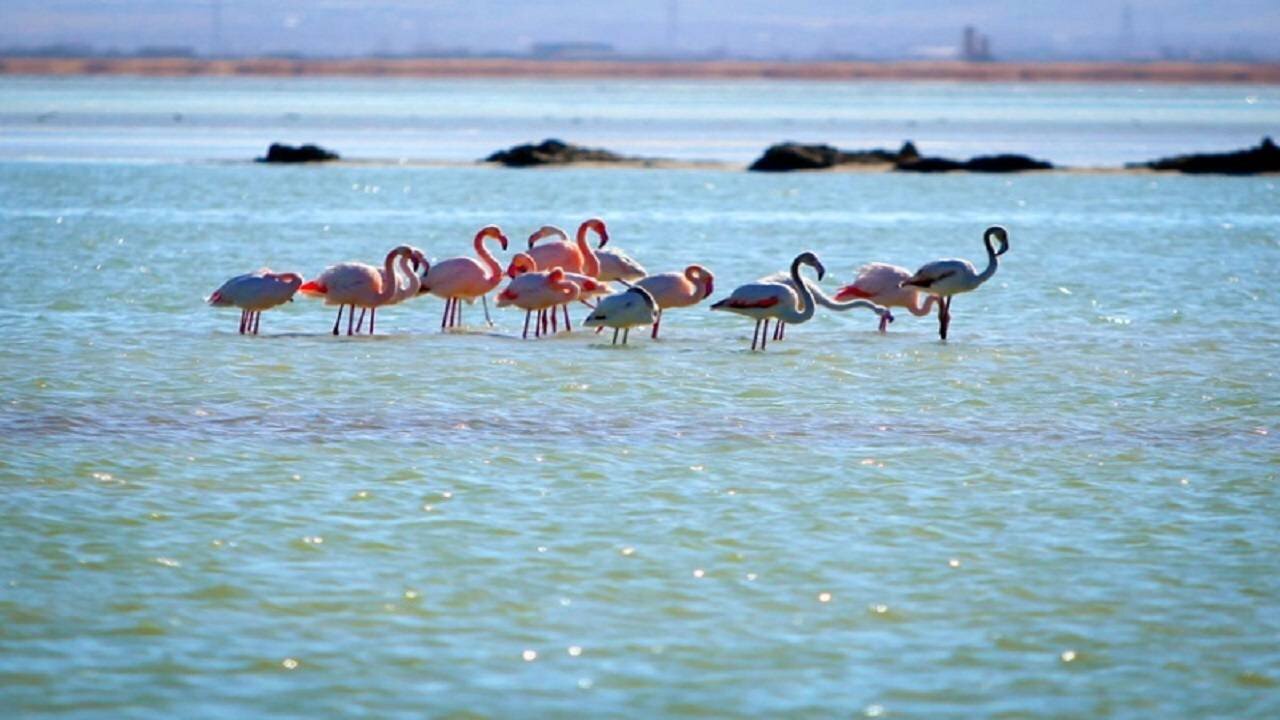
Thanks to an 18-fold increase in the volume of water in Lake Urmia, reaching 4.28 billion cubic meters now, and the restoration of the food resources in this ecosystem, a large number of flamingos have returned to the lake.
With the improved water conditions, over 6,000 flamingos are expected to fly to Lake Urmia and its satellite wetlands.
Filed surveys have shown the birds nesting and breeding in the southern parts of the lake.
Rainfall, restoration projects replenish many wetlands
Recent heavy rainfall, along with restoration projects, has increased water flow into many wetlands, including Shimbar, Zarivar, Helleh, and Hour al-Azim, bringing them back to life.
Thanks to a 3.7 percent increase in average rainfall, the water inflow to wetlands across the country has improved compared to last year, IRIB quoted Arezou Ashrafizadeh, an official with DOE, as saying.
In Gilan province, Bojaq wetland is in good standing. Anzali wetland is in fair condition after the removal of invasive water hyacinths. However, Gorgan Bay, and Miankaleh wetland require additional measures to be restored. Sadly, in Golestan province, Alagol wetland is not in a favorable condition due to low rainfall, the official noted.
About 70 percent of Quri Gol wetland, the only fresh wetland, in East Azarbaijan, is filled with water. Compared to the same period last year, the water level of the wetland has increased by 27 cm, reaching 1912.43 meters now.
Presently, some 116 hectares of the wetland are filled with water. It has about 700 million cubic meters (mcm) of water, which is lower than the 3.8 mcm amount designated for the wetland.
Quri Gol wetland hosts over 92 bird species, which are all migratory birds, except redhead coots, 14 species of reptiles, 4 species of amphibians, and one species of fish, as well as 280 plant species.
In Fars province, 80, 30, and 10-15 percent of Maharloo, Arjan, and Bakhtegan wetlands are filled with water.
With an area of 600 sq. Km, Maharloo Lake in southern Fars Province is a perfect stopover for migratory birds, including flamingos. In mid-summer, the lake loses its water due to high evaporation, leaving behind a white bed and pinkish-colored water.
The Arjan restoration project is in the beginning phase; it covers 2000 hectares. The water of the wetland depends on the amount of rainfall. The wetland is one of the main habitats for migratory birds like cranes, flamingos, wild ducks, and geese.
Bakhtegan is a Salt Lake with a surface area of 3,500 square kilometers, once Iran’s second-largest lake. Several dams on the river had significantly reduced water flow into the lake, increasing its salinity and endangering the lake’s populations of flamingos and other migratory birds.
In Khuzestan province, Hour al-Azim and Shadegan wetlands are in optimal shape. Until last year, Hour Al-Azim wetland, located on the border of Iran and Iraq, was grappling with water scarcity.
Bamdej wetland is being revived. The project to restore the wetland kicked off about two years ago with the help of the private sector, investing 1.3 trillion rials (around 8 million dollars), with 2 trillion rials (about 12 million dollars) more which is needed to complete the project.
Intense rainfalls have led Shimbar, Zarivar, and Helleh wetlands to be filled to 100 percent, and overflow.
Located at the foot of the Zagros mountains, Zarivar is a freshwater wetland designated as a Ramsar Site.
Marreh wetland in Qom province is in a favorable condition. Known as the “Desert Gem”, the wetland stands as one of the five significant wetlands in Qom province, becoming a sanctuary for various bird species.
Sprawled about 40 kilometers north of the city of Qom and adjacent to the Qom – Tehran highway, Hoz-e-Sultan wetland, a salt lake, is struggling with water scarcity.
MT/MG
Disclaimer : This story is auto aggregated by a computer programme and has not been created or edited by DOWNTHENEWS. Publisher: tehrantimes.com