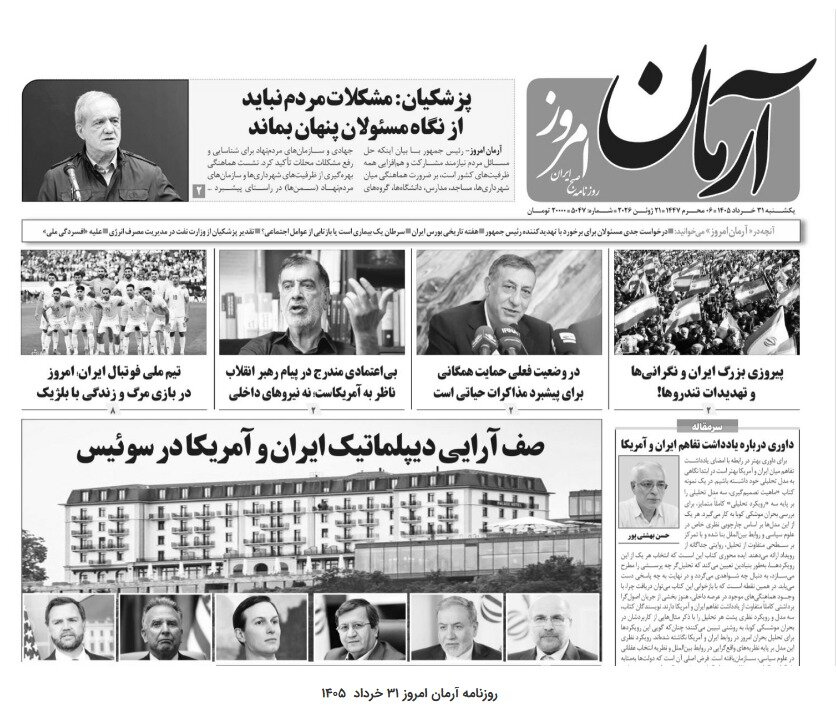
Arman-e-Emrooz analyzed the text of the Iran–US memorandum of understanding and, quoting international affairs analyst Salah al-Din Khadiv, wrote: The publication of the full Islamabad memorandum ended many speculations.
From any angle, the text appears more beneficial to Iran. So far, the only tangible concession the United States has gained is the reopening of the Strait of Hormuz. Iran, however, not only sees its ports unblocked but also receives sanctions exemptions and access to part of its frozen assets. Undoubtedly, this outcome is the product of Tehran’s improved strategic position after the war and the attacker’s inability to convert overwhelming military superiority into strategic dominance. The success of the current initiative depends on maintaining this balance. Iran’s relative advantage in the current process hinges on preserving the leverage of the Strait of Hormuz. Iran’s effort to impose a new regime on this waterway aims to maintain its deterrent capacity against any future aggression.
Ettelaat: Netanyahu’s fate lies in Trump’s hands
Ettelaat examined the uncertainty surrounding Netanyahu’s potential re-election. A report reposted by Trump from Just News claims that Netanyahu’s chances in the fall 2026 elections depend heavily on Trump’s stance, and that the US president now holds significant levers to influence Netanyahu’s political future. Trump told Kan News that he will “probably” support Netanyahu. This statement is effectively a political warning, as Trump has repeatedly criticized Israel’s handling of the wars—especially in Lebanon—arguing that it has harmed US efforts to stabilize the region. Trump views the recent US–Iran agreement as a key part of his strategy to end the conflicts, reopen the Strait of Hormuz, and ease pressure on global energy markets. Therefore, any Israeli action that disrupts this process could provoke strong dissatisfaction from him.
Farhikhtegan: Trump admits sanctions have backfired
In recent days, Trump and J.D. Vance have made notable remarks about the mutual damage the United States has suffered from sanctions on Iran. During a press conference in France at the end of the G7 summit, Trump said regarding the release of Iran’s blocked funds:” We took a lot of their money, and we have their money. It’s not our money; it’s theirs, and we froze it at a certain point. I think we should give it back. If we don’t, no one will ever invest in the dollar again.” In other words, Trump justified the move as necessary to preserve global trust in the US dollar, acknowledging that permanently seizing another country’s assets could undermine confidence in the dollar-based international financial system. Even if Trump’s shift in tone is partly for domestic consumption, it reflects global realities: declining trust in the United States and the gradual trend toward de-dollarization triggered by the weaponization of the dollar for sanctions.
Shargh: The agreement faces a difficult test
Shargh analyzed the challenging environment surrounding the new agreement. Escalating clashes between Israel and Hezbollah in southern Lebanon have placed the fresh US–Iran deals under their first serious test. On Thursday, J.D. Vance sharply responded to Israeli criticism of Trump, urging Israelis to “open their eyes.” He reminded them that over the past three months, two-thirds of the defensive weapons protecting Israel were American-made and paid for by US taxpayers—an unvarnished reminder of Israel’s security dependence on Washington. Trump, just hours before the agreement was announced, harshly criticized Netanyahu for strikes on Beirut’s southern suburbs, saying such actions could have derailed the negotiations. This is the core contradiction: the US wants to preserve the agreement with Iran; Israel wants to maintain freedom of action in Lebanon and the wider region; Hezbollah wants to show it still has the ability to strike. If the new agreement is to endure, it must survive these difficult tests.
Iran: The Leader’s message as a guiding light for negotiations with the US
The message of the Leader of the Islamic Revolution regarding the Iran–US memorandum can be seen as a roadmap for how to proceed with one of the country’s most important political issues in recent months. The message emphasizes deep distrust toward the United States and the principle of reciprocal action. At the same time, it expresses the highest level of confidence and explicit support for President Masoud Pezeshkian and his commitment—at the head of the Supreme National Security Council—to national interests and the system’s defined frameworks. Perhaps the most important political point in the message is the warning against allowing the memorandum to become a source of internal conflict or polarization. The Leader’s message presents three complementary principles to the public: vigilance toward the United States, trust in responsible officials, and avoiding the transformation of a national issue into partisan strife.
Disclaimer : This story is auto aggregated by a computer programme and has not been created or edited by DOWNTHENEWS. Publisher: tehrantimes.com