Music mogul Clive Davis, the celebrated producer and label executive who signed and nurtured genre-defining musicians such as Janis Joplin, Bruce Springsteen and Whitney Houston, died Monday at his home in New York City, according to Davis’ representative Aliza Rabinoff. He was 94.
Davis had recently been hospitalized with an upper respiratory infection.
“To the world, our father was the iconic music legend whose vision, instincts and relentless pursuit of excellence shaped the soundtrack of countless lives,” his family said in a statement. “He discovered, mentored and championed the greatest artists in modern music history, leaving an indelible mark on culture that will endure for generations.
“To his family, Clive was Dad and Granddaddy, the steady presence at the center of our lives, the source of wisdom, strength, encouragement and unconditional love. No matter how extraordinary his professional accomplishments, he never lost sight of what mattered most: the people he loved.”
Known for an unfailing ear for innovative music and an innate ability to navigate the shifting currents of popular music, Davis ruled Columbia, Arista and J Records. He most recently served as the chief creative officer for Sony Music Entertainment.
The Grammy Award-winning producer’s career spanned six decades and was marked with both success and turbulence as he developed an astonishing stable of talent, with Rod Stewart, TLC, Carlos Santana, Aretha Franklin, Barry Manilow, Alicia Keys and Christina Aguilera among others. He also co-founded Bad Boy Records with Sean “Diddy” Combs, home to hip-hop artists such as the Notorious B.I.G.
Admirers said the veteran producer’s longevity as a high-profile record company chief was due largely to his knack for matching artists with can’t-miss songs, which often soared up the charts and raked in Grammy nominations by the armful. His annual pre-Grammy party was a not-to-be-missed industry event, even when it went virtual amid the COVID-19 pandemic in 2021.
Davis’ driving goal was “to find a song that fits naturally, so there’s no sense of artificiality when they sing it,” he told The Times in 2014.
Born April 4, 1932, in Brooklyn, Davis’ parents died when he was still a teen and he moved in with a sister. He received full scholarships to New York University and Harvard Law School and graduated with honors from both. He began his professional career as a corporate lawyer working with CBS Records and was eventually recruited into the label’s executive offices.
The label was then home to a young Bob Dylan, who tangled with Davis when the young folk singer pushed to include a song called “Talking John Birch Society Blues” on his 1963 album “The Freewheelin’ Bob Dylan.”
Davis, as Columbia’s general counsel, felt certain lines in the protest song were libelous and told the infuriated songwriter that it wouldn’t make it onto the record, he wrote in one of his two memoirs. Though furious, Dylan relented.
Davis credited attending the Monterey Pop Festival — the 1967 seminal music festival that featured adventuresome acts such as the Who, Jimi Hendrix and Jefferson Airplane — for opening his eyes to the emerging psychedelic music scene. He also credited the festival for bringing him in contact with Joplin, who then was the lead singer of the rock band Big Brother and the Holding Company. It was his first — and likely his best, he said repeatedly — signing.
During his reign at Columbia/CBS, the company threw open its doors to rock and folk music, issuing early albums from Springsteen, Santana, Aerosmith, Laura Nyro and Billy Joel.
When Springsteen turned in the first recording of his debut album, “Greetings From Asbury Park, N.J.,” Davis asked him if he could come up with some additional material because he didn’t hear any potential hits.
“I went to the beach and wrote ‘Blinded by the Light’ and ‘Spirit in the Night,’” Springsteen said later. “That was a good call. They ended up being two of my favorite songs on the record.”
But Davis’ penchant for spending lavishly caught up with him and he was pushed out of CBS amid accusations that he used company money for his son’s bar mitzvah and other personal expenses — charges that were never proven. He quickly founded Arista Records where his winning streak of mainstream hits continued.
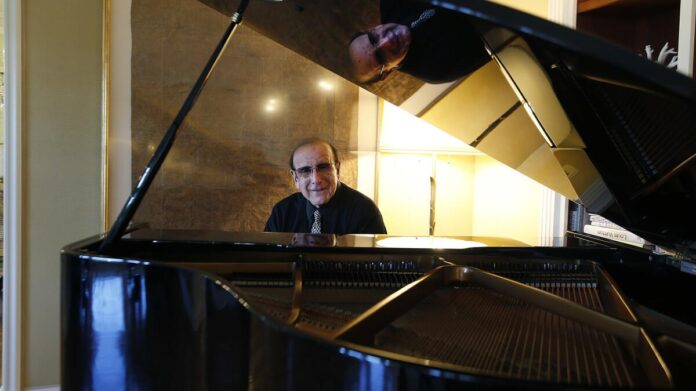
Clive Davis in 2016
(Kirk McKoy / Los Angeles Times)
After signing a 19-year-old Houston, she became one of the most successful female vocalists in recording history. In 1999, he spearheaded Santana’s 1999 comeback album, “Supernatural,” returning the guitarist to contemporary pop radio and winning eight Grammys in the process.
His Midas touch was questioned however when the German R&B duo Milli Vanilli achieved international success and a Grammy only to tumble into infamy when it was discovered that neither of the group’s members sang vocals on their music. The duo was later stripped of their Grammy. Davis insisted he was unaware of the deception.
Despite his successes, Davis was forced out of Arista in 2000, officially because at 71 he was past retirement age. But he didn’t let up, creating J Records, a subsidiary of BMG, and scored hits with artists such as Alicia Keys and Busta Rhymes. Four years later, he was named chief executive of BMG North America, which included control of Arista.
He worked closely with several “American Idol” winners and runners-up at the peak of the singing competition’s popularity, including Clay Aiken and Ruben Studdard. In 2007, he openly feuded with original “Idol” winner Kelly Clarkson over creative control of her second album. He publicly apologized but insisted the album could have been far better.
In 2009, Davis performed another feat by returning a slumping Houston to the top of the charts with the comeback album, “I Look to You,” debuting at No. 1 on the Billboard charts. The singer, who was slated to attend his annual pre-Grammy bash, drowned in a bathtub at the Beverly Hilton the night before the event. Toxicology tests later revealed there was cocaine and other drugs in her system.
“For a while, I did believe that she had stopped drugs,” Davis said of Houston’s final years, devoting much of his second memoir to the pop titan. She visited him at home in L.A. just before she died and he came away believing she was clean and primed to mount a comeback. “There was no comprehension on her part or my part that she was flirting with death.”
As a producer, Davis notched five Grammy Awards, two with Santana, one with Clarkson and one with Jennifer Hudson, but shepherded several nominations and wins for artists. He also received the Grammy Trustees Award in 2000 and the President’s Merit Award in 2009.
The Grammy Museum in Los Angeles named its 200-seat theater the Clive Davis Theater and the Rock & Roll Hall of Fame inducted Davis into its non-performers category in 2000. His alma mater, New York University, named its art school’s music division the Clive Davis Institute of Recorded Music. He was portrayed by Stanley Tucci in the 2022 biopic “Whitney Houston: I Wanna Dance with Somebody.”
Davis was twice married and published his first memoir, “Clive Davis: Inside the Music Business,” in 1976. He followed it with “The Soundtrack of My Life” in 2013 in which he revealed that he was bisexual. He wrote that he first had a sexual encounter with a man during the disco era in New York City and began leading a self-proclaimed “bisexual life” after separating from his second wife, Janet Adelberg, with whom he had two of his four children. He had two long-term partners later in life.
“My family knew and my closest friends knew,” he told Rolling Stone. “But bisexuality is and was misunderstood: ‘You’re either gay or straight, or you’re lying.’ But that’s not true. Maybe I should have had the courage earlier to air the issue. But I knew I would air it when I wrote my autobiography.”
Davis is survived by his four children; Fred, Lauren, Mitchell and Doug; eight grandchildren; two great grandchildren; and longtime partner Greg Schriefer.
More to Read
Disclaimer : This story is auto aggregated by a computer programme and has not been created or edited by DOWNTHENEWS. Publisher: latimes.com