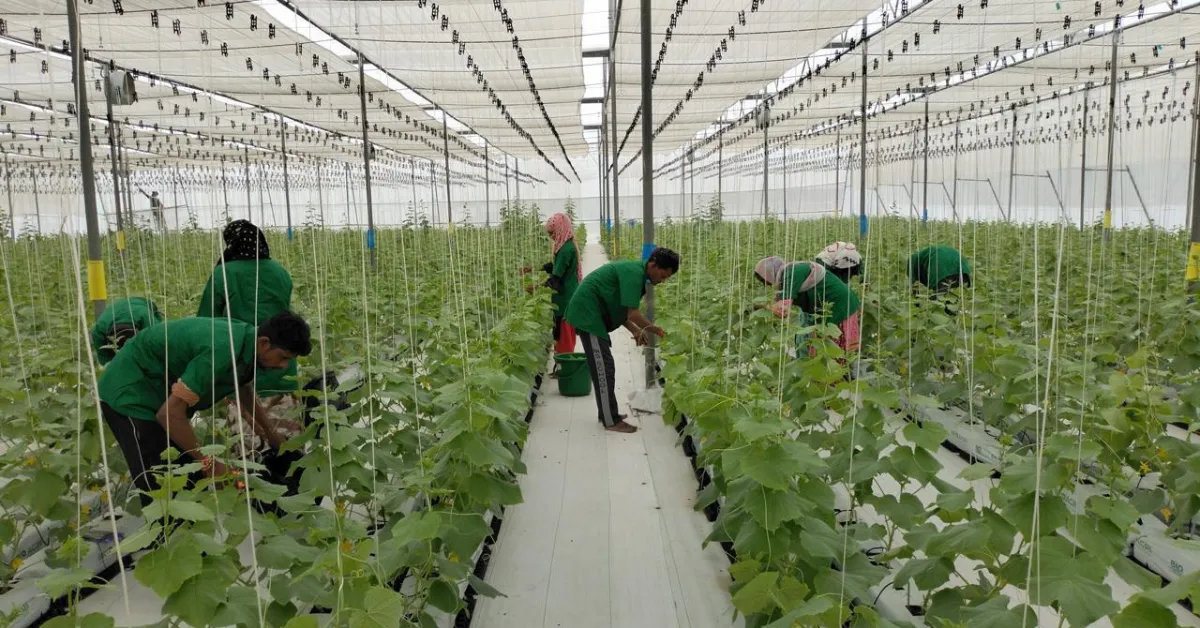
On a hydroponic farm in Gujarat, rows of cucumber vines stretch neatly under a climate-controlled structure. The fruits hang uniformly from the plants, protected from the uncertainties that have long defined Indian agriculture — erratic rainfall, rising temperatures, and dwindling water resources.
For 37-year-old Yash Vora, this sight is more than a successful harvest. It is proof that farming can be planned.
“In Gujarat, water is always a major concern, so hydroponics felt like the right solution for the future,” he says.
“With my hydroponic farm, I can grow vine crops like tomatoes, mainly cucumbers, and red and yellow capsicums in a way that is efficient, consistent, and commercially viable.
He explains that returns are higher because crop quality is high and losses are much lower. It has given me a model of farming that is more resilient, more modern, and more profitable for the long term.”
For generations, Indian farmers have worked with uncertainty as a constant companion. A delayed monsoon, an unexpected pest attack, or poor-quality water could alter an entire season’s earnings.
But for a growing number of farmers like Yash, technology is helping shift agriculture from a gamble to a predictable enterprise.
At the centre of this shift is Gujarat-based Brio Hydroponics, a company that has spent the last decade building climate-resilient farming systems designed specifically for Indian conditions.
A farmer’s son looking for answers
Long before he founded Brio Hydroponics in 2014, Pravin Patel had already witnessed the challenges of agriculture firsthand.
A commerce graduate by education and the son of a farmer by upbringing, Patel grew up watching how deeply weather and resource constraints influenced farm incomes.
“After seeing multiple challenges in agriculture, I realised that soil-less farming could be a great opportunity for India,” he recalls. “We could address some of the biggest problems farmers face and make a meaningful contribution to agriculture.”
What particularly struck him was the lack of predictability in conventional farming.
“In traditional agriculture, there is no forecast for production,” Patel says. “Here, we can forecast and plan. We can produce according to demand and supply in a much better way.”
That idea became the foundation for Brio Hydroponics, which develops climate-controlled hydroponic farming systems that allow crops to be grown without soil while using significantly fewer resources.
/filters:format(webp)/english-betterindia/media/media_files/2026/06/22/brio-hydroponics-2026-06-22-13-37-16.png)
Over the past decade, the company has focused on helping farmers tackle some of India’s most pressing agricultural concerns: shrinking arable land, water scarcity, unpredictable weather patterns, and fluctuating incomes.
Yet Patel insists that the larger goal was never simply about introducing a new technology.
“It was about creating a system-driven way of farming,” he says. “When farmers can plan production and reduce uncertainty, they can improve their economic viability and build a sustainable future.”
Reimagining farming through technology
Hydroponics may sound futuristic, but its core idea is straightforward: plants are grown without soil, receiving water and nutrients directly through carefully monitored systems.
Brio’s model combines Controlled Environment Agriculture (CEA) with IoT-enabled technologies that regulate irrigation, nutrient delivery, temperature, humidity, and crop health.
According to Patel, the first step is protecting crops from external conditions.
“We create a controlled structure for agriculture,” he explains.
“There are multiple layers that protect crops from insects, excessive rainfall, and temperature fluctuations. Through fogging systems, we control humidity and temperature, while rainwater harvesting helps conserve resources.”
The farms also use sensor-based fertigation systems that deliver nutrients with precision.
“We irrigate crops multiple times a day based on their exact requirements,” Patel says.
“The system controls pH, nutrient levels, and water delivery. This reduces human error and allows us to farm scientifically.”
The numbers tell a compelling story. Farmers using Brio’s hydroponic systems can save up to 90% more water than conventional farming while producing five to ten times more per acre.
/filters:format(webp)/english-betterindia/media/media_files/2026/06/22/brio-hydroponics-2026-06-22-13-38-03.png)
In the case of cucumbers, annual yields can reach as high as 500 to 600 tonnes per hectare. More importantly, these gains come with greater consistency, allowing farmers to plan production and income with far more confidence than traditional farming typically allows.
For a country increasingly grappling with climate stress, such efficiencies are becoming more relevant than ever.
“The biggest challenges today are weather uncertainty and water availability,” Patel says.
“If we can save water and grow consistently throughout the year, we can create better outcomes for farmers.”
Beyond technology: Creating agripreneurs
Before hydroponics could transform farms, it first had to overcome doubt. When Patel launched Brio Hydroponics in 2014, many people struggled to accept the idea that vegetables could be grown without soil.
Building confidence in the technology, he says, was every bit as challenging as building the farms themselves.
“The biggest challenge was convincing people that hydroponics was possible,” he says. “Then came questions about markets, skilled manpower, and know-how.”
The company spent years conducting demonstrations, training programmes, and field support initiatives to build trust.
Today, Patel says the conversation has evolved.
“We no longer need to explain what hydroponics is,” he says. “Now we explain how it can become a business and how people can contribute to the industry.”
That shift has helped create a new generation of agripreneurs — individuals who view farming not only as cultivation but also as an enterprise.
“One of our biggest impacts has been changing mindsets,” Patel explains. “Anybody can become an agripreneur. We have seen people from IT backgrounds, students, and traditional farming families enter this field.”
/filters:format(webp)/english-betterindia/media/media_files/2026/06/22/brio-hydroponics-2026-06-22-13-38-50.png)
The company has trained more than 16,000 participants through online, offline, practical, and internship-based programmes.
It has also supported over 150 hydroponic projects across India and internationally, with deployments spanning Gujarat, Maharashtra, Assam, Rajasthan, Tamil Nadu, Singapore, and the Maldives.
As hydroponics scales, the economics become more attractive too. According to Patel, setting up a pilot hydroponic farm typically costs around Rs 50 – 90 lakh per acre, depending on the infrastructure and level of automation.
However, as projects expand and operations become more efficient, that cost can reduce to roughly Rs 25 – 40 lakh per acre. At optimal scale, farms can generate annual revenues of Rs 60 – 80 lakh per acre, while the infrastructure itself is designed to last 15–20 years with regular maintenance.
The real impact is measured in confidence
The strongest measure of any agricultural innovation, however, lies not in technology but in the lives it changes.
For 36-year-old Mehul Shah from Assam, hydroponics offered something traditional farming rarely could: certainty.
“Before hydroponics, farming in Assam meant living with uncertainty — too much rain, too little control, and very little consistency,” he says.
“Today, with my hydroponic farm, I can grow cherry tomatoes, coloured capsicums, and cucumbers with far better quality and predictable harvests.”
What stands out most for him is the ability to plan. Today, he knows what he will produce, when it will be ready for harvest, and the value it is likely to command in the market. That sense of predictability has transformed his outlook on agriculture.
For the first time, farming feels less like a gamble dependent on the season and more like a business that can be planned, managed and grown with confidence.
/filters:format(webp)/english-betterindia/media/media_files/2026/06/22/brio-hydroponics-2026-06-22-13-39-39.png)
In Maharashtra, 42-year-old Gaurang Parikh echoes a similar sentiment.
“I started hydroponics because I wanted to grow something high-value and reliable, not just depend on the weather every year,” he says.
“Crops like English cucumber, beefsteak tomato, and capsicums have changed everything for me.”
For Gaurang, the real change is not just in the harvest but in the way he approaches farming.
At the heart of its appeal is hydroponics’ efficient use of water and the discipline it introduces into everyday farming practices.
“It has helped me think like an agripreneur, not just a cultivator,” he adds.
Patel remembers countless stories of similar transitions.
One, in particular, remains close to him. A former college acquaintance from Bihar, whose family had limited resources, approached Brio seeking guidance. Through government support schemes and technical handholding, he established a hydroponic venture of his own.
“He never imagined he would do something like this,” Patel says.
“Today, he has earned respect within his family and community. Those moments make us feel that we are contributing something meaningful.”
Farming’s next chapter
As climate change continues to reshape agriculture, Patel believes the future of farming will depend on systems that are more precise, resource-efficient, and resilient.
He envisions hydroponics evolving from a niche practice into a critical part of India’s food security infrastructure.
“Healthy, hygienic and chemical-free food will become increasingly important,” he says. “Agriculture must become tech-driven. We have to move towards becoming system operators rather than relying entirely on uncertainty.”
That vision is already taking shape. In Talod, Gujarat, Brio is developing a 100-acre hydroponic project, among the largest of its kind in the country, to create cluster-based agricultural ecosystems that generate employment and improve food production.
/filters:format(webp)/english-betterindia/media/media_files/2026/06/22/brio-hydroponics-2026-06-22-13-40-27.png)
For farmers like Yash, Mehul and Gaurang, however, the future is already visible in the crops they harvest today.
It is visible in the confidence to plan a season before it begins. In the ability to conserve water without compromising productivity. And in the growing belief that farming can be both sustainable and profitable.
For generations, Indian agriculture has largely depended on adapting to nature’s uncertainties. Hydroponics does not eliminate every challenge, but for a growing community of farmers, it is proving that the future of farming may lie not in predicting uncertainty but in reducing it.
All images courtesy Brio Hydroponics team
Disclaimer : This story is auto aggregated by a computer programme and has not been created or edited by DOWNTHENEWS. Publisher: thebetterindia.com