
From the aisles of American grocery chains to the literary corners of London, the humble canvas bag is being reimagined as the ultimate cultural shorthand. We explore the rise of this “anti-luxury,” “high-intellect” status symbol and why some of the world’s most stylish people are trading designer leather for screen-printed cotton.
As the man takes his seat in the café, he doesn’t just set his bag down beside him—he carefully adjusts it so that its design is facing outwards, like a proud announcement of not just where he’s been but what it says about him. It’s a fabric tote bag from Daunt Books—a popular chain of independent bookshops in London founded 36 years ago that has recently found a newly reinforced global fandom through the power of social media. I recognize it instantly, not just because I’m familiar with the store, but because I’ve seen a few of these exact same bags flaunted at the Emirates Airline Festival of Literature during the past couple of years. Online, I’ve seen it casually slung over the shoulder of celebrities such as Emily Ratajkowski, Benedict Cumberbatch, and Elizabeth Olsen. And I’ve also seen a well-loved version worn by my friend Tamreez Inam, a Dubai-based author who is one of the most well-read people I know.
In all instances, seeing these bags instantly tells me one thing: that the person carrying it is a member of the literati—a cultured, intellectual person that champions the small business over the multinational conglomerate; that this person is studious but in the sexiest way—because they value the quality of the analog over mindless digital ‘brain rot’—and that they move in well-traveled circles, because they could only have gotten this either by traveling to one of these shops in the UK or being gifted one. I got all this from a glance at a humble tote bag—and it’s just one of many simple canvas carry-alls that are becoming a lifestyle status symbol.
To understand how a simple sack became a cultural shorthand for identity, we first have to examine its journey from utility to icon. The name “tote” itself is likely a remnant of the 17th century. The word is a verb that means “to carry,” and it’s a term that’s still used today. The “tote bag” as we recognize it today, however, it only took its modern form in the mid-20th century. Its origin story is one of rugged pragmatism: in 1944, American outdoor brand L.L. Bean introduced an innovative new creation called the “Ice Carrier” or “Boat Bag.” Made of heavy-duty canvas that could lug up to 500 pounds of stuff, it was designed for a singular, grueling task: helping households transport blocks of ice from cars to freezers.
By the 1950s, the bag had migrated from the docks of the state of Maine to America’s suburbs, becoming a family staple for grocery shopping, beach outings, daily chores, and beyond. But the real shift began in the 1960s, when the bag first transformed from an item of pure utility into a bona-fide fashion-adjacent accessory. Innovators like Bonnie Cashin—the legendary designer who helped shape the aesthetic of Coach—introduced the “Cashin Carry” tote. Cashin used leather and refined metal hardware to make the open-top silhouette both elegant and practical, challenging the idea that something so useful couldn’t also be chic.
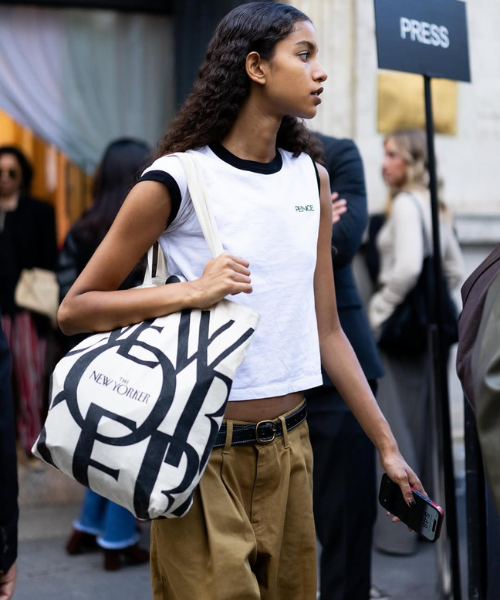
In the 1980s, bookstores, museums, and small boutiques began selling sturdy canvas totes as merchandise—and once they realized these bags could also be used as a walking advertisement, some would even occasionally give them away to customers as a free gift-with-purchase, provided they were spending enough there to negate the cost anyway. Carrying a simple tote bag from the Strand Book Store told society that you were a bibliophile—and depending on which version of each limited-edition design you had, it also showed how long you’d been part of this intellectual club. The Strand has been making their tote bags since the 1980s, and in 2013, equally iconic New York institution The New Yorker created its own tote bag. In 2014, they realized that by giving them away to subscribers for free, they could entice readers to embrace them as a sign of cultural aptitude: like the Strand tote, to have one wasn’t just to receive a useful free gift; it was a badge of membership in a global, well-read community. They followed a similarly clever model by partnering with the illustrators they’d hire for the magazine to create limited-edition runs, turning this hallmark of sophistication into a timestamp that proved just how long you have had taste, too.
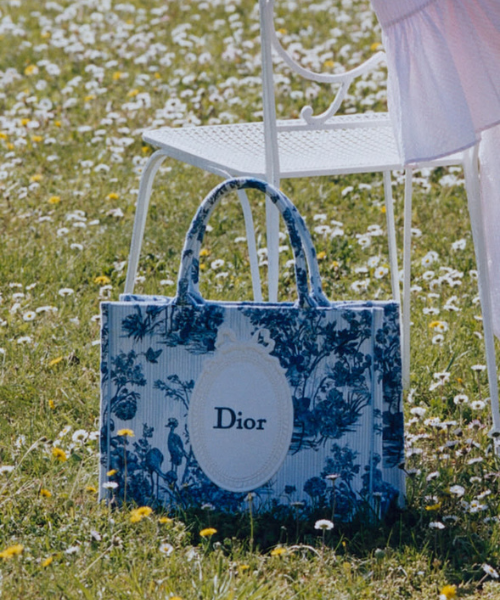
Meanwhile, in the decades since, amidst the ebb and flow of the luxury fashion industry’s trends, a desire for rebellion against the rigid rules and four-figure price tags of classic luxury has also found its footing—and high fashion has managed to subvert this “anti-luxury” sentiment by embracing it, rather than ignoring it. Take the Dior Book Tote, for instance. Introduced by Maria Grazia Chiuri for the brand’s SS18 collection, this now-iconic style—inspired by a 1967 drawing by Marc Bohan—honors and reveres the idea of blending practicality with high-fashion luxury. The “haul-all” bag can handle a heavy load (not just of books, but of modern women’s needs, from laptops to water bottles and more), but its construction is a celebration of savoir faire: each bag requires over 37 hours of work and more than 1.5 million stitches of intricate embroidery.
The Dior Book Tote silhouette has since gone so viral that it has spawned hundreds of literal copycats from high-street retailers as well as inspired respectful homages by other designers globally. Even in the local market, we’ve seen this come to life through creative, fun collaborations like the Nuaimi x Waitrose Special Edition UAE Shopping Bag. This series of limited-edition collections, created by UAE-based designer Huda Nuaimi for Waitrose grocery stores in the country, elevates the routine supermarket run into a design-led experience and turns a functional shopping tool into a collector’s item laced with regional pride.
On the opposite end of the spectrum, Balenciaga’s “Trash Pouch” takes a totally different approach to interpreting a utilitarian everyday item. First showcased at their AW22 show, this bag looked, for all intents and purposes, like a literal plastic disposable drawstring garbage bag—despite being made of premium calfskin with a glossy coating to mimic plastic—and was sold for US$1,790 apiece. Then-Balenciaga Creative Director Demna Gvasalia—who has since gone by the mononym Demna and moved to Gucci in 2025—reportedly aimed to create a disruptive and socially charged fashion item with it, and it seems he succeeded. The bag’s controversy—a high-fashion “dare” that flipped the sentiment of the humble everyday item on its head—has carried through to the current day: when Chinese actress Zhang Jingyi walked the red carpet of the Beijing International Film Festival holding a nondescript yellow plastic bag, people across the world questioned if it was a new Balenciaga drop. It wasn’t—it was actually just a standard, actual grocery store bag—but Demna’s provocation had done its job. While options like the Daunt Books canvas tote suggest a rejection of conspicuous consumption in favor of substance, Balenciaga’s Trash Pouch is luxury masquerading as the mundane. Some see it as an insult, while others see it as a cynical commentary on what we define as “covetable” in an era of ironic luxury.
Sitting somewhere between the US$20 bookstore find, the US$1,790 designer trash bag, and the US$2,450 to US$4,300+ luxury book tote is the Marc Jacobs “The Tote Bag.” Introduced in 2019, it has since become a global phenomenon by leaning into its own identity. By boldly labeling the bag with its own function, Jacobs created a meta-icon that is unapologetically practical yet elevated—a luxury item that doesn’t demand you be precious with it. This obsession with the “ordinary made extraordinary” reached a fever pitch in early 2024 with the Trader Joe’s mini-tote frenzy. Originally retailing for a mere US$2.99 at the American supermarket chain, these small canvas bags—available in simple, vibrant colors—became an overnight viral sensation through TikTok. Within days, stores were cleared out, and the secondary The market for it exploded. On resale platforms like eBay and Depop, these humble grocery bags were listed for hundreds, and in some extreme international listings, as much as US$50,000. While it’s still a coveted item in the US, where it’s from, it’s overseas that the real demand is driven. In 2025, one Reddit user on the r/JapanLife subreddit proclaimed, “Seriously, what’s up with the Trader Joe’s bag’s [sic] here?” Indeed, the bag has been particularly popular in Tokyo, as well as London and Seoul. It figures, then, that people in its country of origin don’t always get it—as a Facebook user from a group in Southern California (the state with the most Trader Joe’s stores in the US) said last month, “If I see another Trader Joe’s tote post, I’m going to lose it. It’s a bag.” Part of its appeal is the scarcity bias and the clout of a souvenir proving you could travel to the US to get it. Part of it is the number of popular celebrities that have been spotted using it.

This absurdity highlights a major shift in how we now define what is iconic. A limited edition status has always been able to turn a simple item into a high-stakes cultural asset, but social media’s viral narratives are now taking it to a whole new level. Whether it’s a bookstore souvenir or a viral grocery bag, anything can become an overnight legend – especially if it’s a stamp of “I was there” or “I know this” at a specific cultural moment. But beyond the hype and the resale value, there is a deeper, more personal reason why the tote bag has endured. While the world of high-fashion accessories has historically defined the “it-bag” through famous labels bearing buttery leathers and intricate craftsmanship, today’s most coveted pieces are an expression of personal identity. While the market may assign a high price to a rare material or colorway, to the individual, the true worth of a bag is being increasingly decoupled from its cost. When a bag becomes a repository for a specific memory—a summer spent exploring a new city, a hard-won professional milestone, or a gift from someone significant—it becomes an item that transcends the trend cycle entirely. A well-worn tote doesn’t just hold our belongings; it carries our stories. It represents a shift towards a more democratic, deeply personal form of luxury where what an item represents to society is one thing, but what it represents to the individual is more priceless. The evolution of the appeal of the tote bag is a story reminding us that the most iconic thing we can carry isn’t a label; it’s a piece of our own journey: a meaningful status symbol that may not necessarily cost the most but that may hold the most powerful memories—or at least have the best narrative.
– For more on luxury lifestyle, news, fashion and beauty, follow Emirates Woman on Facebook and Instagram
Images: Supplied
Disclaimer : This story is auto aggregated by a computer programme and has not been created or edited by DOWNTHENEWS. Publisher: emirateswoman.com




