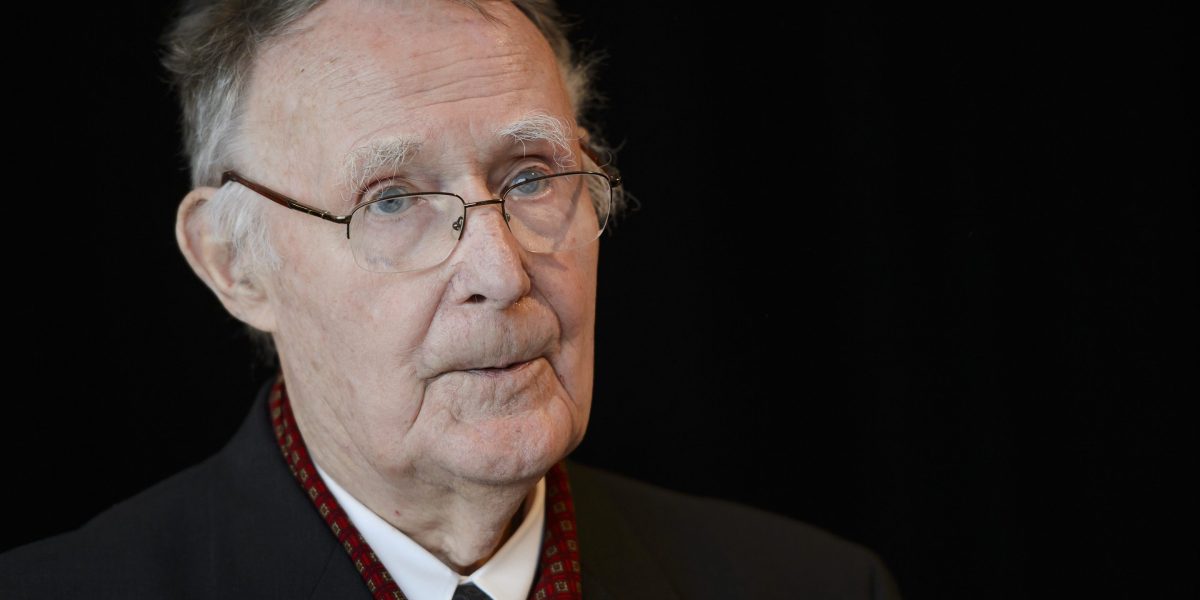
As the saying goes, watch the pennies and the pounds look after themselves. But as it turns out, even some of the wealthiest people on the planet follow the money-saving mantra, well after they’ve made it. IKEA’s billionaire founder, Ingvar Kamprad, took his love for budget furniture home with him—literally.
Despite having an estimated $58.7 billion net worth and being one of the richest men alive, the late businessman would buy his clothes at flea markets and drove an old Volvo.
“I don’t think I’m wearing anything that wasn’t bought at a flea market,” Kamprad said in a 2016 documentary on Sweden’s TV4. “I want to set a good example.”
Kamprad could have bought himself anything. But like many average Joes, he’d sneak home little packets of salt and pepper from restaurant visits.
Taking his frugality one step further than most, he reportedly even recycled tea bags, ate at his own cafeterias, and flew economy.
He once revealed to the newspaper Sydsvenskan that the €22 haircut price in the Netherlands was above budget and that he’d usually get it done while visiting “a developing country.”
“Last time it was in Vietnam,” Kamprad added.
And although he certainly no longer needed the cash, he kept working at Ikea until he was 87, before passing away in 2018 at 91.
Warren Buffett, Mitzi Perdue, and the world’s youngest billionaire are frugal, too
When you look among the ultra-wealthy, many opt out of wasting their money on status symbols that drain rather than build wealth.
The youngest self-made female billionaire, Lucy Guo; the late founder of Ikea, Ingvar Kamprad; and actress Kiki Palmer all have a beat-up old car in common.
Mitzi Perdue, the billionaire heiress of Sheraton Hotels and Perdue Farms, doesn’t even own a car—let alone a flashy one. She gets around by riding the subway instead.
“The Hendersons and the Perdues did not encourage extravagance,” Perdue previously told Fortune. “Nobody wins points for wearing designer clothes.”
Perhaps most famously, legendary investor Warren Buffett has long adopted a frugal lifestyle: he never spends more than $3.17 on breakfast, he lives in the same house he bought for $31,500 in 1958, and he drives a car that’s over 20 years old.
The man worth $144 billion is often quoted for saying: “I’m not interested in cars, and my goal is not to make people envious. Don’t confuse the cost of living with the standard of living.”
The Ikea founder said frugality is in the Småland blood
Kamprad long insisted that his penny-pinching ways were just down to his upbringing in Sweden. “It’s in the nature of a Smaland to be thrifty,” he said in the same TV4 interview.
Småland is the rural province in southern Sweden where Kamprad grew up and, with a “local ethos,” built IKEA at just 17 years old in 1943. In the company’s employee guidelines, Kamprad stressed that “wasting resources is a mortal sin at IKEA.”
“We have Småland in the blood, and we know what a krona is—even though it is not as much as it was when we bought candy and went to elementary school,” he said, referring to the Swedish currency.
For some, the founder came across as cheap. Kamprad reportedly became known as “Uncle Scrooge” and “The Miser”. He was also criticized for tax avoidance. And in the later years of his life, he faced serious questions over past links to fascist groups. Swedish security police noted his activities in 1943, the same year he established Ikea.
It’s a complicated legacy to sit with. But Ikea has outlived its founder, with frugality a part of its DNA. Being simple, efficient, and affordable is what has kept it such a huge success decades later.
Today, Ikea has 504 stores across 63 countries worldwide. Last year alone, it generated around $50 billion in sales and welcomed 915 million visitors.
Disclaimer : This story is auto aggregated by a computer programme and has not been created or edited by DOWNTHENEWS. Publisher: fortune.com