
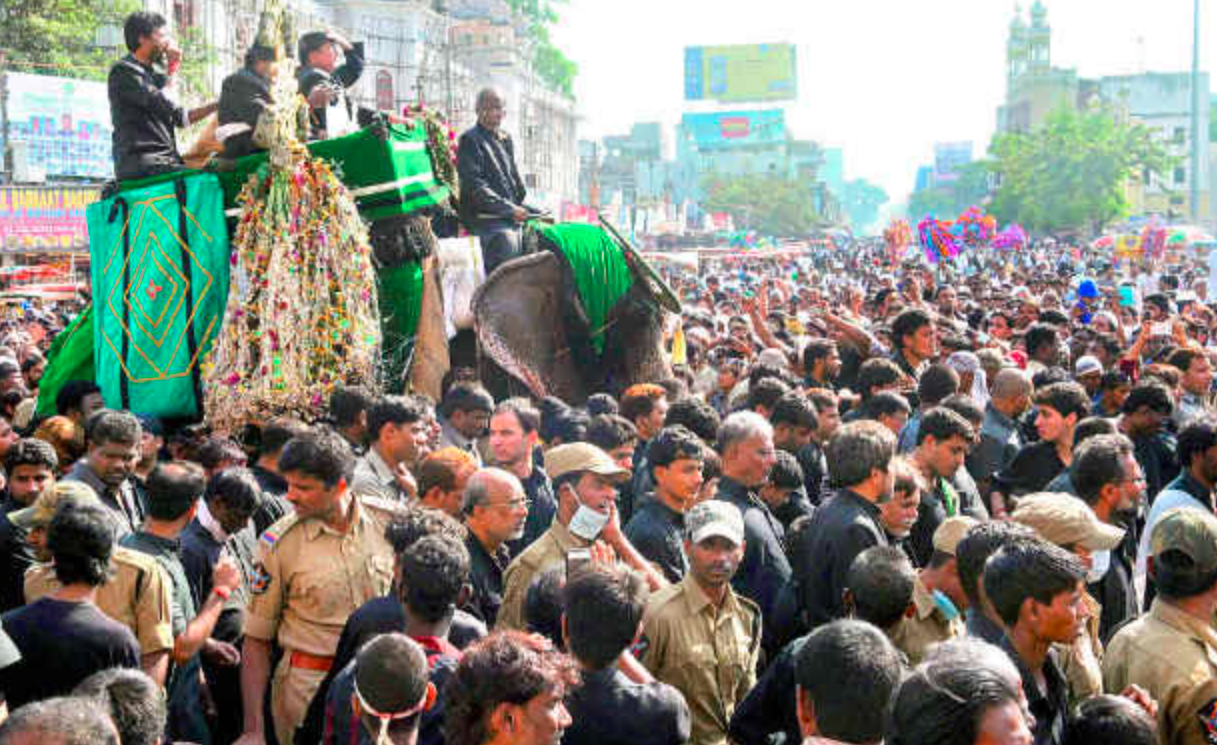
Hyderabad: As the crescent moon ushers in the solemn days of Muharram, Hyderabad transforms into a city of remembrance. Draped in black, echoing with elegies and lined with stalls serving sherbet and water, the city’s centuries-old observance of Ashura is not merely a religious event but a living testament to Hyderabad’s rich history and composite culture.
Today (June 26), thousands of devotees gather to mourn the martyrdom of Hazrat Imam Hussain, the son of Imam Ali and grandson of Prophet Muhammad, who was martyred along with his companions in the Battle of Karbala in present-day Iraq nearly 1,400 years ago. His sacrifice against injustice continues to inspire millions across the world.
The day is of immense religious significance for Shia Muslims and is also deeply intertwined with Hyderabad’s heritage, where Muharram has been observed for over four centuries.
What Happens on Ashura?
From the early hours of the morning, Ashoorkhanas across Hyderabad witness a steady stream of devotees offering prayers before sacred Alams that contain Tabarruk—relics associated with Imam Hussain and his family.
Across the Old City, streets are filled with mourners dressed in black. Temporary stalls distribute chilled sherbet, milk drinks and water free of cost to devotees and passersby. Religious congregations, known as Majlis, recount the events of Karbala, while processions move through the city’s historic lanes.
The atmosphere is one of grief, devotion and reflection rather than celebration.
What is Muharram?
Muharram is the first month of the Islamic calendar and one of the four sacred months in Islam.
For Shia Muslims, the first ten days commemorate the sacrifice of Imam Hussain at Karbala in 680 AD. The tenth day, known as Ashura, marks the culmination of mourning.
Many Shia households in Hyderabad install Alams in their homes during Muharram, continuing a tradition that has existed for centuries. In Telangana, Muharram is also popularly known as Peerla Panduga, with many Hindus joining the observances, reflecting the state’s shared cultural traditions.
What is an Ashoorkhana?
An Ashoorkhana is a house of mourning where sacred Alams and relics associated with Imam Hussain are kept. Throughout Muharram, these places host Majlis, recitations and prayers.
Hyderabad is home to nearly 140 major and minor Ashoorkhanas, many dating back to the Qutb Shahi era. Among the most prominent are:
- Badshahi Ashoorkhana
- Bibi Ka Alawa
- Hussaini Alam Ashoorkhana
- Imambara Yakutpura
- Ashoorkhana Hazrat-e-Abbas
- Azakhana-e-Zehra
These heritage structures attract thousands of devotees during Muharram.
The 430-Year-Old Bibi Ka Alam Procession
The history of Hyderabad’s Muharram processions revolves around the Bibi Ka Alam Juloos, a tradition that dates back to 1594, during the reign of the Qutb Shahi dynasty. Today, more than 430 years later, it remains one of India’s oldest and most significant Muharram processions.
Held on the 10th day of Muharram (Ashura), the procession is led by the revered Bibi Ka Alam, mounted on a beautifully decorated elephant. The Alam is believed to contain a piece of the wooden plank on which Syeda Fatima, the daughter of Prophet Muhammad and mother of Imam Hussain, received her final ablution before burial.
The procession begins from Bibi Ka Alawa in Dabeerpura and passes through historic landmarks including Charminar, Gulzar Houz, Pathergatti, Mir Alam Mandi and several other parts of the Old City before concluding at Chaderghat.
The Mourning of Karbala
One of the most striking aspects of the procession is the expression of grief by mourners.
Thousands of barefoot devotees dressed in black perform matam—rhythmic chest beating—as a mark of mourning for Imam Hussain. Elegies (marsiyas and nauhas) recounting the tragedy of Karbala are recited throughout the procession.
Some devotees also perform khooni matam, a symbolic act of self-flagellation using small blades to commemorate the sacrifices made by Imam Hussain and his companions.
Hyderabad’s Royal Legacy
Hyderabad’s association with Muharram dates back to the city’s founders—the Shia Qutb Shahi rulers.
The Badshahi Ashoorkhana, built in 1594 by Sultan Muhammad Quli Qutb Shah shortly after Charminar, remains one of the city’s most important heritage monuments.
The Bibi Ka Alam is among the most revered Alams in India and has enjoyed centuries of royal patronage. The Nizams of Hyderabad adorned it with diamonds, emeralds and precious jewellery. Even today, descendants of the Nizam continue the tradition of offering dhatti (sacred cloth) and nazrana during Muharram.
Another historic landmark is the Hussaini Alam Ashoorkhana, closely associated with the famous Langar tradition established by Hayat Bakshi Begum. According to local legend, after Prince Abdullah Qutb Shah safely returned from the forest following a near-fatal incident with his elephant, the queen fulfilled her vow by distributing food and offering a gold chain at the Ashoorkhana—a tradition that continued for generations.
Disclaimer : This story is auto aggregated by a computer programme and has not been created or edited by DOWNTHENEWS. Publisher: deccanchronicle.com





