
During the May local elections in England, a canvasser was out in the London borough of Barking and Dagenham campaigning for her party. At one doorstep, the occupant asked if she was Muslim. When she said yes, he told her she should be hanged.
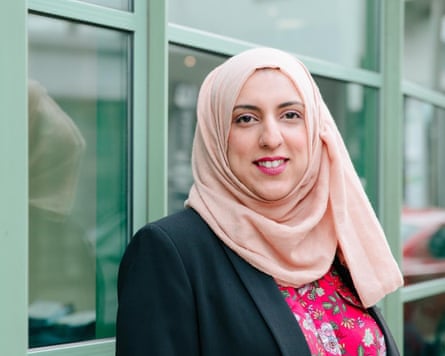
It is one of dozens of stories that Akeela Ahmed, head of the British Muslim Trust (BMT), the government’s official partner for monitoring anti-Muslim hatred, has heard in recent weeks.
Ahmed said the scale of anti-Muslim hatred in Britain had yet to properly register with much of the public and political class, and admitted she had been shocked by what she had heard while travelling across the country.
“We’re in an unprecedented situation since the Southport riots of 2024,” Ahmed said. “My parents suffered racism in the late 70s and early 80s after coming to this country. The violence we’re seeing now really reminds me of that kind of racism, but this is also another level.”
Her concerns are echoed by Muslim leaders across the UK, who describe a growing sense of fear, as well as mounting frustration that an increase in attacks has not been matched by what they see as a coordinated response from government, police, the media and other institutions.
For many, the official response to the attack in Edinburgh last weekend, in which five people were injured after a man began attacking people near a mosque, crystallised those concerns. A man has since been charged with five counts of attempted murder aggravated by a terrorist connection. Keir Starmer told parliament the attack appeared to have been motivated by anti-Muslim hatred.
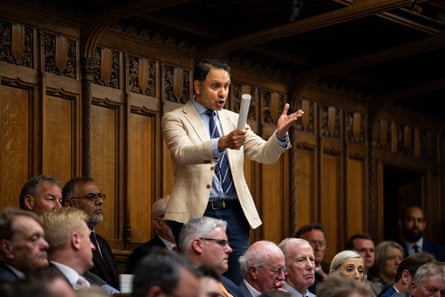
The broadcaster Mishal Husain was among those who questioned the level of attention the attack initially received from the press, while at prime minister’s questions on Wednesday, the independent MP Shockat Adam asked Starmer why a Cobra meeting had not been called.
Anti-Muslim hate crime in England and Wales rose by 19% in the 12 months to March 2025. Last year, over a three-month period, Ahmed’s team documented 27 attacks against 25 mosques in 23 different parts of the country. In Scotland, Muslims were the target of nearly a third of religious hate crime.
In the past six months alone, incidents have included attempted firebombings, vandalism and violent attacks targeting mosques in Glasgow, Edinburgh, Blackburn, Manchester, Liverpool, Shrewsbury and east London, alongside an alleged firebomb attack on an imam’s family home in Bolton, the torching of the political activist Salma Yaqoob’s car in Birmingham, and a pig’s head being left outside a Muslim family’s home in Stockport.
Official figures are widely regarded as an undercount. A recent BMT survey found that more than half of Muslims (56%) had experienced religious prejudice in the past year. Muslim women appear to bear the brunt of the hostility, with reports of hijabs being ripped off, women being abused on public transport and others being harassed or filmed in public.
While campaigners welcomed the government’s adoption of a non-statutory definition of anti-Muslim hatred earlier this year, some were frustrated by the pace of progress.
Lady Shaista Gohir, the founder of the Muslim Women’s Network, said ministers had acted “quickly and swiftly” after the racist riots of 2024 but had become increasingly hesitant as Reform UK rose in the polls.
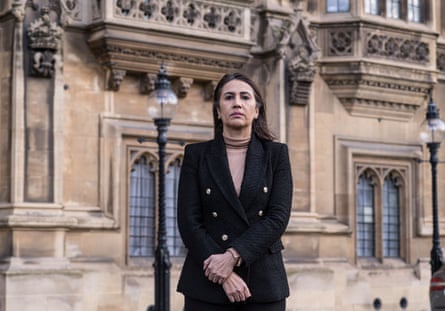
“They lacked courage to actually speak out,” she said. “If any community is under attack, the government should be robustly coming out and protecting communities. Instead, they’ve been really weak and feeble. They’re really scared about saying the wrong thing, and the far right can see that.”
Earlier this year, Labour insiders admitted Downing Street had previously hesitated to challenge anti-immigrant language because of concerns it could appear “soft on immigration”.
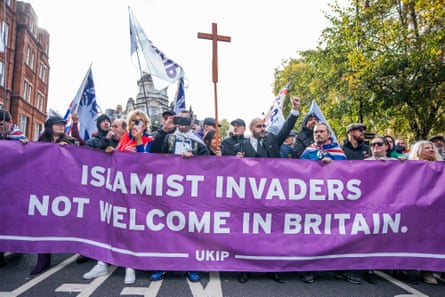
But campaigners argue that such caution underestimated how effectively far-right groups have fused anti-immigration and anti-Muslim narratives, portraying Muslims as outsiders regardless of their citizenship. As Shabna Begum, director of Runnymede Trust, warned in the months after the 2024 riots: “No one wants to be seen to defend Muslims.”
In the House of Lords this week, Gohir asked when the government would renew its hate crime strategy, which lapsed in 2020, and why it had failed to strengthen existing hate crime laws to close loopholes being exploited by extremists. She said both issues had been repeatedly raised with government over many months.
A government spokesperson said ministers were taking “decisive action” to tackle anti-Muslim hatred, pointing to the adoption of a definition of anti-Muslim hatred, a record £40m for protective security at places of worship, £4m for programmes tackling anti-Muslim hatred.
Ministers have also launched a social cohesion action plan, which includes measures on tackling anti-Muslim hatred.
But Gohir believes the measures have not gone nearly far enough. She also criticised what she described as a postcode lottery in the policing of anti-Muslim hate crime, pointing to cases in which some forces had acted swiftly while others had failed to take victims seriously until her organisation intervened.
In Northern Ireland, attention has moved on from the racist rioting that engulfed Belfast earlier this month, but among minority communities the fear remains.
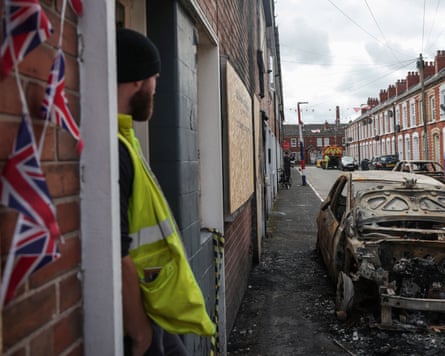
Naomi Green, assistant secretary general of the Muslim Council of Britain, said many people felt abandoned by institutions that failed to protect them.
“I literally felt like I was in a dystopia. I was getting messages from people saying: ‘I’m here in the house. My six-year-old daughter is here. Our house is on fire. Nobody’s coming’,” Green said.
“I will never forget that message.”
Green said since the riots, some politicians had doubled down on rhetoric around illegal migration. “Nobody who was attacked was a so-called illegal migrant, but they’re conflating Muslim communities with illegal migration, with just not being white.”
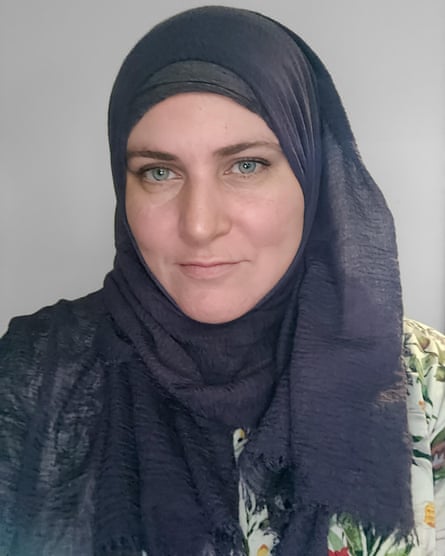
Green, who is white and converted to Islam 20 years ago, said students at her son’s school had not only taken part in the riot, but told her son he would be next, saying: “Foreigners like you are going to go home.”
“My son messaged me ‘Mum, come get me.’ My son is 12’,” she said. “Our kids grow up very quickly. I have nieces and nephews on my brother’s side who don’t think the way my kids think, because they don’t have to. My daughter said: ‘I have to work twice as hard to prove that I belong here.’”
Ahmed has had repeated requests from parents for support on how to talk to their children about rising anti-Muslim hatred. Her 13-year-old son recently told her of an incident in school. “Everybody had to share their middle names as part of this exercise. My son shared his middle name, and then another boy said: ‘Oh, you’re called al-Qaida,’” Ahmed said.
In Scotland, Zara Mohammed, a former secretary general of the MCB, said communities were in a state of shock after recent attacks in Glasgow and Edinburgh.
“It is a bit of a gamechanger because traditionally we have focused on mosques being secure. Now we’re talking about people walking back from university, or in a restaurant, or having to hide in a shop,” she said.
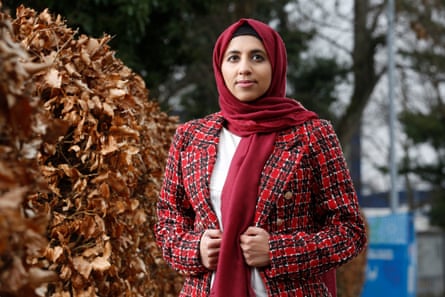
She described a growing tendency to view ordinary activities through a security lens. “One mosque had a family fun day planned on the Saturday. Their biggest fear was: are police even going to come? Are we going to be secure? Should we even go ahead?”
She added that across the country, Muslims were avoiding certain areas, changing travel plans, limiting evening outings, altering how they dressed, skipping mosque activities or asking relatives to accompany them because they no longer felt safe in public spaces.
Despite everything, Ahmed rejects the idea that communities should retreat from public life. “The majority of people in this country are good people,” she said. “We need to be able to come together as allies and draw boundaries around what we will not tolerate. We will not tolerate violence against people, hateful views against people.”
Disclaimer : This story is auto aggregated by a computer programme and has not been created or edited by DOWNTHENEWS. Publisher: theguardian.com



