
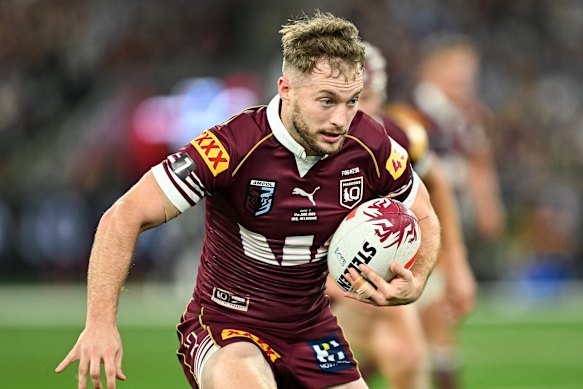

The prevailing buzzword in rugby league today is “moments”, with players, coaches and the media focused on defining games in terms of a turning point try, tackle, a crucial penalty or sin-binning, implying the remainder of the game is of lesser importance.
“Moments” may well be a way of describing the NRL, but it is momentum which goes a long way to explaining why, in State of Origin football, the relationship between talent and victory over nearly 50 years is enduringly deceiving.
“We lost the big moments,” a NRL club coach or captain will say after a defeat.
The media use “moments” as convenient hooks upon which to hang the story of a match. Even Phil Gould, a natural media contrarian, occasionally talks moments.
Channel Nine streaming and broadcast boss, Amanda Laing, when announcing the network’s record ratings for the second State of Origin match at the MCG, proudly asserted the coverage brought “Australian together through moments that genuinely capture the national conversation.”
Yet Origin II was won not by moments, but by momentum. The two words derive from the same Latin root but describe different motions.
The Maroons won by building momentum until the Blues succumbed. Sure, NSW contributed to their own defeat by swinging the ball from side to side, without first gaining territory up the middle.
It seems certain Blues coach Laurie Daley will choose a hooker in the mould of Queensland’s Harry Grant for the decider in Brisbane, such as Cronulla’s Blayke Brailey or Wests Tigers’ Apisai Koroisau.
NSW needs some deception around the rucks to release their main forward weapon, Payne Haas, who averaged 7.5 metres per carry in Melbourne. Penrith’s Liam Martin, should he be recalled to the team. He is a dangerous right-side runner but will need the Maroons backpedalling to be effective.
The Blues will also need to manage their bench better in Brisbane, rather than start the second half without a big bopper to carry the ball forward. NSW made 20-30m per set in the first nine minutes after the break, before Haas (normally an 80-minute player) came on to replace captain Isaah Yeo.
Middle forward Addin Fonau-Blake joined him five minutes later, but by then Queensland led by 12 points. Fonau-Blake was replaced after only 10 minutes by Ethan Strange to find some points, but by then it was Queensland led by 14 and they had all the momentum.
Devotees of the “moments” school will point to the send-off of Queensland fullback Kalyn Ponga in Origin I as the defining moment of that game.
Sure, it was a turning point, but the momentum NSW subsequently enjoyed, playing against 12 men for the final 23 minutes, secured their victory. In any case, there was a rarely mentioned rival moment when the Maroons declined an easy kick at goal which would have meant the game ending in a draw and proceeding to over-time.
Focusing on a game’s big moments seduces a player into thinking the action in between does not matter. It is viewing a game as a light switch which is turned on and off.
Penrith halfback Nathan Cleary understands this. The day after the Sydney match, he was quoted saying, “Little moments lead to big moments.”
Melbourne Storm coach Craig Bellamy used the same words when I asked him his view of the trend of explaining games in terms of moments.
The Maroons never thought of big moments when they won eight successive Origin series between 2006-13. They made every moment count, staying alive on every play-the-ball, never clocking off when the ball went the other way, being alert to every offload, or inside pass from an opponent, chasing kicks together. For every superstar, such as Cameron Smith, Johnathan Thurston, Greg Inglis and Billy Slater, they had a worker, such as Dallas Johnson or Ashley Harrison.
All executed the fundamentals, “faster, stronger and longer than the opposition”, as the Maroons say. It helped that they had intelligent players with loud voices studded through their team, including current Queensland coach Slater at fullback.
The year (2014) their streak ended, Cooper Cronk, the halfback who kept his teammates’ minds on the now, broke his arm in the 10th minute of the opening match and did not play the remainder of the series.
But NSW deserved their 2014 series win because, as their second-rower Ryan Hoffman explained, they rated choices over moments.
“In game one, (won 12-8 by the Blues) Josh Morris made the choice to get up off the ground, while being treated for a major injury, and made a try saving tackle on Greg Inglis. That was an Origin choice. A choice is putting yourself in a position to stop a moment that can be game changing.”
Similarly, should this year’s third game go the way of almost all the Origin series won over Queensland’s golden decade and be decided in the final 10 minutes, it will be by a wrong choice, such as a 40-20 that misses, or a cut-out pass that is intercepted or goes to ground.
Asked his thoughts on Queensland’s strategy in the MCG match, in terms of the relationship between moments and momentum, Slater responded with a smile and said, “We had a bit of luck”. Told in unsubtle terms that his team’s victory at the MCG was more than that, he amped up the golden grin much loved by his fans.
“You always need a bit of luck,” he repeated, but his eyes betrayed the smile and told a different story, typical of Queenslanders at Origin time. “You are a supporter of the Blues and I’m telling you nothing,” was his unspoken message.
 Roy Masters is a Sports Columnist for The Sydney Morning Herald.Connect via email.
From our partners
Disclaimer : This story is auto aggregated by a computer programme and has not been created or edited by DOWNTHENEWS. Publisher: www.smh.com.au




