
As Kimi Raikkonen famously said after winning in Austin in 2018: finally. He may have added another word before it, beginning with the same letter, to underline just how long he’d waited since Melbourne 2013.
George Russell didn’t have to wait five and a half years for his Spielberg victory. But after everything that’s happened over the past three months, it must have felt almost as long.
Finally, he won again.
It took Russell a while to admit he had indeed been struggling. Back in Montreal, ahead of the weekend, he was still brushing off suggestions that he’d lost ground, pointing instead to a string of unfortunate events that had cost him points. Then came Canada. Then Monaco. Both hit hard. Eventually, Russell admitted this year’s Mercedes wasn’t playing to his strengths in quite the same way as last year’s car – while seeming to suit Kimi Antonelli rather better.
“It feels like the gods don’t want me to be in this fight,” he said.
The higher you climb, the further you fall.
It wasn’t Russell himself who declared he was the title favourite before the season. That was simply the logical conclusion many arrived at.
After comfortably holding his own against Lewis Hamilton for three years, after delivering an almost faultless 2025 campaign, and with Mercedes once again appearing to have the strongest package at the start of 2026, there weren’t many other logical candidates.
Russell was labelled the pre-season favourite for a reason. But that reason wasn’t just the Mercedes.
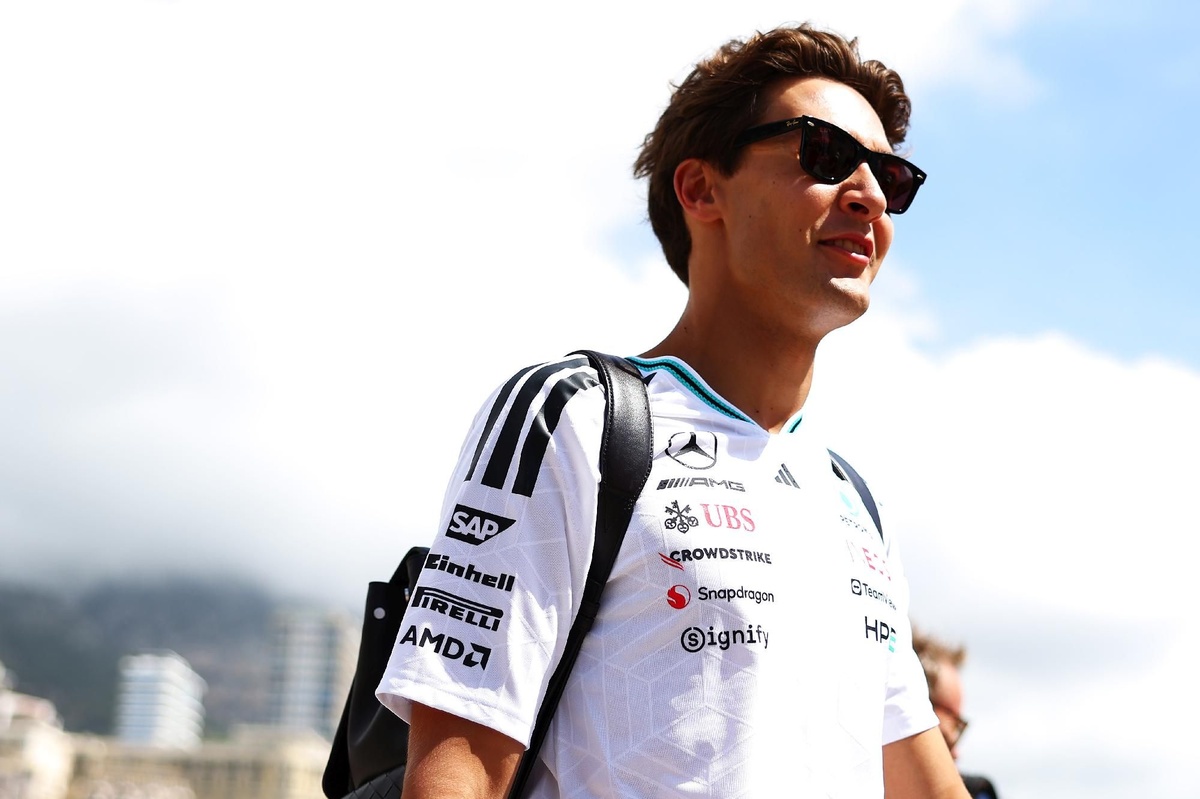
George Russell, Mercedes
Photo by: Darko Bandic / Getty Images
It was the fact he’d done almost everything right throughout his career to arrive at this moment as the established leader of Formula 1’s strongest team. There was no chest-beating from Russell. No claims that the championship was already his. But he could be forgiven for thinking he’d done everything within his power to earn this opportunity.
Everything else – in terms of expectations – mostly came from outside. That’s why it’s too simplistic to describe the opening part of 2026 as Russell’s failure.
His championship campaign didn’t start in Melbourne. It started years ago. It started with the famous PowerPoint presentation in Toto Wolff’s office. With GP3 and Formula 2 titles. With three long seasons helping rebuild Williams before he finally got his Mercedes chance. With more than holding his own alongside the seven-time world champion.
The opening races of 2026 are just another chapter of that story. A challenging one, but far from the first.
Yet for many, a handful of difficult weekends was enough to declare Russell wasn’t capable of leading a title challenge at all – often conveniently ignoring that bad luck genuinely had played a significant role in putting him on the back foot.
Austria doesn’t suddenly change the championship. Russell still trails Antonelli by 40 points. That’s a substantial gap, however long the season still is. And judging by Antonelli’s pace in the closing stages at Spielberg, Russell will have to fight for every single point.
What Austria does change, though, is something else. It serves as a reminder that Russell hasn’t suddenly forgotten how to drive. That’s also something he kept repeating himself over recent weeks. He said it again after qualifying.
Formula 1 has always been a sport where disaster quickly turns into euphoria. But the old saying that you’re only as good as your last race has never been more true than in today’s social media-driven world.

Charles Leclerc, Ferrari, George Russell, Mercedes
Photo by: Max Slovencik / Getty Images
Russell admitted he’d been caught in exactly that cycle.
He admitted he’d started overthinking. Trying harder. Searching for answers that perhaps weren’t there.
“There’s definitely a factor of that,” he’d said on Saturday. “But it’s so difficult, because if you’re on the back foot and you’re off the pace by a tenth or two or three, to then say, ‘I’m going to try less hard,’ it doesn’t compute. You know, when things aren’t going your way, you always want to do more and more and more. And when you’re in the car, to say that, ‘I’m going to approach this corner and I’m going to brake five metres earlier than the lap before,’ that’s just not how our brains work. But sometimes that is the faster way.”
A lot has been said about Russell’s bad luck this season. Austria, though, was also an example of Russell making his own luck.
Without pole on Saturday, there probably wouldn’t have been a victory on Sunday. And Russell’s pole lap was extraordinary not only because of the first two sectors, but perhaps even more so because of how he handled Turn 9.
Russell judged his lift for Verstappen’s yellow flags perfectly – enough to satisfy the stewards, but not enough to cost himself pole position.
It was one of those laps even Russell struggled to explain afterwards. He admitted he’d been several tenths slower than Antonelli at various points during the weekend. Then, almost out of nowhere, everything came together.
Russell gave much of the credit to a radio message from Wolff that sounded almost comically simple.
“George, just drive.”
To television viewers it may have sounded like little more than a routine radio message. For Russell, it was exactly the reminder he needed.
“Toto said to me in Q2, ‘Just enjoy it, just enjoy the drive.’ He said the same ahead of Q3: ‘Just go out and enjoy it’. And I said that to myself, ‘Just don’t overdrive it, just enjoy it,’ because it’s quite a cool thing that we do.”
It worked.
“It’s such a high-pressure environment,” Wolff himself explained on Sunday, “[when] you have a young team-mate and then he’s so strong, you have a DNF, you’re falling behind, and I think like every top athlete, you can kind of get yourself in a spiral. It’s not a spiral of negativity, it’s more a spiral of overthinking. ‘What can I do more?’, ‘Where do I need to optimise?’
“And then sometimes you forget about the co-essence and it’s just driving the car…”

George Russell, Mercedes, Toto Wolff, Mercedes
Photo by: Sam Bagnall / Sutton Images via Getty Images
Perhaps the most important part wasn’t the message itself. It was who it came from.
Social media had long decided Wolff’s attention had shifted entirely towards Antonelli. That Russell had become yesterday’s man. Whether that narrative was ever true is almost irrelevant.
For Russell, making sure everyone heard those words – and saw Wolff’s support – clearly mattered.
Austria ends with Russell still 40 points behind in the championship, but there will now be headlines saying his championship challenge has been revived.
That would be just as premature as writing him off after Monaco and Canada.
Wolff perhaps summed it up best.
“In this sport we tend to swing between mania and depression…” he said on Sunday. “If we would have spoken about George 36 hours ago, we would have said this campaign is really not going and ‘is he ever going to recover?’ Now, Sunday afternoon, he’s the real deal.”
So let’s not swing to the other extreme. Austria doesn’t revive Russell’s title challenge on its own. It simply proves that nothing needed reviving in the first place.
He never forgot how to drive. He’s good enough to win races and beat his team-mate. Now comes the difficult part: making sure the next win doesn’t take another three months.
We want your opinion!
What would you like to see on Motorsport.com?
– The Motorsport.com Team
Disclaimer : This story is auto aggregated by a computer programme and has not been created or edited by DOWNTHENEWS. Publisher: motorsport.com








