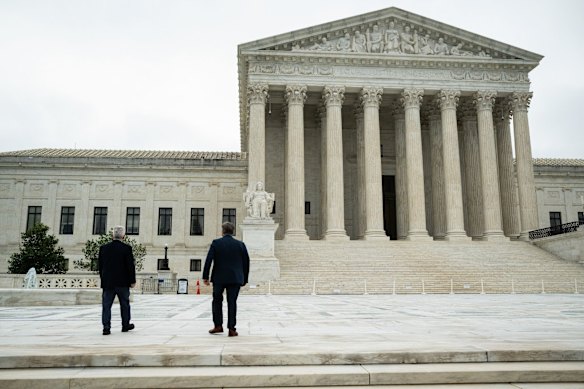

Washington: The US Supreme Court refused to hear Donald Trump’s appeal against a 2023 jury verdict that he sexually abused and defamed writer E. Jean Carroll, while also dramatically expanding the president’s power to fire notionally independent regulators.
In another decision, the nation’s highest court upheld a Mississippi law allowing mail-in ballots to be received and counted five business days after an election – defeating a Republican push to wind back mail-in voting, one of Trump’s preoccupations ahead of the midterm elections.
The slew of rulings issued just before the summer break delivered a mixed bag for Trump, who is still awaiting a verdict on his attempt to end birthright citizenship – a policy that conveys US citizenship upon anyone born on American soil.
Trump was angered by the court’s refusal to review the jury verdict against him in the E. Jean Carroll case. Carroll, a former journalist and advice columnist, successfully sued Trump for sexually abusing her in a department store dressing room in the 1990s.
Trump has always denied the allegations, first made by Carroll in 2019 when he was president. But in 2023, a jury in New York believed her, and also accepted that he defamed Carroll in his denials of her claims.
A separate jury later awarded Carroll $US83.3 million ($121 million) in damages, though Trump is still appealing that decision.
Like Australia’s High Court, the US Supreme Court is not required to review a case, and declined to do so on this occasion. It did not provide reasons.
Trump on Monday (US time) called Carroll’s lawsuit a “fake case”, and said he had never met her, other than in a meet-and-greet line at a party in the 1980s.
“I will continue the fight against this Weaponisation and Lawfare Case against me, including the ridiculous claim of Defamation, with all of my power and strength,” he said.
But in a decision that overturned a century-old law restricting presidential power, the conservative-led court found that Trump had the power to fire Rebecca Slaughter, a commissioner on the Federal Trade Commission – an independent regulatory agency on consumer affairs.
Slaughter was a Democratic appointee sacked by Trump without cause. She and another commissioner were told their service was inconsistent with the Trump administration’s priorities.
In a 6-3 ruling, the court found subordinates who exercised the president’s powers were subject to removal by him – even in agencies that are described as “independent” of executive authority.
“Although it is up to the Senate to decide whether to confirm those with whom the President would prefer to work, neither Congress nor the courts may saddle him with those with whom he cannot work,” the court said.
That decision has significant implications for commissioners at dozens of agencies, and expands presidential power in a way that will outlast Trump’s term.
The three liberal, Democrat-appointed justices on the bench dissented from the ruling. The court under Chief Justice John Roberts is widely described as the most conservative US Supreme Court in 100 years.
But in a separate case, the court prevented Trump from sacking Lisa Cook as a governor of the Federal Reserve – at least for now – saying she should have been given more opportunity to respond to claims against her.
Trump revelled in the Slaughter decision, noting on social media that “90 years of precedent has been COMPLETELY AND UNEQUIVOCALLY OVERRULED”.
That referred to the court throwing out the judgment in Humphrey’s Executor v. United States, a 1935 ruling that restricted the president’s power and enabled Congress to shield people in Slaughter’s position.
“Today’s Historic Slaughter Decision by the Supreme Court is the Greatest Increase in Presidential Power in the last 100 years,” Trump said. “Such a Monumental Ruling at such an important time!”
He indicated he would keep pursuing Cook’s removal from the Federal Reserve, saying the court had only found against him on a technicality.
In a separate opinion also issued on Monday, the court upheld a Mississippi law allowing mail-in ballots to be received up to five business days after an election.
Trump is pressing the US Congress to pass a law, known as the SAVE Act, which would limit mail-in voting to circumstances such as absence, illness or incapacity.
He falsely claims the Democrats used mail-in ballots to rig the 2020 election, which he lost to Joe Biden, and falsely claims postal votes are systematically used to rig elections across the country.
Trump called the court’s decision a “tremendous loss” and used it to pile pressure on the handful of Senate Republicans who are refusing to support the SAVE Act.
Get a note directly from our foreign correspondents on what’s making headlines around the world. Sign up for our weekly What in the World newsletter.
 Michael Koziol is the North America correspondent for The Age and Sydney Morning Herald. He is a former Sydney editor, Sun-Herald deputy editor and a federal political reporter in Canberra.Connect via X or email.
From our partners
Disclaimer : This story is auto aggregated by a computer programme and has not been created or edited by DOWNTHENEWS. Publisher: www.smh.com.au