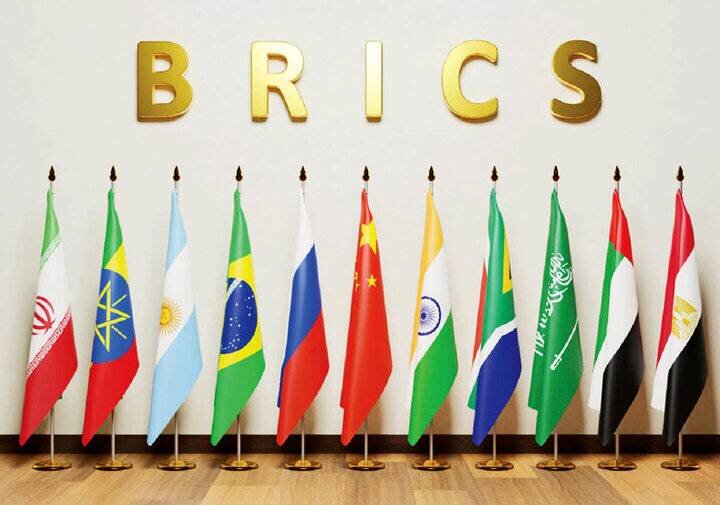
TEHRAN – The Iran National Science Foundation (INSF) and BRICS Science, Technology, and Innovation (STI) Framework will support the implementation of strategic collaborative research projects through joint flagship calls.
Only research projects that involve collaborations among at least four BRICS member states (including Iran) for the flagship joint call will be supported; one of the member states must act as the project coordinator, Mehr news agency reported.
The international collaboration is planned to be carried out with the participation and support of reputable scientific organizations in Brazil, China, Egypt, Iran, Russia, and South Africa.
To develop and implement the projects, the researchers and scholars are required to establish a scientific network among institutions, universities, organizations, and specialists of BRICS member states.
The joint call will be centered on three strategic fields, including BRICS Intelligent Telescope, Digital Earth and Data Network, and Psych-molecular tools. The grant, amounting to 30 billion rials (about 200,000 dollars), will be allocated to each research project for at least three years (with a two-year extension).
The program has a mission-oriented approach, looking for sustainable solutions to address shared global challenges. So, selected projects would lead to fundamental transformations and high impact on science, technology, and community empowerment.
The projects are required to be interdisciplinary and will be supervised by prominent professors of member states. The ultimate goal is to establish integrity in the value chain and propose technological solutions that possess the potential for long-term growth.
Besides the flagship call, the two organizations announced support for the implementation of the research projects that involve the collaboration of at least three BRICS member states for a regular joint call in April.
The regular joint call focused on the following fields:
1. Water Resources
Monitoring and Data for Water Systems
Water Treatment, Reuse, and Resource Circularity
Resilience to Water Hazards and Extreme Events through Data-Driven Approaches
High Performance Computing and Artificial Intelligence
High Performance Computing and AI Infrastructure Co-Design
Artificial Intelligence and Large Language Models
Quantum Computing, Sensing, and Secure Information Technologies
2. Energy
Solar Energy Technologies and Applications
Integrated Smart and Renewable Energy Systems for Resilient Power Networks
Low-Carbon Energy Pathways, Sector Coupling, and Energy Efficiency
3. Health, Biotechnology and Biomedicine
Advanced Biotechnology, Genomics, and AI-Assisted Discovery
Personalized Medicine, Diagnostics, and Cell-Based Therapies
Digital Health, Telemedicine, and AI-Enabled Healthcare Systems
4. Food
Climate-Resilient Crops and Advanced Plant Biotechnology
Digital and Precision Agriculture for Sustainable Production
Sustainable Fisheries, Aquaculture, and Food Quality Monitoring
5. Materials Science
Advanced Functional and Smart Materials
Materials for Energy Conversion, Storage, and Sustainability
Advanced Functional Materials: Nanomaterials, Biomaterials, and Resilient Systems
MT/MG
Disclaimer : This story is auto aggregated by a computer programme and has not been created or edited by DOWNTHENEWS. Publisher: tehrantimes.com