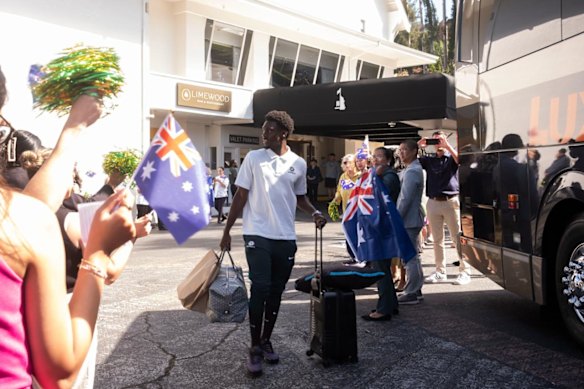

San Francisco: For the past month, the Socceroos have called the Bay Area home, and it has genuinely felt like one. From their FIFA-assigned base camp in northern California, they have trained on the same pitches, slept in the same beds and flown to their World Cup matches before returning to the comfort of what had become familiar surroundings, and a community who embraced them as their own.
On Tuesday, they said their goodbyes and flew to Dallas, knowing there would be no coming back.
With a change of scenery comes a change of mindset. From here on out, as Jordan Bos puts it: “It’s eat or be eaten.”
And he’s not talking about Texas barbecue. The only chance team dietician Julie Meek will allow them to indulge in any southern hospitality, Bos reckons, is if they beat Egypt and become the first Australian side to win a knockout match at a men’s World Cup. And even then, it’d probably be only “a little nibble”.
After conducting their final training session at the Oakland Roots facility in Alameda, which has provided coach Tony Popovic and his players with a secluded base from which to build their campaign, they returned to their hotel to pack up.
As they boarded an airport-bound bus the next morning at the Claremont Resort & Club in Berkeley, all players, coaches and staff walked through a guard of honour formed by mostly hotel employees and other guests, who waved green and gold pom poms and Aussie flags as Men At Work’s Down Under, the unofficial anthem of the Socceroos, blared in the background.
The Claremont, a grand old resort built in 1915 which is perched over San Francisco Bay, will quickly revert to being just another luxury hotel. The green and gold livery and inspirational images of great Socceroos moments that have been plastered on the walls will come down.
During the World Cup’s group stage, every team is assigned a base camp where it lives, trains and prepares, flying to host cities for matches before returning. But once the knockouts begin, that system disappears; the bracket sends them from city to city, and they stay wherever FIFA sends them until they’re eliminated, or lift the trophy.
“Change is sometimes good,” midfielder Ajdin Hrustic said.
“We did enjoy our time here. But I’m hoping this change gives us a little bit of a boost, positive energy. We’ll see what Dallas will bring. I’ll see the hotel and the training pitch. I think that’s about it.”
Dallas will not feel like home in the same way. They won’t be there long enough to feel that way, no matter what happens. Plus, the weather will be a huge change from what the Socceroos have been used to; they lucked out with a draw that kept them, until now, on the west coast, where temperatures have remained in the early-to-mid 20s, but it’ll be at least 35 degrees each day they’re in Texas.
Fortunately, AT&T Stadium – the lavish home of the Dallas Cowboys – is indoors and air-conditioned. Hrustic rates it a 10-out-of-10 facility from afar, and can’t wait to check it out.
“We’re buzzing,” he said.
But the biggest change for the Socceroos won’t be the conditions, the stadium or the unfamiliar surroundings. It will be the stakes; they have risen dramatically.
This is only the third time Australia have reached the knockout stage of a men’s World Cup, and they’ve never taken the next step. They may never get a better chance than this, their first run in the new round of 32.
Egypt, whose captain Mohamed Salah remains under an injury cloud, present a far more manageable assignment on paper than Italy in 2006, or Argentina four years ago, both teams that went on to become world champions.
If Salah plays, Bos said Socceroos players would show the former Liverpool star and his teammates all the respect they deserve – until kick-off, at least.
“He’s been at the top for a very long time. We’ll definitely have to look at how we can stop him, and Egypt. We’ve already done a little bit about that,” Bos said.
“On the field, there’s no respect. It’s just eat or be eaten. That’s how everyone’s going to go in the game, and that’s how I will go in the game.”
This is new territory for the Pharaohs, too. Their 3-1 win over New Zealand was their first – and so far, only – victory at a World Cup.
At full-time, one of these two nations will have broken new ground, and the other will be going home.
“It’s just that extra bit of something that if you lose, you’re out,” said Bos.
“In the group stages, if you lose the game or if you didn’t win, then you still have another chance – but for the knockouts, there’s no second chances. It’s [about] going to this game like there is no tomorrow, because if we lose, there is no tomorrow. It’s just flicking that switch.”
By the time the Socceroos take the pitch on Saturday (4am AEST), it will have been eight days since their last match, the 0-0 draw with Paraguay which clinched second position in Group D.
Paraguay’s stunning upset of Germany has only reinforced Australia’s belief that their scoreless draw to clinch second place in Group D was a stronger result than many gave them credit for.
Having watched a fair few upsets unfold already at this World Cup, Hrustic sees no reason why Australia can’t go further than they ever have before.
“Most likely it will happen one day, and it can be us,” he said.
“If you have your day on that day, you go further. You’ve got to create it. You’ve got to make it happen. It’s not going to get gifted to you. We’re definitely going to fight for it, and we’ll work and prepare the best we can.”
Get across our World Cup coverage
From our partners
Disclaimer : This story is auto aggregated by a computer programme and has not been created or edited by DOWNTHENEWS. Publisher: www.smh.com.au