
Creatives are demanding fresh assurances from the Albanese government that it won’t water down copyright laws under a potential deal with tech giants to attract more than $50bn worth of datacentre investment in exchange for a $350m-a-year fund for artists.
Guardian Australia has been told an industry proposal has been presented to cabinet that would grant AI companies special exemptions to mine creative content.
In exchange, the companies would bankroll the artists’ fund and commit more than $50bn worth of investment in datacentres.
The independent senator David Pocock said the proposal was the “ultimate dirty deal” as he demanded the government categorically rule it out.
The government insisted it had no plans to weaken copyright protections.
The potential adoption of a text and data mining exemption would represent a major reversal from the federal government, which last year ruled it out after criticism from artists, authors and media groups.
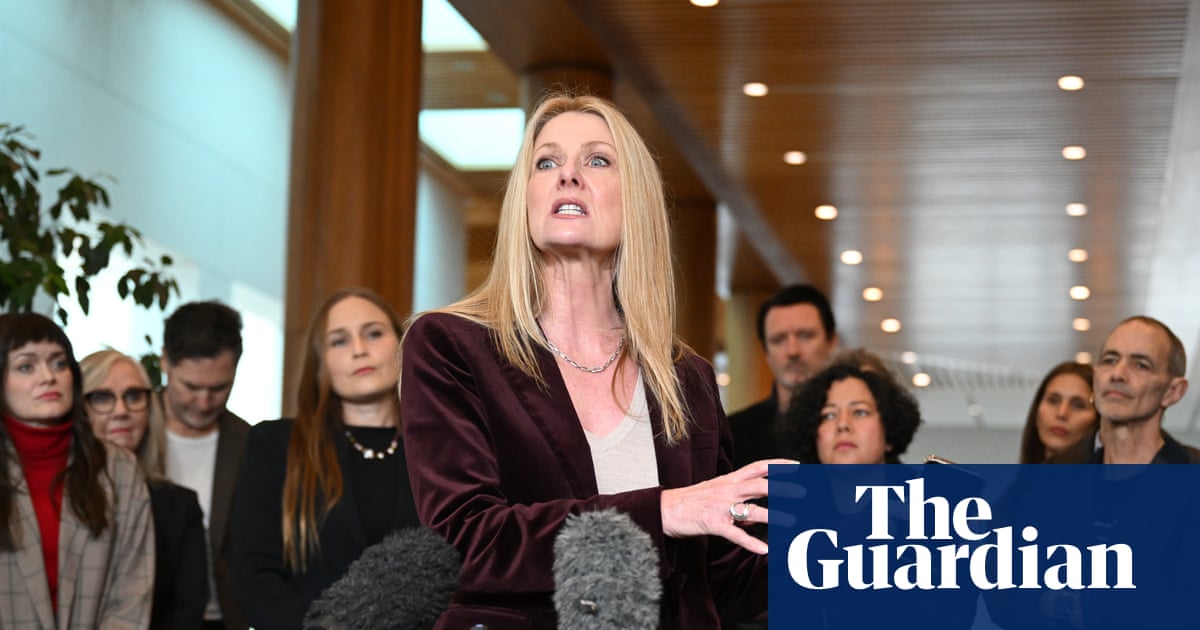
Amid fears the government could capitulate to big tech, a delegation of creatives staged a press conference in parliament house on Wednesday to urge the government to hold the line.
“The idea that copyright law should be watered down or chiselled away at to provide a freebie or a handout to gigantic multinational, multi-billion dollar companies to train their AI models makes absolutely no sense to me,” said Paul Dempsey, the lead of singer of Something for Kate.
“I simply don’t get it.”
The author Anna Funder described herself as a “victim of crime”, citing the ease with which big technology had made money from her books.
“My books that I’ve lived off for 30 years, have all been hoovered up in many editions, in many countries, in many languages by big tech, broken down for parts and used for them to make money,” she said.
Pocock last week revealed he had been provided with information showing Anthony Albanese was preparing to announce a plan on or about 15 July, which may offer expedited approvals and investment for new datacentres.
Albanese confirmed last week he would deliver a major speech in July about the government’s approach on AI. He met with representatives of Anthropic last week.
Guardian Australia has been told competing cabinet submissions about the plan are in train, with the Department of Industry, Science and Resources and the Attorney-General’s Department split over the best approach.
The second option involves a possible licensing extension to cover AI model developments.
The former industry minister Ed Husic had argued for new AI guardrails and consideration of major new laws, but he was dumped from cabinet in 2025. Tim Ayres, his successor in the portfolio, is in favour of a lighter touch approach.
The government rejected Pocock’s claims as inaccurate and insisted its position on a text and data mining exemption had not changed.
But Pocock was adamant the information was correct.
“What cabinet is considering is the ultimate dirty deal, selling out Australian musicians, writers, authors and other creatives in return for an eye-wateringly large investment in AI data centres, which, as we know, are currently wildly unregulated in this country,” he said in a speech to parliament on Wednesday.
“The government has criticised me a lot, but has not denied it, because it is true. The government needs to get up in this place and categorically rule out any carve-out, any exemption, any watering down of copyright exemptions now and into the future.
“To sell out Australian creatives would be a reckless act.”
In a statement to Guardian Australia on Wednesday, a spokesperson for the attorney general, Michelle Rowland, said the government had “repeatedly said that there are no plans to weaken copyright protections when it comes to AI”.
“We are committed to ensuring that Australia has a fit-for-purpose copyright framework that protects and supports Australia’s creative and media industries while unlocking AI innovation,” the spokesperson said.
The government is encouraging the tech giants and creatives to work together to negotiate deals to “support innovation while ensuring creators are compensated”.
The musician Holly Rankin, whose stage name is Jack River, said artists were prepared to make deals.
“To the government we say, ‘don’t back down, do not sign our rights away’, and to big tech we say ‘ask us, get permission, pay us, we are here ready to do deals with you’,” she said.
Guardian Australia is among the media companies supporting the campaign to safeguard copyright laws.
Disclaimer : This story is auto aggregated by a computer programme and has not been created or edited by DOWNTHENEWS. Publisher: theguardian.com








