
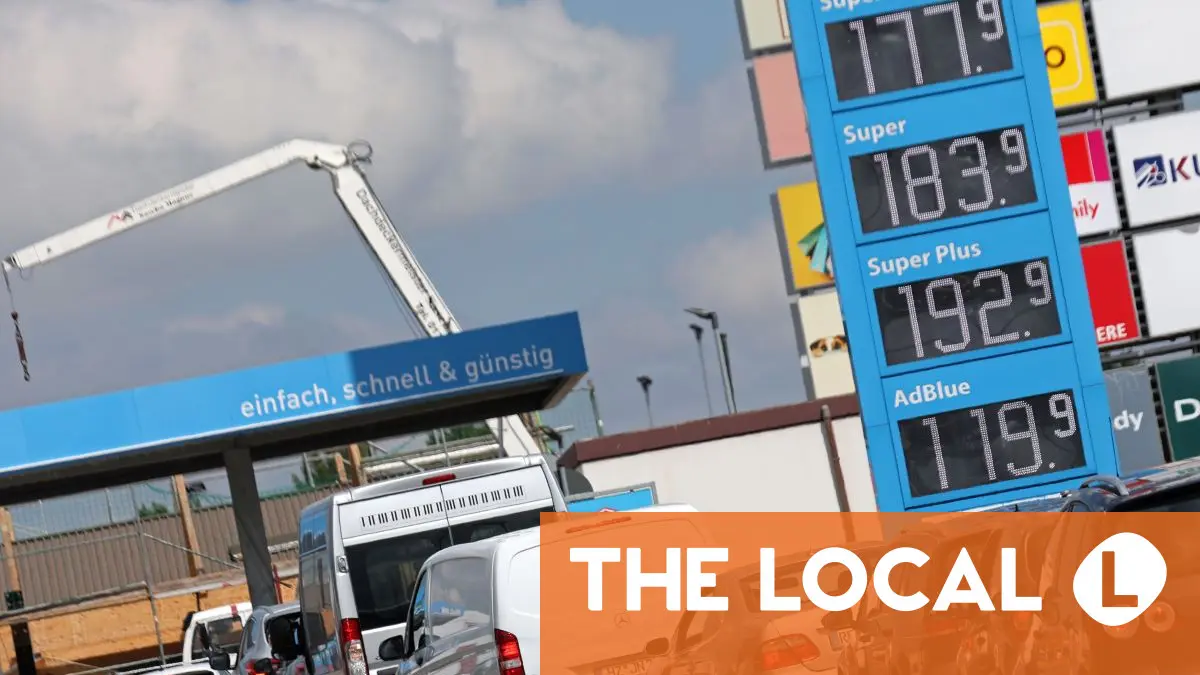
Drivers across Germany woke up to higher fuel costs after the tank discount ended this week. Prices jumped quickly, and earlier than many expected.
Fuel prices across Germany have risen sharply since the ‘fuel discount’ (Tankrabatt) scheme came to an end at midnight on Wednesday.
By Wednesday morning, drivers were already paying significantly more, and the increases continued through the day.
The scheme – introduced on May 1st to ease the burden of high energy costs during the Iran war – cut fuel taxes for two months.
Now that it has expired, many motorists may be wondering what to expect on their next visit to the petrol station.
How much have prices risen?
The short answer is: quite a lot, and very quickly.
According to ADAC figures, petrol prices jumped by around 13 to 18 cents per litre almost overnight, with diesel rising even more steeply by roughly 15 to 20 cents.
The cut in taxes amounted to about 17 cents per litre.
READ ALSO: Thousands of gas stations in Germany flout fuel pricing rule
By Wednesday afternoon, average prices stood at about €2.15 for Super E10 and €2.11 for diesel. On Thursday morning, prices remained elevated with averages still well above last week’s levels.
For context, before the Iran war earlier this year drivers were paying around €1.83 per litre for petrol and €1.75 for diesel.
Did the price increases begin too soon?
The ADAC, Germany’s largest motoring organisation, says that many petrol stations effectively increased prices too early.
Because of the ’12 o’clock rule’ – which allows stations to raise prices only once per day, at midday – operators appear to have kept prices artificially high the day before the discount ended, instead of lowering them as they normally would.
In practice, this meant drivers were already feeling the impact of the rebate’s end before it officially expired at midnight. The ADAC also points out that, in many cases, fuel stored at stations had still been purchased at the reduced tax rate, raising further questions about the timing of the increases.
What happens next?
Prices have already risen sharply – in many cases by roughly the full value of the expired tax cut (of around 17 cents per litre).
According to MDR, researches warn that further increases are still possible and will depend mainly on developments in global oil markets, which remain volatile due to geopolitical tensions.
No new government measures are currently planned, but there are still a few practical ways in which drivers can save money.
The ADAC recommends filling up just before noon, when prices tend to be lower under the current pricing rules. Using price comparison apps can also help locate cheaper stations nearby.
READ ALSO: Three apps to help drivers in Germany find the cheapest fuel
Was the fuel discount a success?
Following the US and Israeli attack on Iran, the Tankrabatt was introduced to cushion the impact of sharply rising energy prices – for consumers.
According to the Ifo Institute, the discount was was in fact passed on to consumers almost entirely for petrol, but only partially for diesel, where a noticeable share appears to have been absorbed by oil companies.
READ ALSO: ANALYSIS – Is the cost of living coming down in Germany?
The measure also appears to have had some positive effects more generally. Data shows that June was the cheapest month for fuel since the war began, and wider economic reporting indicates the tax cut may have helped to slow inflation during the period.
On the other hand, the fuel discount mainly benefited drivers – especially those with larger, less efficient cars – while people who don’t drive saw little direct support. Some critics argue the move also sent the wrong signal from an environmental perspective.
Disclaimer : This story is auto aggregated by a computer programme and has not been created or edited by DOWNTHENEWS. Publisher: thelocal.de





