On a humid morning in Kolkata, a group of workers bends over a patch of freshly dug earth, carefully pressing saplings into the soil. Standing among them is 26-year-old Manav Sony — sleeves rolled up, hands muddy, checking whether each plant has enough space to grow.
Around him, the land is still rough and unfinished. But Manav smiles easily as he walks across the site, greeting workers by name and explaining how this once-barren stretch will soon become a dense green patch using the Miyawaki method of afforestation.
“A lot of people think social work is only about charity,” he says.
“But for me, it is about solving problems in a smart and practical way. If we can create impact and dignity together, why shouldn’t young people choose this path?”
Just two years ago, Manav’s life looked very different. Fresh out of law school, he was building a career as a corporate lawyer in Kolkata’s real estate sector — the kind of stable, respectable path many young professionals spend years chasing.
Today, he leads Funsmart Knowledge Solution Foundation, a grassroots organisation working across education, environment, waste management, women’s health, and disability inclusion.
What started as a one-person initiative in 2024 now operates across 35 cities with over 400 volunteers.
But the journey from corporate law to community work was far from easy.
The moment that changed everything
Born and raised in Kolkata, Manav says he had always been drawn towards social impact work. During school, he was part of environmental clubs and frequently volunteered in community initiatives. Still, practicality won when it came time to choose a profession.
After completing his BBA and LLB, he joined Kolkata’s real estate sector as a corporate lawyer. The work was stable, well-paying, and secure — everything a young graduate is expected to want.
Yet even while working long corporate hours, weekends pulled him elsewhere.
He spent his free time teaching children in government schools, organising food distribution drives with friends, and trying to sponsor the education of underprivileged students.
One experience, however, stayed with him.
A young girl whose education he had tried to support finally secured admission to a good school. When her family called him to share the news, their relief and gratitude deeply affected him.
“That moment kept repeating in my mind,” he recalls. “I started asking myself — if helping even one person can create this much change, then why am I limiting myself?”
Soon after, he registered Funsmart Knowledge Solution Foundation.
The name itself reflected the kind of organisation he wanted to build. Manav says he deliberately avoided choosing a typical NGO name because he wanted the foundation to feel young, creative, and solution-oriented.
“Funsmart,” he explains, “comes from the idea that people can think in fun, innovative ways while still creating smart solutions for real-world problems. And ‘Knowledge Solution’ is about using ideas and awareness to solve challenges in society.”
At first, he continued balancing both worlds — attending office during the week and building the NGO after hours. But things slowly began shifting. Through his legal work, he developed networks with municipal bodies and government officials, learning how large projects are planned and executed.
In 2025, after pitching his early work to a municipal corporation official, the organisation received its first small funding support.
A month later, Manav resigned from his corporate job.
Starting small, learning along the way
The decision came with uncertainty.
Manav had no large investors, no family business backing the NGO, and no guarantee that the organisation would survive financially. There were months with barely any projects, operational setbacks, and times when expenses exceeded budgets.
At one point, the stress became so overwhelming that he fell ill while working from a co-working space he could barely afford.
“I had not even told my parents that I had left my job,” he says quietly. “They found out only after I became sick.”
Eventually, his family stepped in to help him stabilise the organisation in its earliest phase. Slowly, donors and partnerships followed.
Looking back now, Manav says the biggest lesson was realising that passion alone is never enough. Building a social organisation, he explains, requires clarity, patience, and systems — much like building any other long-term venture.
For young people hoping to start something similar, his advice is surprisingly practical.
The first step, he says, is understanding where your heart genuinely lies.
“A lot of people say they want to do social work, but you first need to identify your area,” he explains.
“Is it environment, education, women’s welfare, healthcare? You cannot solve everything together.”
For him, the answer was clear from the beginning: environment and education.
The second step, he believes, is learning from people already working in the field. Before formally registering the NGO, Manav spent time speaking to experienced founders, understanding their struggles, funding challenges, and team-building processes.
“That gave me a roadmap,” he says. “Experience from others saves you from making avoidable mistakes.”
Then came the formal work — finding the right name, completing registrations, and understanding the legal and financial structure required to run a non-profit.
But according to Manav, the most important decision came after that: building the right team.
To find people aligned with the organisation’s values, he posted openings on LinkedIn, conducted written assessments and face-to-face interviews, and looked beyond qualifications.
“We wanted people who were emotionally connected to the work, not just looking for a salary,” he explains.
Once the team was formed, they began studying the real challenges facing West Bengal — from waste mismanagement and environmental degradation to gaps in education and sanitation.
Instead of working independently, they approached local governments, corporations, and grassroots organisations to collaborate.
/filters:format(webp)/english-betterindia/media/media_files/2026/06/23/funsmart-knowledge-solutions-2026-06-23-18-49-50.png)
That hyper-local approach slowly became Funsmart’s biggest strength.
Today, the organisation works across multiple verticals — from tree plantation and waste management to school infrastructure, sanitary hygiene awareness, disability support, and women’s empowerment.
The organisation has completed over 50 projects and reached more than 3.8 lakh people.
Building forests and livelihoods
One of Funsmart’s earliest large-scale projects involved planting over 4,000 trees through the Miyawaki method in collaboration with corporate partners.
For a team of just three people at the time, the scale felt intimidating.
“We were honestly shocked when we got the project,” Manav shares with a laugh. “There was paperwork, land identification, and maintenance planning.”
The plantation site was located nearly 755 kilometres away from Kolkata. Yet what stood out most to the team was the unexpected support they received from local municipal workers and communities.
The project eventually created livelihood opportunities for around 30 underprivileged individuals who now maintain the plantation site, water saplings, and sell fruits grown from the trees.
For 48-year-old Dinesh Mohanti, that opportunity became life-changing.
Before joining the project, Dinesh worked as a school gardener with a very limited income while trying to support his three children’s education.
“The salary was too low, and managing household expenses was difficult,” he says.
Through Funsmart’s plantation initiative, Dinesh began maintaining planted saplings and earning a better income.
/filters:format(webp)/english-betterindia/media/media_files/2026/06/23/funsmart-knowledge-solutions-2026-06-23-18-50-49.png)
But the work gave him something else too: dignity.
“In society, people often do not respect work like ours,” he explains. “But for the first time, someone valued what I do. That made me feel respected.”
Turning festivals into climate action
While tree plantations became one pillar of the organisation, another ambitious initiative emerged during Kolkata’s Durga Puja celebrations.
Led by 21-year-old team member Debayan Bhattashali, the campaign focused on tackling plastic waste generated during the festival season.
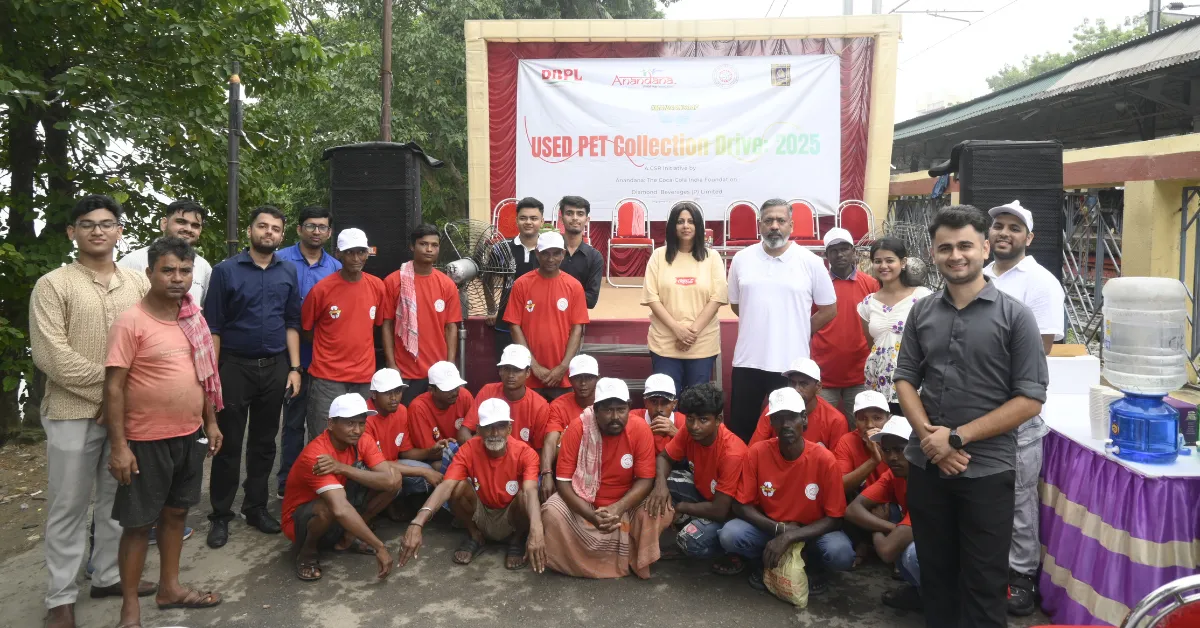
Over six days, the organisation collected more than 12 tonnes of plastic waste through kiosks installed near pandals across the city.
The waste was later recycled into furniture for children.
But Debayan says the biggest challenge was not logistics — it was changing public behaviour.
“Even when bins were placed right beside people, many still threw plastic on the roads,” he says. “We realised how deeply civic habits need to change.”
The campaign required round-the-clock volunteer coordination, transportation management, and continuous awareness drives during one of the busiest public festivals in the city.
For Debayan, who studies sociology at Jadavpur University, the experience reshaped his understanding of inequality and grassroots work.
“Once you actually speak to communities and work on the ground, you realise how many people still need support and opportunities,” he says.
Beyond charity, towards confidence
Alongside environmental work, the organisation also focuses heavily on education and youth development.
Nineteen-year-old Anjani Singh first encountered Funsmart during a resume-building and career guidance session at her college.
/filters:format(webp)/english-betterindia/media/media_files/2026/06/23/funsmart-knowledge-solutions-2026-06-23-18-52-03.png)
Coming from a lower middle-class family in Dhanbad, Anjani often worried whether financial difficulties would force her to discontinue her education.
The organisation later supported part of her college fees and connected her with skill-building workshops focused on communication, career readiness, and financial literacy.
“Before this, most of my energy went into worrying about money,” she says. “Now I can focus on improving myself and planning for my future.”
More than financial help, she says what stayed with her was the organisation’s approach.
“They listened without judging me,” she explains. “That gave me confidence.”
Why young Indians are choosing purpose
For Manav, Funsmart’s growth reflects something larger than one organisation’s success.
He believes many young Indians are beginning to question conventional definitions of success and searching for more meaningful work.
At the same time, he is honest about the emotional realities of the sector.
“There are months with no funding, projects that fail, team conflicts, and constant uncertainty,” he says. “But if your purpose is clear, you keep moving.”
He also hopes stories like his can encourage more young people to enter the social impact space without shame or hesitation.
/filters:format(webp)/english-betterindia/media/media_files/2026/06/23/funsmart-knowledge-solutions-2026-06-23-18-52-50.png)
“A lot of people still misunderstand NGO work,” he says. “But social work is not a weakness. It is leadership, problem-solving, and community building.”
As the sun begins setting over the plantation site, workers gather their tools while rows of young saplings sway gently in the evening breeze.
For now, they are still small, but with enough care, patience, and people willing to nurture them, they will grow into something much larger, like the movement Manav and his team are trying to build, one community at a time.
All images courtesy Manav Sony
Disclaimer : This story is auto aggregated by a computer programme and has not been created or edited by DOWNTHENEWS. Publisher: thebetterindia.com