French-moroccan Lawyer and Gallerist Amal Rakibi discovered that true harmony lies in not choosing between two worlds, but in embracing them both.
There is a version of Amal Rakibi who walks into a boardroom in Houston or Abu Dhabi, sharp-eyed, ready to close a multibilliondollar merger surrounded by men the energy sector. As a chief legal officer working in the high-pressure world of petrochemicals it is her job to be the one with the solution. And there is another Amal Rakibi. The one who opens the doors of her home in Dubai, hung with vintage finds and contemporary canvases, and welcomes collectors in for dinners and convivial conversations. For years, she assumed these were two women fighting for one life. It took her years to realise they were never meant to be separated at all. “I started as a lawyer and I love being a lawyer,” Rakibi says with assurance. “I love the complexity of the thought process. I love to solve problems. I love to be part of something that is bigger than what most people can imagine.” She has recently closed a 60-billion-dollar M&A deal – exhilarating, high-stakes. But it is also, by her own description, “not creative at all.” “I have always worked in oil and gas, petrochemicals,” she explains, “I like to be a female in these highly powerful, male dominated environments, but I need some glam in my life. I need some creativity in my life.” That need is what prompted her to start her own art gallery in 2018, which she first cleverly called Amalgame (a French word that roughly translates to “a mixture of different things”). It initially came into being when Rakibi was working in Texas, and now it lives inside her expansive Dubai home. The original name, the gallerist confesses, came about “because I arrived in the art world out of the blue, where I had no legitimacy.”
She kept her own name off it deliberately at the beginning, to keep her two worlds from touching. “I wanted to disconnect them from each other. I wanted to make sure that people in law firms, or in the law environment, didn’t know what I was doing in my private life.” In point of fact, the gallery was a bit of a happy accident. After moving to Texas for work Rakibi found herself in an empty house with bare walls. But then a friend’s offhand suggestion – instead of buying furniture, buy art – changed everything. Rakibi followed that bit of advice and gradually started collecting, and her choices began to get noticed. “People started to tell me, ‘oh, you have an eye that’s really unique,’” she says. Her husband, the entrepreneur of the family, pushed her to formalise it into a gallery – but she nearly talked herself out of it before she’d begun. “Who am I to even start doing this? I’m an impostor, I cannot,” she remembers thinking. It was her husband’s blunt reframing that got her moving: “What’s gonna happen if you fail? You fail. But at least you tried it.” In the end, what Rakibi decided to build was unlike any conventional gallery she had known, and she has taken plenty of criticism for her choice. “I even had some galleries telling artists who I was working with that if they continued to work with me that they would stop representing them, all because they didn’t want to be connected to something that wasn’t, in their minds, a real gallery,” she recounts. But over the years Rakibi has made peace with the label.
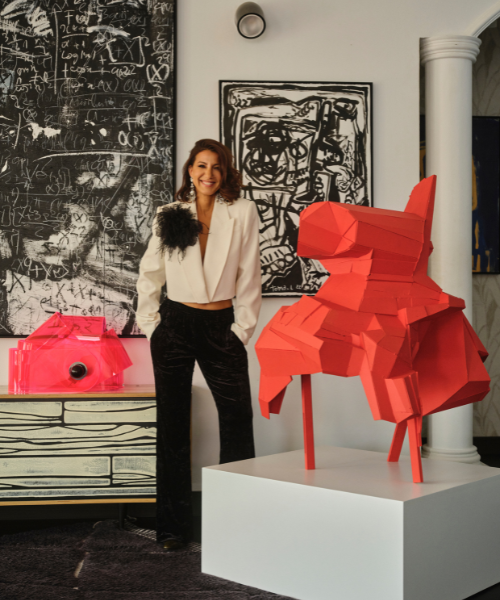
Now known as the Amal Rakibi Gallery, its very existence inside her home makes it instantly feel special and different. Clients come to her villa, have dinner, and experience the art displayed in situ all over her house. The pieces become a part of a living and breathing environment, rather than the typical sterile white-walled world of a more traditional art gallery. “I believe so much in this concept where people want an experience more than just a transactional deal,” Rakibi says, noting that collectors are increasingly coming to her not just to buy art, but to help them create a life around it. She is so committed to this vision that she often lets clients take works home for weeks, even months, to be sure they can live with the art. “I call it the puppy dog clause,” she says. “Nobody ever gives a puppy dog back once they have taken it home,” she explains with a smile. When Rakibi first arrived in Dubai she says the art requests she fielded from clients were purely decorative. “I literally had people sending me a picture of a green couch and saying find me a painting that is green to match it.” But over the past six years she has watched the nation’s relationship to art mature as its international creative community continues to flourish. “Now there is a lot of creativity, a lot of designers, a lot of people that really want to create something that is not, you know, a hotel lobby.” The gallerist has also noticed a real regional pride taking hold among her collectors, many of whom now actively seek out artists from the Middle East and North Africa rather than simply chasing prestige names from the west or Asia. That sense of pride also eventually caught up with her own self-concealment.
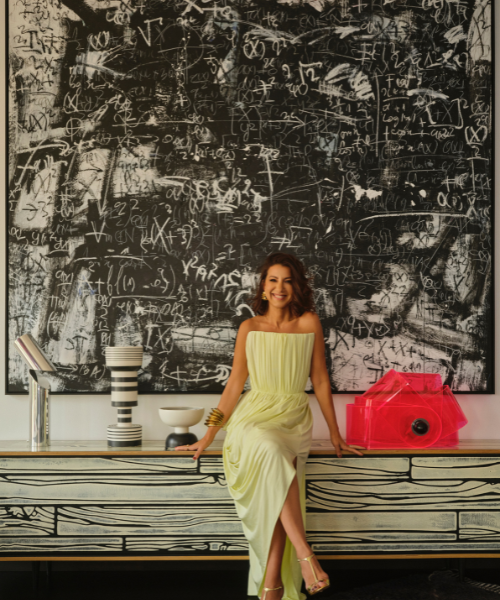
A colleague searching for her name in Arabic for a company communication stumbled across her other life. “She was like, oh my god, Amal, you are a creative,” Rakibi recalls. But rather than feeling exposed, she felt something like a sense of relief. “Since I did my “coming out,” I feel very, very peaceful. Finally I am openly claiming the two sides of my personality, and I no longer worry about what anyone thinks.” There is one painting, Rakibi says, that holds the whole story of finding this new balance in her life in a single frame – a black-and-white work by the Colombian artist Santiago Parra, that is hung in her dining room. She bought it the year she walked away from a job she had held for 15 years at a oil and gas company. A job and a culture she describes as having been “married to.” “I made the decision to take a risk and resign, to accept a job outside of my comfort zone, and for me this painting represents freedom.” The purchase of that work marked the moment Rakibi chose her own direction over the safe one. “When I look at this painting, it reminds me about how I bet on myself. It was the hardest decision and the best decision of my life.” This one piece of art became the physical embodiment of Rakibi believing in herself and the importance of following your inner voice. That instinct – to walk away from the obvious win when it doesn’t actually serve her – has only sharpened with time. Not long ago, Rakibi was offered the kind of job most lawyers spend a career chasing: senior vice president of a newly merged 60-billion-dollar company. She turned it down. “I feel so happy now. I love my life here. I love the gallery and watching how it continues to grow,” she says. “If I took that job I would be breaking all the momentum I have created and would have to go back to square one.”
When her employer pushed back, asking why she’d refuse such an opportunity, her answer was simple: “Because it doesn’t make me happy.” She is unequivocal about what that decision says about her values now. “Harmony is not necessarily taking the obvious choice,” she reflects. “It’s picking the one that makes sense for you at that moment.” Rakibi traces this clarity she has found in her life to being in her forties, and to loss – a close friend who died young, and recently her mother. “It was a bit of a wake-up call that life might not last for as long as I plan,” she states. So now she is intentional about where she spends her energy and who she spends it with. “Every day should be a day that makes you happy.” It is, in the end, the same lesson her two careers have been teaching her in tandem – that harmony was never about resolving the contradiction between the lawyer and the gallerist. “I think I will never be able to separate the two,” she says, “because they are two parts of my own identity.” Today Rakibi no longer feels the need to choose because, as she so eloquently puts it, “Why should anyone be defined by one thing?”
– For more on luxury lifestyle, news, fashion and beauty, follow Emirates Woman on Facebook and Instagram
Images: Supplied
Disclaimer : This story is auto aggregated by a computer programme and has not been created or edited by DOWNTHENEWS. Publisher: emirateswoman.com