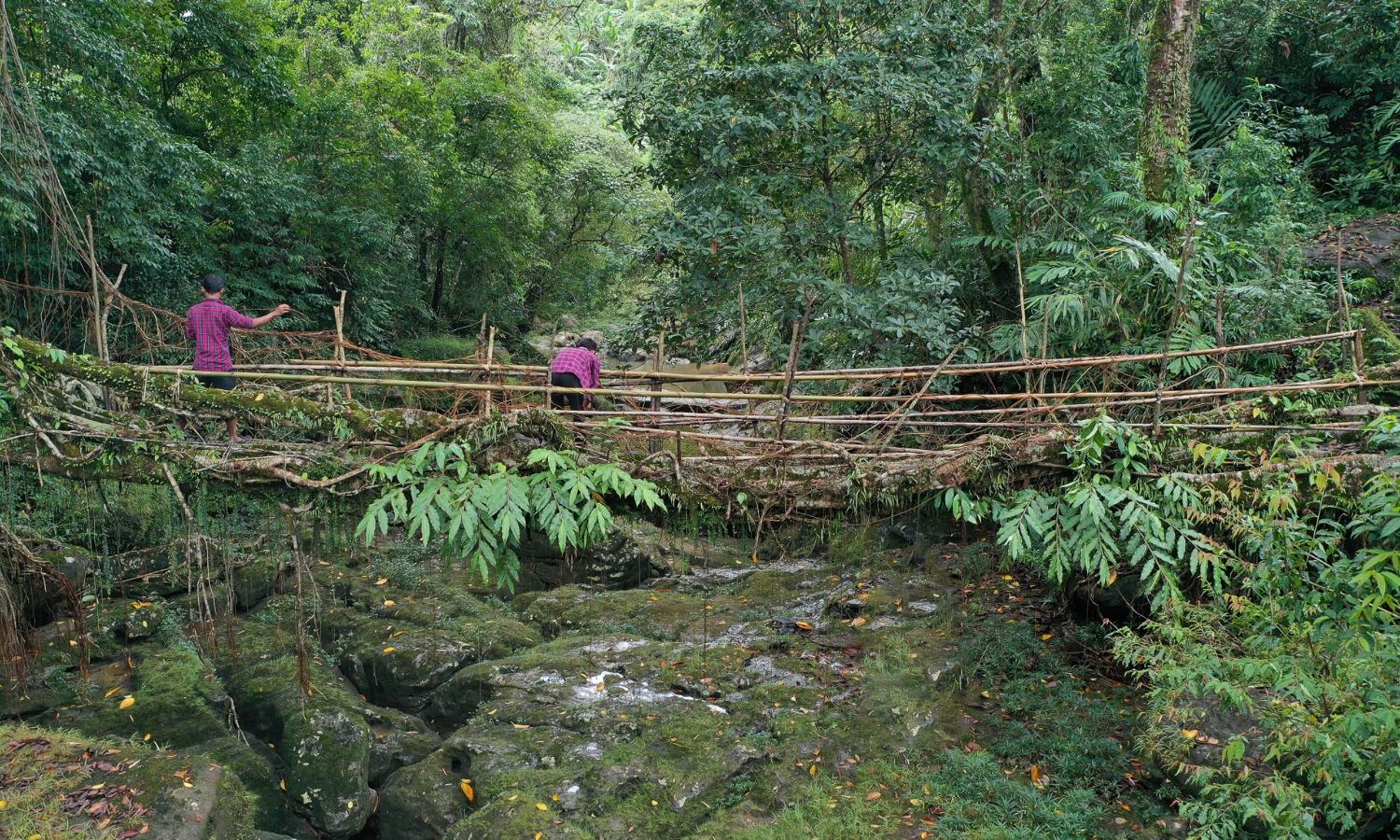
Prime Minister Narendra Modi’s recent reference to Meghalaya’s Living Root Bridges in Mann Ki Baat has renewed interest in a conservation model built around India’s commons: shared natural resources such as forests, rivers and grazing lands that communities manage collectively rather than as private or state property.
In the Jingkieng Jri / Lyu Chrai Cultural Landscape of the southern Khasi and Jaintia Hills, Living Root Bridges made from the aerial roots of Ficus elastica trees have carried communities across rivers for generations. Rooted in the Khasi belief that humans are caretakers rather than owners of the land, each bridge takes decades to mature and survives only through continuous community care, making it as much a climate adaptation tool as a heritage structure.
Forty-six community cooperatives across more than 74 villages have organised under the Syrwet U Barim Mariang Jingkieng Jri Cooperative Federation Ltd to steward this landscape collectively. Their work spans forests, rivers, sacred groves and traditional footpaths, and today the landscape is home to more than 120 Living Root Bridges that together buffer the region against the erratic rainfall and landslides increasingly linked to a warming climate.
What sets Meghalaya apart is how the state has approached this commons. Through the Meghalaya Basin Development Authority (MBDA), government agencies have chosen to strengthen existing community institutions rather than replace them, backing local leadership and traditional governance instead of imposing new structures. The partnership has helped establish 26 Iing Mariang (Nature Homes) and a Centre for Learning at Shlem Jingtip, alongside 25 nurseries for native species and restored forest trails.
“The Ficus tree teaches us that strength comes through embrace, not possession. As its roots reach out to support one another, so too do our communities come together as caretakers of Mother Earth,” says Pren Khongbri, a member of the Federation.
Highlighting the government’s approach, Wankit K Swer, General Manager, MBDA/Meghalaya Basin Management Agency (MBMA), said: “MBDA’s role has been to strengthen these efforts by supporting community-led initiatives. Our commitment is to work alongside communities as equal partners, ensuring that conservation continues to be led by the people who know and care for this landscape the best.”
The collaboration has also underpinned a UNESCO World Heritage nomination for the landscape. As India looks for scalable climate resilience models, Meghalaya’s commons-based governance, anchored in community stewardship and backed rather than supplanted by the state, offers a template worth studying.
Disclaimer : This story is auto aggregated by a computer programme and has not been created or edited by DOWNTHENEWS. Publisher: deccanchronicle.com