

Mersad Smajic, a St Louis, Missouri, real estate investor and restaurant owner, has been thrilled to see fellow Bosnian immigrants thrive in their new home, which has been especially evident during the World Cup.
The midwestern city has about 70,000 Bosnians, most of whom fled the country during its war in the 90s, making it the largest such community outside the Balkan country.
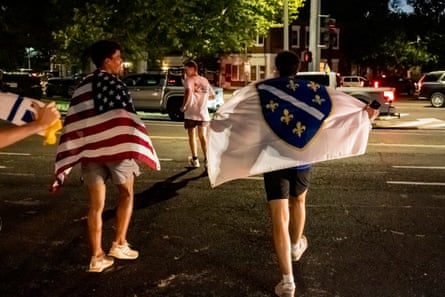
Before a World Cup warmup match in St Louis between Bosnia and Herzegovina, and Panama, thousands in the community paraded through the city with their native country’s blue, white and yellow regalia.
“People have been here for a long time, so they can afford a lot more things now,” said Smajic, who has been in St Louis since 1997. “They can go to different games and travel and spend money” and “support our team”.
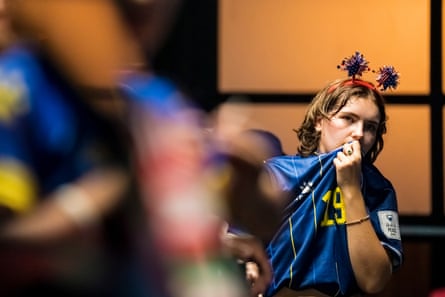
That success was on full display on Wednesday when the United States played Bosnia and Herzegovina in the knockout stage of the World Cup.
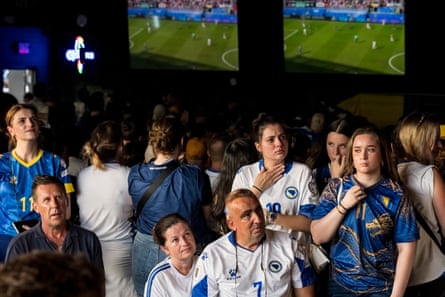
Nearly 2,000 people braved uncomfortably hot weather to watch the game at Smajic’s restaurant, Bevo Caffe Lounge.
Whenever a diaspora community’s native country plays their new home country in a big game, a natural question is: who will you support?
But among Bosnians in St Louis, which has been nicknamed “Soccer City”, there seemed to be an “everybody wins” sentiment around the event, a sense that the game itself was an accomplishment.
“It’s going to feel likely like a big celebration more than a rivalry,” Elvir Kafedžić, a Bosnian former professional soccer player who is now an assistant coach for St Louis City 2, the Major League Soccer club’s reserve squad, said before the match. “Families will be split, jerseys will be mixed, but regardless of the result, there will be pride in seeing Bosnia compete at this stage of the World Cup, but also at the same time a huge appreciation for the US, the country that has become home.”
During the Bosnian war, which occurred from 1992 to 1995, more than 100,000 people died – including a genocide of about 8,000 Muslim boys and men – and more than 2 million people were forcibly displaced.
Bosnians were allowed to emigrate to the United States as refugees during and after the war, and St Louis “became a preferred destination due to the availability of jobs and inexpensive housing”, according to Saint Louis University.
Most lived in Bevo Mill, a historic German neighborhood named for a mill built by August A Busch Sr, the brewing magnate who led Anheuser-Busch. The neighborhood became known as “Little Bosnia”.
The city now features a long list of Bosnian restaurants including Balkan Treat Box, whose chef recently won a prestigious James Beard Award.
“We’re incredibly grateful for the opportunity to do what we love every day, sharing our culture, our food and our hospitality with our community in St. Louis,” the restaurant posted on Instagram.
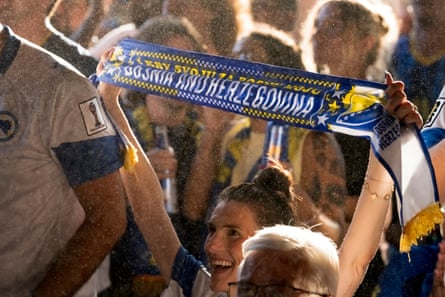
Bosnians have also brought their passion for soccer to the city. Kafedžić was born in 1982 in Bosnia and grew up playing the game in the streets.
“Some of the first presents that many kids in Bosnia get is the soccer ball,” Kafedžić said.
He and his family fled the country in 1993. They were separated from his father in Montenegro, and Kafedžić never saw him again. After the war, his mother discovered some of his father’s belongings at a mass grave.
They moved to Berlin and then in 1998, to St Louis, where his family had relatives.
He continued to play soccer, eventually for Lindenwood University and the St Louis Strikers in the United Premier development soccer league.
His adopted home has a rich soccer history and the US men’s team captain, Tim Ream, is a St Louis native. The city has also been among the top 10 US cities in terms of World Cup viewership this year.
Samira Nukic, 28, was born to Bosnian parents in Germany and came to St Louis before she turned 1. Her parents opened a restaurant, Berix, with just six chairs in Bevo Mill. They are now located outside the neighborhood in a space that can accommodate 100 people. They offer dishes like ćevapi, which are traditional beef sausages in a Bosnian flatbread, and bureky, a thin, flaky dough filled with beef, potatoes, cheese or spinach.
Nukic tried playing soccer as a child but wasn’t very good – so she managed her high school’s boys and girls teams instead. She remains a big fan and traveled to Los Angeles to see the World Cup match between Bosnia and Herzegovina and Switzerland. Bosnia lost 4 to 1.
“I definitely lost my voice just cheering for my team,” said Nukic, who helps manage the restaurant in addition to a full-time job in marketing. “Just carrying that Bosnian pride with me, being so proud of our little country in the World Cup, it was something unlike anything else.”
Smajic estimated that the temperature on the packed patio at his restaurant during Wednesday’s game was about 130 degrees.
“That was mesmerizing to me, that that many people came,” said Smajic, who sold thousands of sausages during the game.
Most of the fans wore Bosnian team jerseys, but in the parking lot, there were cars and trucks that each had both US and Bosnian flags.
The United States ultimately won the game 2 to 0 and will next play Belgium.
“We are a little sad,” Smajic said, “but we are happy that United States is going through, and we are going to beat Belgium on Monday.”
Whitney Curtis contributed reporting to this story.
Disclaimer : This story is auto aggregated by a computer programme and has not been created or edited by DOWNTHENEWS. Publisher: theguardian.com






