
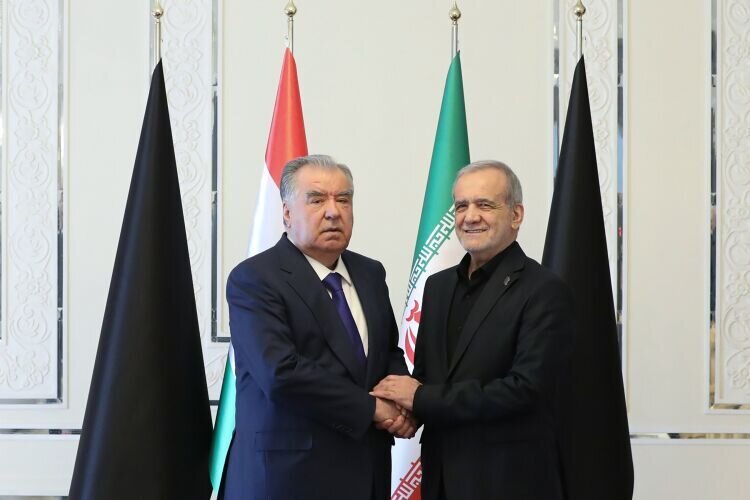
TEHRAN — President Masoud Pezeshkian held a series of meetings on Thursday with foreign leaders and officials who traveled to Tehran for the funeral of Ayatollah Seyyed Ali Khamenei, the Leader of the Islamic Revolution martyred in U.S.-Israeli strikes on February 28. With delegates from nearly 100 countries in attendance, Pezeshkian used the gatherings to thank Iran’s allies for their solidarity and to reaffirm that the nation will not waver in the face of foreign aggression.
“The enemies believed that by targeting the Leader and applying intense pressure, the Islamic Republic would falter and collapse,” Pezeshkian said in one of the meetings. “But the result of this action was nothing but increased cohesion, solidarity and national unity among the Iranian nation.”
He added: “The Islamic Republic of Iran will not bow to any bully. They want to impose their will on nations, but our people will not submit to force.”
Tajikistan: ‘We felt this aggression was against all of us’
In a meeting with Tajik President Emomali Rahmon, Pezeshkian expressed gratitude for the sympathy and support shown by the Tajik government and people, emphasizing the deep historical, cultural and linguistic bonds between the two nations.
“The Islamic Republic of Iran and the Republic of Tajikistan are more than two friendly and neighboring countries — they are two nations with shared cultural and civilizational roots,” Pezeshkian said. “Iran is the second home of the Tajik people, and Tajikistan is the second homeland of the Iranian nation.”
The Iranian president condemned the recent U.S. and Israeli aggression against Iran, describing the attacks as lacking any legal legitimacy and violating fundamental principles of international law. He noted that the strikes martyred the Leader, along with commanders, scientists, officials and innocent citizens, including schoolchildren, and targeted civilian infrastructure.
President Rahmon expressed deep sorrow over the martyrdom of Ayatollah Khamenei, stating that he had enjoyed the honor of friendship and cooperation with him for over three decades.
“The news of the martyrdom of the Leader deeply saddened the people and government of Tajikistan,” Rahmon said. “The people of Tajikistan share in the grief of the Iranian nation and consider this sorrow their own.”
He added: “I personally followed the developments concerning Iran day and night with concern. We consider ourselves one nation and one family with the Iranian people. We felt that this aggression was not only against Iran but against all of us.”
Rahmon said he had repeatedly told American officials that “the language of force, threats and war can never force the Iranian nation to retreat. The Iranian nation is a civilization-building people with a deep and brilliant history.”
Iraq: ‘Security of region and security of Iran are intertwined’
In a separate meeting, Pezeshkian welcomed Iraqi President Nizar Amidi, thanking him for his government’s condolences and solidarity.
“The Islamic Republic of Iran considers Iraq not merely a neighbor, but a brotherly and close country,” Pezeshkian said. “The deep cultural, religious, historical and social ties between the two nations are such that geographical borders can never create distance between the Iranian and Iraqi peoples.”
Pezeshkian described the U.S.-Israeli aggression as a violation of all recognized principles of international law. “The crimes committed, including the martyrdom of the Leader, officials, commanders and innocent citizens, as well as the targeting of civilian, educational and scientific infrastructure, are clear examples of violations of human rights and international humanitarian law,” he said.
President Amidi expressed solidarity with the Iranian people, saying that “the people of Iraq consider themselves partners in this great sorrow.”
“The recent developments once again showed that the security of regional countries depends on cooperation, convergence and mutual trust among regional governments,” Amidi said. “Sustainable security cannot be built on the presence and support of foreign powers. Recent experience proved that true security comes from regional cooperation and constructive relations among neighboring countries.”
He added: “The Iranian nation demonstrated unparalleled resistance and resilience in the military and diplomatic arenas and was able to defend its national rights and interests. This steadfastness is respected by the peoples of the region.”
Armenia: ‘We will not allow our friendly relations to be tarnished’
President Pezeshkian also met with Armenian Prime Minister Nikol Pashinyan, thanking him for the expressions of sympathy and solidarity with the Iranian nation.
“Iran-Armenia relations have always been based on mutual respect, good neighborliness and shared interests,” Pezeshkian said. The president expressed hope that negotiations on a comprehensive cooperation treaty between the two countries would be finalized soon.
Pezeshkian emphasized that relations between Iran and Armenia should be insulated from foreign interference. “Experience has shown that the presence and interference of extra-regional powers have not helped resolve regional issues, and in many cases have complicated challenges and increased instability,” he said.
Pashinyan, expressing deep condolences, noted that he had met the martyred Leader on two occasions. “The news of his martyrdom was deeply moving for the people and government of Armenia, and we consider this grief our own,” he said.
The Armenian prime minister offered assurances regarding Iran’s security concerns. “The Republic of Armenia has repeatedly and explicitly stated that the security of the Islamic Republic of Iran is of particular importance to us,” he said. “We assure that Armenia has not and will not participate in any plan, project or action against the interests and security of Iran.”
He added: “We have no secrecy in our interactions with various countries and are always ready to discuss any concerns with our Iranian friends. We will not allow this friendly and constructive relationship to be tarnished under any circumstances.”
Pashinyan described current relations between Iran and Armenia as being at “the highest level since Armenia’s independence,” with cooperation expanding across political, economic and infrastructure sectors.
Turkmenistan: ‘War has never been a sustainable solution’
In a meeting with Gurbanguly Berdimuhamedov, the National Leader of Turkmenistan, President Pezeshkian thanked the Turkmen government for its expressions of solidarity since the first days of the crisis.
“The late Leader always emphasized that Iran and Turkmenistan are two friendly, brotherly countries with relations based on good neighborliness, mutual trust and respect,” Pezeshkian said. “The shared border between Iran and Turkmenistan is among the most secure and stable borders in the region.”
Pezeshkian called for accelerated implementation of bilateral agreements in areas including energy, transportation, transit, trade and investment.
Berdimuhamedov expressed condolences and praised the character of the martyred Leader. “He was an enlightened, visionary figure respected by the peoples of the region and held a special place in the hearts of the Turkmen people and government,” he said.
“War has never been a sustainable solution to problems,” the Turkmen leader said. “We hope the Iranian nation will endure these difficult days with patience and resilience, and that our region will soon move out from under the shadow of war and insecurity.”
Berdimuhamedov recalled his last meeting with the late Leader, during which Ayatollah Khamenei had spoken warmly about building mosques and religious education centers in Turkmenistan. “A memory that will remain forever in my mind and heart,” he said.
Georgia: ‘Ready to remove obstacles to relations’
In a meeting with Georgian President Mikheil Kavelashvili, Pezeshkian expressed gratitude for Georgia’s condolences and described the U.S.-Israeli aggression as a violation of international law and the U.N. Charter.
The Iranian president condemned the destabilizing actions of the Israeli regime in the region, stating that Iran has always sought to expand friendly relations with neighboring countries and that Georgia holds an important place in that approach. He called for expanded cooperation in political, economic, commercial, scientific, academic, cultural and tourism sectors.
President Kavelashvili expressed deep condolences, stating that Georgia followed the tragedy with great sorrow and stood by the Iranian people during these difficult days.
“Relations between Iran and Georgia have a deep historical, cultural and human background spanning centuries,” Kavelashvili said. “After Georgia’s independence, the development of bilateral relations has been pursued seriously.”
He added: “Georgia is determined, in cooperation with the Islamic Republic of Iran, to open a new chapter in bilateral relations and turn the relationship into a successful model of cooperation and friendship in the region.”
The Georgian president also expressed his country’s readiness to remove obstacles in the path of developing relations and praised Iran’s support for Georgia’s territorial integrity.
Turkey: ‘The entire world witnessed resistance of Iranian nation’
In a separate meeting with Turkish Vice President Cevdet Yılmaz, Pezeshkian thanked Turkey for its support during the war, describing the U.S.-Israeli aggression as a violation of the U.N. Charter and international humanitarian law.
“The martyred Leader, along with commanders, officials, scientists and innocent citizens were martyred in these attacks,” Pezeshkian said. “Yet the perpetrators of these actions continue to brazenly appear on the international stage claiming to defend human rights and humanitarian values.”
Pezeshkian emphasized the need to strengthen Islamic unity, stating that Muslim countries share deep religious, cultural and civilizational bonds and can work together to bring development, prosperity and lasting stability to the region.
“The more cohesion and cooperation among Islamic countries increases, the less room there will be for the intervention and influence of destructive actors in the region,” he said.
The president also thanked Turkey for its positions and cooperation during the recent war and expressed hope that the political will in both countries would translate into concrete programs and tangible achievements across various sectors.
Vice President Yılmaz conveyed Turkish President Recep Tayyip Erdoğan’s condolences and expressed deep sympathy over the martyrdom of the Leader and Iranian citizens, particularly the schoolgirls of Minab.
“These incidents deeply saddened the Turkish nation, and our people consider themselves partners in the grief of the Iranian people during these difficult days,” Yılmaz said.
He noted Turkey’s diplomatic efforts to prevent the escalation of conflict and support the ceasefire process, coordinating with regional countries including Qatar and Pakistan. He expressed hope that the process would lead to lasting and comprehensive peace in the region.
“The entire world witnessed the steadfastness and resistance of the Iranian nation in these difficult circumstances,” Yılmaz said.
The Turkish vice president stressed the importance of developing bilateral relations in economic, commercial, energy, transit and investment fields, stating that “the stronger and closer the relations between Iran and Turkey, the less room there will be for extra-regional interventions and the creation of divisions among regional countries.”
Disclaimer : This story is auto aggregated by a computer programme and has not been created or edited by DOWNTHENEWS. Publisher: tehrantimes.com





