The past three decades have delivered faster growth in Poland than in most other countries except China.
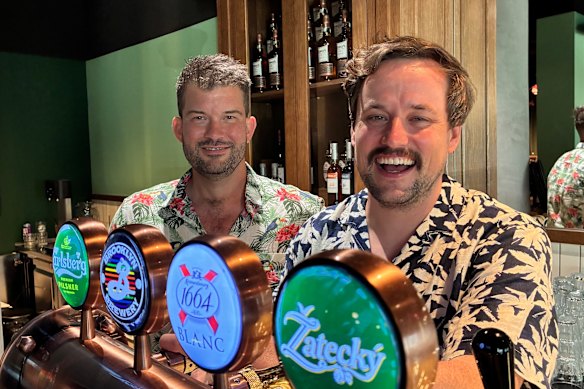
Warsaw: Sitting in a comfortable booth at The Exchange Bar and Grill in central Warsaw on a warm Saturday night, Rob Turner puts his beer on the table and describes life in the Polish capital.
“Amazing,” he says. “It’s a beautiful city, it’s very safe, it’s very clean, it’s very modern. I can live here very easily. The lifestyle is great. And there are opportunities here if you’re willing to work hard and try to do something above and beyond the norm.”
Turner, 43, is one of the owners of this bar on the ground floor of a steel-and-glass office building in a district that is noisy with new construction. Raised in Adelaide, he has been in Poland for seven years and expects to stay for many more.
Sitting alongside him is Justin Lestal, 35, another owner of the bar, who sets out the case for doing business in one of Europe’s most conspicuous success stories.
“It’s a pro-business, entrepreneurial country,” Lestal says. “I had no business background when I came to Poland. It’s just a country where there’s a lot of opportunity.”
Over the decade since he moved from Sydney, he has seen this downtown area of Warsaw – not far from the central railway station – transformed by new apartments and office towers.
“This wave is growing and continues to grow,” says Lestal of Poland’s economic rise. “It’s evident in everything – the infrastructure, the GDP. And it’s evident in how much things are costing. The cost of living is going up as the economy’s grown.”
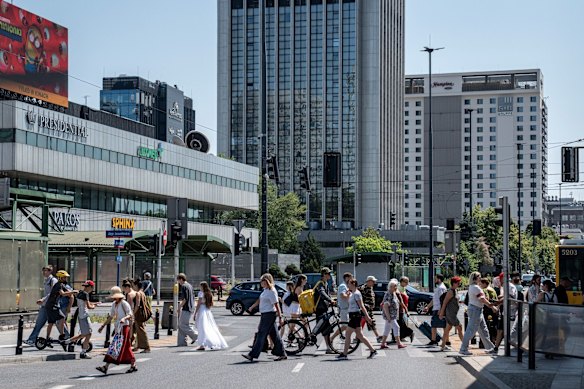
The hustle is obvious on nearby streets. Global companies have been moving into this part of Warsaw over the past decade, and it has the look of an American city with wide streets and high towers. Warsaw also has a picturesque old town, where traditional buildings line a square full of cafes, but the growth is elsewhere.
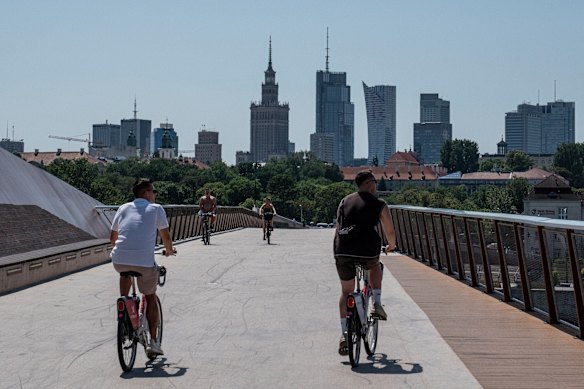
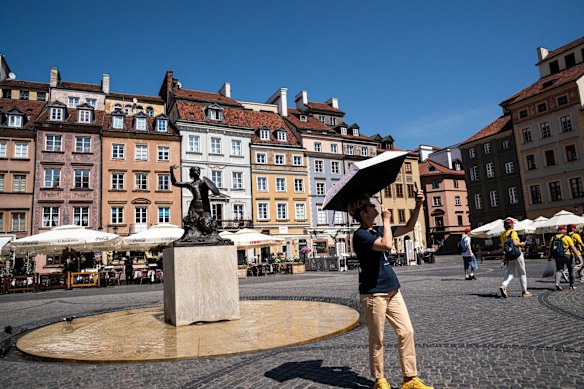
So much of the city was destroyed in the Second World War, and then rebuilt in the drab concrete of Communism, that there are, sadly, few historic wonders to be saved. So, the people of Warsaw have no compunction in knocking things down and starting again.
The young workers heading to work on their scooters can find good jobs at employers in finance, services and tech. This is a city with plenty of upside for smart workers – such as the software developers at the Google campus. Companies ranging from law firms to medicine manufacturers use cities across Poland – Krakow, Poznan, Katowice – as their back office.
In Britain, plenty of workers groan under the burden of high costs and slow growth, while politicians prepare to install the seventh prime minister in a decade. In France, the national assembly is paralysed, while workers take to the streets against pension reforms. In Germany, the economy has stalled and carmakers are laying off workers.
The old parlour game of naming the “sick man of Europe” is easy when there are so many countries in trouble. Poland, however, is in rude health.
The numbers tell the story – and they highlight what growth means for the future. They also hint at the implications for Australia when it seeks out allies in Europe.
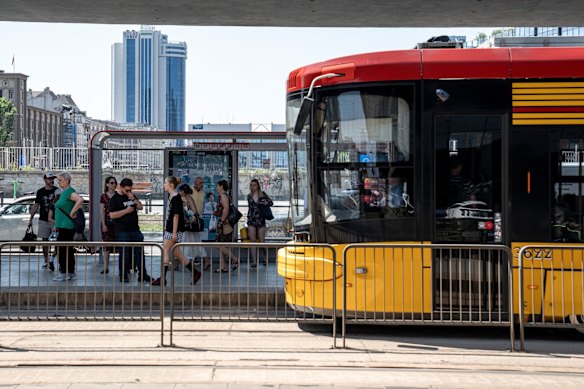
Poland, with a population of 38.8 million, is posting the kind of growth that other nations only dream about. Its economic output per person – per capita GDP – expanded by 209 per cent from 1990 to 2023, according to the Polish Economic Institute. Once a poor country trapped behind the Iron Curtain, it is gaining the wealth enjoyed by its neighbours to the west. Its per capita GDP was 41 per cent of the European Union average in 1990, but is now higher than 81 per cent.
The Polish economy grew by 3.6 per cent last year, while Germany grew by 0.2 per cent, France by 0.9 per cent and the United Kingdom by 1.3 per cent.
Unemployment, at just 3.1 per cent, is not only lower than most European countries but below the Australian rate of 4.4 per cent. Government debt is about 60 per cent of GDP and is likely to rise to 68 per cent over the next two years, but it is lower than the levels in Britain and France.
“Poland’s economy is impressively dynamic,” BNP Paribas economists said in February. “In 2025, the country posted the highest growth rate in Central Europe and one of the highest in the European Union. This growth pattern should, yet again, be observed in 2026.”
Two events helped the country to rise. First, it regained independence in 1989 and set its own path during the collapse of the Soviet Union, forming a stable democracy. It avoided the Moscow model of transferring economic power to oligarchs or centralising political power in a strongman. Second, it joined the European Union in 2004 and gained access to millions of customers.
Michał Baranowski, undersecretary of state at the country’s Ministry of Economic Development and Technology, says the past three decades have delivered faster growth in Poland than in most other countries except China.
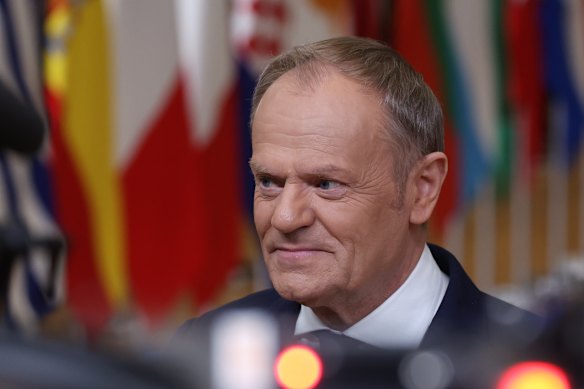
“If you look at the bigger picture of the last 35 years, the economic transformation is amazing,” he tells this masthead. Baranowski, an economist who trained at Mercer University in the United States, the University of Oxford in England, and Maastricht University in the Netherlands, was appointed by Prime Minister Donald Tusk in 2024.
“Poland did not develop an oligarchy like some did,” he says. “We had a period of challenges to the rule of law, but they were overcome. That’s the foundation.”
Baranowski says Poland benefited from European Union finance for roads, rail and other infrastructure, from sources such as the European Recovery Fund, and he knows this is a big focus in the media. He argues that Poland spent the money well by decentralising power, making sure that decisions were made by people closer to the actual projects.
Not all countries have prospered from the EU in the same way. In Hungary, for instance, leaders in Brussels froze more than €16 billion ($26 billion) in funds due to concerns about corruption and curbs on democracy under former prime minister Viktor Orbán, who governed for 16 years until he lost national elections in April. The EU is releasing the funding under his successor, Péter Magyar.
When this masthead spoke to Hungarian voters in Budapest in April, some complained that their government had not been able to deliver the same growth as Poland. In the post-Communist era in Central Europe, the approach taken in Warsaw has clearly worked.
More important than access to the EU funds, says Baranowski, was access to the EU market.
“The even bigger benefit is the way that Polish businesses took advantage of the single market,” he says. “Over 99 per cent of Polish companies are small and medium enterprises, and they thrived in the single market, and now they are going beyond.”
Australians can see evidence of the rise of Poland as a manufacturer and an exporter. Much of the Twinings tea sold to the world market is packed in Poland. An Australian supermarket may stock Colgate toothpaste or Finish dishwashing tablets made there.
A car factory at Tychy in southern Poland used to make Fiats under licence during the Communist era. Now the factory, owned by Stellantis, makes the Fiat 500 for export markets. (Australians, however, are more likely to see the Fiat 500e electric vehicle made in Turin.)
There are signs of strain, however. Tusk, the centrist prime minister, is at odds with Karol Nawrocki, the conservative president. As in other European countries, there is significant concern about migration. At the same time, the country has one of the lowest birthrates in Europe, so it may need foreign workers to fill local jobs. In the taxis around Warsaw, it is common to find drivers from Uzbekistan or Georgia.
The war in Ukraine, meanwhile, heightens anxiety about security at the same time as it spurs investment in defence and brings more activity to the NATO military bases that support the Ukrainian armed forces.
Damien Stewart, head of the Polish chapter of the Polish Australian Chamber of Commerce, says he is seeing more Polish companies seeking to do business in Australia than the other way around. Talking over a coffee in Fabryka Norblina, a historic factory converted into a busy food and shopping centre, he says he wants to encourage more of both.
Judging by the volume of trade and investment today, there is plenty of potential. Australian investment in Poland was worth $2.2 billion in 2025, according to the Department of Foreign Affairs and Trade. Investment in the other direction was $25.1 billion. Trade figures show Australia buys more from Poland than it sells there.
Things may change under the free-trade agreement signed between Australia and the EU this year. While the deal provoked concerns from farmers in France and Ireland, the Polish government was seen as a supporter. This is not only about Australian beef and lamb exports: when Poland held its annual MSPO defence expo last year, 50 Australian defence companies attended.
“Australia has a lot to offer in our growing economic relationship with Poland,” Australia’s ambassador to Poland, Benjamin Hayes, says. “We see particular opportunities for defence industry, the energy security and renewables sector, and critical minerals export and co-investment.”
Baranowski wants more trade and investment with Australia – although, based on his travel plans, it is fair to say his priority will be big export markets such as India and China. “The FTA with Australia is helping,” he says. “We are not there yet with Australia. But we are building.”
Get a note directly from our foreign correspondents on what’s making headlines around the world. Sign up for our weekly What in the World newsletter.
Disclaimer : This story is auto aggregated by a computer programme and has not been created or edited by DOWNTHENEWS. Publisher: www.smh.com.au