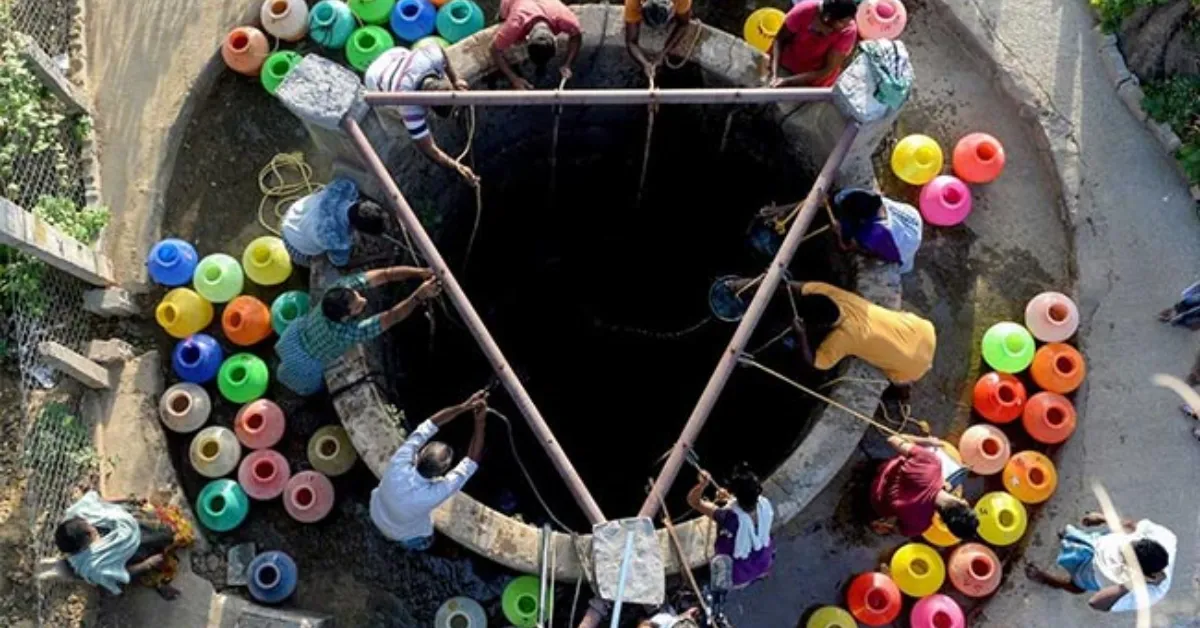
In the summer of 2019, Chennai looked like a city waiting for water.
At street corners, plastic pots stood in long lines before tankers arrived. In apartment buildings, taps ran dry. Hotels cut back on laundry services. Restaurants reduced their working hours. Some offices even asked employees to work from home because toilets had stopped functioning.
It was a startling image for a coastal city shaped by the rhythms of the monsoon.
That year, all four of Chennai’s major reservoirs had nearly dried up. Close to 10 million people were pushed into what many described as a “Day Zero” moment — the point at which a city’s water system begins to buckle under demand.
But Chennai’s water crisis did not begin in 2019. By then, it had been building for decades.
Long before the city became a cautionary tale about urban drought, it had already discovered part of the solution. It simply stopped holding on to it.
The years of extraction
In the 1990s, Chennai’s population stood at around 3.8 million. The city’s piped water network struggled to keep pace with its growth.
Families queued at public taps. Those who could afford it bought water from private tankers. Thousands of households drilled borewells, drawing groundwater faster than it could be replenished.
The consequences soon became visible.
As water tables dropped, seawater began creeping into underground aquifers. In many neighbourhoods, well water turned saline. Residents recalled brushing their teeth with water that tasted of the sea.
For water conservationist Sekhar Raghavan, the turning point came in 1995 while studying old land records.
What he found was not a new technology, but an old memory.
Villages around Chennai had once relied on interconnected tanks, ponds, lakes and recharge channels — systems designed to capture monsoon rain and slowly return it to the earth.
The principle was simple: all freshwater begins as rain.
A law for every roof
Raghavan adapted that wisdom for a growing city.
Instead of restoring entire village water systems, he proposed something practical: rooftop rainwater harvesting.
Rain falling on roofs, terraces and paved surfaces could be redirected through pipes and filters into underground aquifers or storage tanks.
At first, the idea struggled to gain support.
Then policy stepped in.
In 2001, the state’s leadership made rainwater harvesting a key part of Tamil Nadu’s water strategy.
/filters:format(webp)/english-betterindia/media/media_files/2026/07/06/chennai-2-2026-07-06-18-13-13.png)
By 2003, the state had made it mandatory for every building — old and new.
The policy was strict. Buildings without functioning rainwater harvesting systems risked losing water and sewerage connections. Completion certificates and property-related approvals were tied to compliance.
The law transformed water conservation from an individual choice into city-wide infrastructure.
When the rains proved the point
The first major test came in 2005.
That year, Chennai received nearly double its normal rainfall. But this time, much of that water did not disappear as runoff.
Thousands of rainwater harvesting systems were already in place. Rain seeped underground. Wells recovered. Groundwater levels rose by nearly 20 feet in several parts of the city.
For almost a decade, that recharge acted as a buffer.
It showed that Chennai’s water crisis was not always about scarcity. Often, it was about storage.
The city had become one of the earliest examples of decentralised urban water conservation at scale.
When the system weakened
But rainwater harvesting came with one condition: maintenance.
And that is where Chennai faltered.
Over time, filters clogged. Recharge pits went uncleared. In many buildings, rainwater harvesting systems existed only on paper.
By 2019, investigations found more than 41,000 buildings without rainwater harvesting systems, while thousands more had systems that were broken or poorly maintained.
When reservoirs dried up again that year, the consequences became clear.
Rainwater harvesting was never meant to be a one-time intervention. It required regular inspection, upkeep and public participation.
Building a second generation of water systems
This time, Chennai’s response has gone beyond rooftops.
The city is restoring more than 80 ponds ahead of the monsoon by desilting them, strengthening embankments and clearing encroachments.
For years, many of these ponds were treated as wastelands. Today, they are being brought back into Chennai’s strategy for flood management and groundwater recharge.
At the same time, the city has begun building rainwater harvesting parks, often referred to as sponge parks.
/filters:format(webp)/english-betterindia/media/media_files/2026/07/06/chennai-3-2026-07-06-18-17-12.png)
Its first large-scale sponge park in Mathur MMDA Colony, announced in 2025, will resemble a sports ground on the surface, complete with football turf, walking tracks and courts. Beneath it, the park will store up to 12 lakh litres of stormwater.
The city is also experimenting with newer technologies.
Using German catch-pit technology, Chennai has started installing modular underground systems beneath parks to store and filter rainwater more quickly than conventional recharge wells. Some of these systems can hold millions of litres of water.
It marks a broader shift in thinking.
First came rooftops. Then ponds. Now entire neighbourhoods are being redesigned to absorb rain rather than push it away.
The unfinished lesson
Chennai’s story is ultimately about memory.
The city once knew how to live with rain. Over time, that knowledge was buried under concrete, rapid expansion and neglect.
But Chennai’s journey also shows that policy can change behaviour, and that old ideas can still help solve modern problems.
Sources:
‘How Chennai used rainwater to quench its thirst and avoid a Cape Town-like water crisis’: by Yasaswini Sampathkumar, Published on July 16 2018
‘Best rain water harvesting systems in Chennai’: by Prince Frederick, Published on October 25 2021
‘Chennai’s first sponge park with sports courts coming up’: by IANS, Published on 7 September 2025
‘Chennai civic body ramps up pond restoration, rainwater harvesting parks ahead of monsoon’: by IANS, Published on 4 September 2025
Disclaimer : This story is auto aggregated by a computer programme and has not been created or edited by DOWNTHENEWS. Publisher: thebetterindia.com