
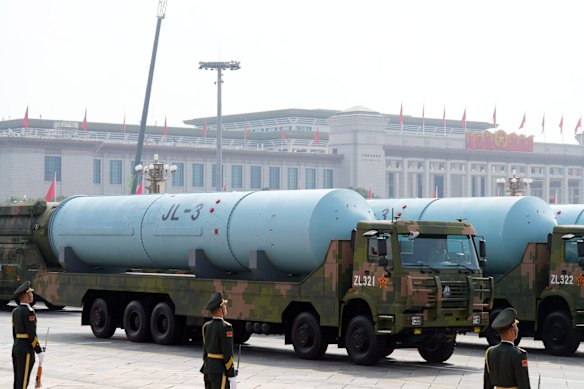
On Monday, China test-fired a submarine-launched ballistic missile with a dummy warhead into the waters of the South Pacific. The launch of the nuclear-capable missile was described as “destabilising” by Australian Foreign Minister Penny Wong and the Japanese government expressed its “grave concern”. Expect China to test many more.
Submarine-launched ballistic missiles (SLBMs) are deployed on nuclear-powered ballistic submarines. They fly on a ballistic flight path, meaning that they are launched into flight by a brief burst of rocket power. They then travel in a high, arcing trajectory under their own momentum. They are different from cruise missiles, which are powered continuously and follow a lower, flatter path.
SLBMs are highly survivable against enemy attacks, unlike land-based ballistic missiles, which can be threatened by US advantages in space-based surveillance and precision strike capabilities. SLBMs give China the ability to retaliate massively to an enemy’s surprise, large-scale nuclear first strike. Known as a “second-strike” capability, it means that even if an enemy destroys your country, society and government with overwhelming nuclear forces, you can do the same in retaliation.
China’s official news agency Xinhua issued a one-sentence statement stating that the test was part of routine annual training. The missile was most likely the JL-3, a new generation missile that China displayed at a military parade in Beijing last year. It has a range of 10,000 kilometres and is one generation up from the JL-2, which has a range of 7200 kilometres.
The reason for this missile modernisation is that China’s submarines are not yet stealthy enough to evade detection and have to stay in semi-enclosed, protected waters near China. From there, the JL-2 missile can reach Guam, Hawaii and Alaska but it cannot reach the continental United States. If China’s submarines leave their relatively secure location and sail deep into the Pacific Ocean, they become vulnerable to US and Australian anti-submarine forces. But a submarine armed with the longer-range JL-3 can attack the north-western parts of the continental United States, provided it is based in the Bohai Sea, in northern Chinese waters. Even then, it cannot target the US capital, Washington, DC, on the far side of the US continent. To attempt that, it must sail past north-east Japan and into the Pacific Ocean, where it once again becomes vulnerable to US and Australian anti-submarine forces.
Newer, quieter Chinese submarines may be on the way. US naval researchers claim that Russia is helping Chian develop a quieter propulsion system for these boats. If Russia’s economy becomes dependent on China’s, such co-operation and technology transfer may get stronger.
The last time China test-fired a long-range missile into the open ocean was in September 2024. That missile landed in the sea near the Marquesas Islands in French Polynesia, more than 12,000 kilometres from the Chinese mainland. It was launched from a purpose-built vehicle known as a transporter erector launcher (TEL), located on Hainan Island, its southernmost province. Before that, its last full-trajectory flight test occurred in May 1980 – a lifetime ago in strategic terms.
All these launches are detectable by US-Australian early-warning systems; the Joint Defence Facility at Pine Gap in the Northern Territory controls satellites in a Space-Based Infrared System. This program aims to detect and track missiles just after they lift off (the “boost phase”) because they are slower, easier to track, and easier to intercept. It looks for infrared emissions from rocket launches, providing missile warning and battlespace characterisation.
China’s tests do not appear to be related to the new mutual defence treaty that Australia just signed with Fiji. Its missile development program operates according to its engineering requirements rather than regional sensitivities. Other nuclear-armed states conduct similar tests. The United States test-fired four unarmed Trident SLBMs from an Ohio-class ballistic missile submarine near Florida in September 2025. Russia test-fired an SLBM in October 2025. India did the same thing in December.
China is therefore likely to continue to keep testing and developing its missile capability. It appears willing to bear the reputational costs associated with these launches. There will be several more “routine” tests this decade.
Professor Clinton Fernandes is in the Future Operations Research Group at UNSW. His latest book is Turbulence: Australian Foreign Policy in the Trump Era.
The Opinion newsletter is a weekly wrap of views that will challenge, champion and inform your own. Sign up here.
 Professor Clinton Fernandes is part of University of NSW’s Future Operations Research Group which analyses the threats, risks and opportunities that military forces will face in the future. He is a former intelligence officer in the Australian Army.
From our partners
Disclaimer : This story is auto aggregated by a computer programme and has not been created or edited by DOWNTHENEWS. Publisher: www.smh.com.au


