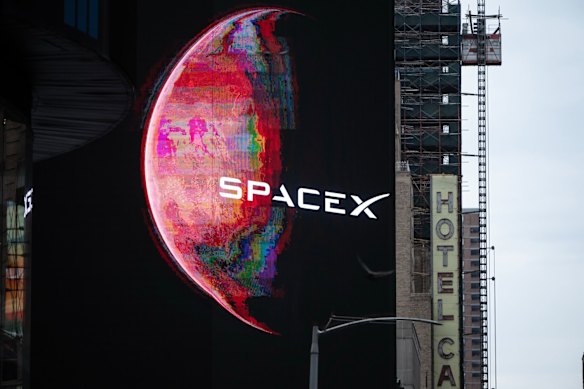
Three weeks ago, Elon Musk’s SpaceX was valued by the market at more than $US2.5 trillion ($3.6 trillion). On its first day of inclusion in the Nasdaq index, which was expected to trigger a wave of forced index fund buying, its value fell below $US2 trillion.
The 6.83 per cent fall in its share price on Tuesday took the slump from SpaceX’s peak on its second day of listing last month to about 22 per cent. The forced buying of index funds to reflect its weighting in the Nasdaq index has failed to materialise to date.
Not even a wave of uber-bullish reports by six of Wall Street’s most prominent investment banks – Morgan Stanley’s “bullish” case for the company has a price target of $US600 a share, or a market capitalisation of more than $US8 trillion – helped.
In debt markets, the spreads on SpaceX’s $US25 billion raising are blowing out. Initially priced at 1.4 percentage points over US Treasuries, the spread has swollen to 1.65 percentage points. Debt that has an investment grade rating is trading in junk bond territory.
SpaceX isn’t alone. The uncritical enthusiasm for the mega-techs and all things artificial intelligence-related has faded.
The “Magnificent Seven” mega-tech stocks are down 6.5 per cent from their recent highs in May, despite a rebound last month. The PHLX Semiconductor Sector Index has fallen 16 per cent in a fortnight after a massive 105 per cent AI-driven surge earlier in the year.
In the debt markets, a $US25 billion Amazon bond issue attracted only about half the interest shown in a previous issue in March and caused the prices of other AI-related debt to drop and their yields to rise (prices and yields have an inverse relationship) in a sign that the market is satiated with AI companies’ debt.
The equity and bond market conditions for AI issuance suggest a certain level of fatigue, and perhaps nervousness.
When SpaceX floated, investors were prepared to attribute extraordinary amounts of value to things that only exist inside Elon Musk’s mind – data centres in space, the colonisation of Mars – within an environment where the value of the AI aspirants only ever increased.
OpenAI and Anthropic – both valued at less than $US200 billion in fund raisings last year – were talking about, and filing draft prospectuses for, trillion-dollar floats of their own following SpaceX’s spectacular debut.
OpenAI is now talking about, perhaps, floating next year and, inevitably, Anthropic will also be having second thoughts about launching into the current market.
AI looks like being a winners-take-all industry. Either a company emerges as a dominant force in AI or they disappear.
The sudden volatility injected into trading in AI stocks flows from continuing concerns that, after a four-year AI-driven bull market, the sector is in bubble territory.
That’s making some investors nervous because the insatiable appetite for capital to fund AI investment relies on continued access to equity and debt markets on ever-improving terms.
If that access shrinks, or the price of access rises materially, the entire sector could implode, with unpleasant implications for the broader market and economies, particularly the US economy.
Pure AI companies, such as OpenAI and Anthropic, or even a SpaceX, where the valuation is dominated by AI-related potential, have to keep raising equity and, increasingly, debt to fund their continually increasing investment in computing and the infrastructure that supports it.
To attract that equity and debt, their valuations, which are based on the prospect of earnings for companies that today generate increasing losses, have to keep rising. If they don’t, they’ll lose access to capital, and their inability to sustain the spending required to keep up with their more diversified competitors will cause them to implode.
Even hyper-scalers such as Google, Meta, Amazon and Microsoft, with massive non-AI cashflows, are being stretched in funding the levels of capital expenditures that their AI ambitions are dictating.
They’ll invest more than $US750 billion between them in AI this year, more than $US1 trillion next year and even more in 2028 and beyond, outstripping even their ability to generate cash. Hence, even Amazon and Google’s parent, Alphabet, are raising new equity and debt.
AI looks like being a winners-take-all industry. Either a company emerges as a dominant force in AI or it disappears.
Where, until very recently, investors didn’t discriminate between the AI combatants (other than perhaps the highly leveraged Oracle, whose share price has fallen 43 per cent in a month), that may be changing as investors evaluate which of the competitors has capacity to last the distance and eventually emerge with the super-profits that justify the extraordinary levels of investment being made.
It is conceivable, of course, that those super-profits don’t eventuate.
To date, the rate at which AI investment has been growing has outstripped the growth in revenues, with the gap widening as the scale of capital expenditures ratchets up and the take-up of AI by businesses, while sizeable, lags expectations because AI hasn’t yet delivered the productivity gains, relative to its cost, that the AI companies envisaged and companies expected.
AI is also increasingly commoditised, with the advantage gained by the launch of a new frontier model erased within weeks by the release of competitor models. Cheaper Chinese AI models are mopping up the demand for less sophisticated AI functions.
If neither the AI promoters nor their business and consumer customer bases can get a decent return on the capital they are risking, the sectors’ current business model of investing at exponential growth rates to generate exponential revenue growth collapses.
A draft US Treasury report obtained by digital news outlet NOTUS (News of the United States) has, as have many in the markets, drawn parallels between the AI and dotcom booms and concluded that AI companies are more entrenched in the US economy than their dotcom counterparts and posed significant risk to the financial system and economy if financial conditions changed, productivity goals were missed or choke points stymied growth.
Financial conditions might be changing, and may be a factor in recent AI trading. Choke points are emerging, as data centre developers and semiconductor manufacturers struggle to maintain the pace required to meet the demand.
The yield on the two-year Treasury notes that are most sensitive to current financial conditions has kicked up 13 basis points, to 4.19 per cent, since last month’s Federal Reserve Board meeting raised the prospect of interest rate hikes this year.
The yield on 10-year bonds has risen 11 basis points, to 4.55 per cent. Ten-year bonds provide the “risk-free” rate that is central to the discount rates used for calculations of net present value.
For companies priced for perfection, as AI companies are, given that their dizzying valuations are predicated on massive revenues materialising in the not-too-distant future and the growth being sustained well into the future, any material increase in interest rates decreases their notional value.
If that were to translate into actual decreases in their sharemarket valuations, it could, given the increasing financial leverage within the sector and the operational leverage created by a myriad of contractual relationships between all the major AI participants, trigger a meltdown.
The hyperscalers, with non-AI cashflows, might survive and, indeed, emerge as the winners of the desperate scramble for AI supremacy, but a significant slice of the sector – AI developers, chipmakers, data centre operators and others providing the “picks and shovels” for the AI boom – would be distressed.
Until recently, investors were prepared to ignore the potential risks that the sector is laden with, valuing everything AI as if there were a seamless and risk-free pathway to realisation of its potential, including data centres in space and colonies on Mars.
That may now be changing, with at least a greater awareness of the risks. Whether that leads to a significant deflation of the bubble-like valuations, with the threats to the wider financial system and economies that might provide, or is simply a pause in the cycle is a judgment only the experience and hindsight will deliver, perhaps brutally.
The Business Briefing newsletter delivers major stories, exclusive coverage and expert opinion. Sign up to get it every weekday morning.
From our partners
Disclaimer : This story is auto aggregated by a computer programme and has not been created or edited by DOWNTHENEWS. Publisher: www.smh.com.au