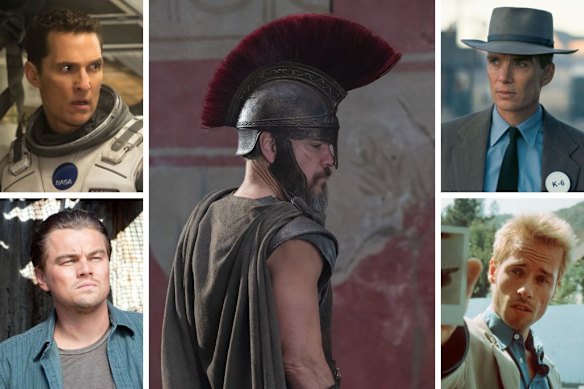
Like all of Christopher Nolan’s heroes, the King of Ithaca is yearning for home.
Movies, like myths, persevere longer in our cultural consciousness the more open they are to ongoing interpretation. And few filmmakers’ movies are quite so ripe for repeat viewing than those of Christopher Nolan, whose most recent magic trick was adapting a 700-page biography about a theoretical physicist into a best-picture-winning blockbuster. Oppenheimer’s success was representative of Nolan’s inimitable skill for combining complex thought experiments and labyrinthine narratives with jaw-dropping, IMAX-worthy spectacle.
But while plenty of ink has been spilt lionising the formal and technical aspects of Nolan’s work – his commitment to celluloid and on-set practical effects – just as much has been written about his film’s characters, and this is where the appraisals haven’t always been so kind. For starters, each new outing seems to reignite the on-again-off-again discourse surrounding his often problematic women characters (they’re “dead wives”; they’re barely there; when they are there, they’re underwritten plot devices serving the narrative needs of men).
To his credit, though, one trope Nolan has generally managed to avoid is that of the sceptical spouse attempting to dissuade their husband from an all-consuming quest (see: JFK, Zodiac, even Close Encounters of the Third Kind). Overly symbolic though they may be, Nolan’s female characters represent the opposite – not an obstacle for their husbands to overcome, but something they yearn to return to: family.
In Memento (2000), Guy Pearce’s insomniac Leonard Shelby sifts through his fractured memories to avenge his wife’s death. In Inception (2010), Leonardo DiCaprio’s dream thief Dom Cobb takes one last job, infiltrating the subconsciousness of a wealthy industrialist and sparring with memories of his own long-lost wife, all for the chance to reunite with his kids. In Interstellar (2014), Matthew McConaughey’s NASA pilot-turned-farmer (and did I mention widower?) Joseph Cooper travels to a distant galaxy and through the mouth of a black hole just to get one last glimpse into his daughter’s childhood.
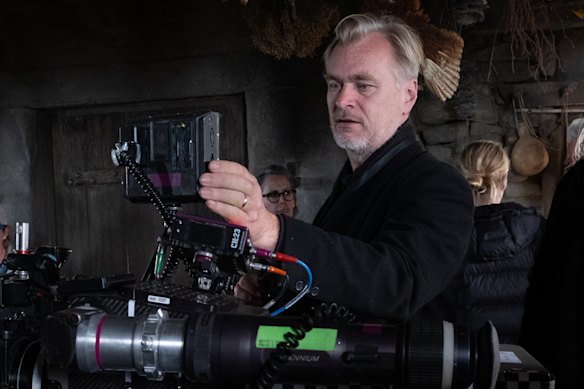
Emily Blunt’s long-suffering wife in Oppenheimer (2023), Maggie Gyllenhaal’s sacrificial prosecutor in The Dark Knight (2008), even the invisible women in the margins of Dunkirk (2017) – in one form or another, there is a family waiting at home for all of Nolan’s scientists, soldiers and superheroes, if only they weren’t so duty-bound to greatness.
Despite the puzzle-box nature of his movies and his own enigmatic reputation, Nolan often wears his heart on his sleeve when it comes to discussing this prevailing motif in his work. “I’ve written quite a few dead wives, that’s true,” he confessed while doing press for Inception back in 2010, “but you try to put your relatable fears in these things … you take the things you are actually worried about in real life, or things you care about in real life, and you extrapolate that into [something] universal.”
Elsewhere, he has talked at length about the double-edged sword of his success: creative carte blanche, but at the expense of getting to watch his children grow up the way a regular father might. “The tension in so many of my films is between family and wanting to be with family and having responsibilities outside of that, being pulled outside of that,” Nolan said in a recent interview with GQ. “It’s something I relate to very strongly.” Luckily for us, he has managed to wring hundreds of millions of dollars out of Hollywood to explore this very personal agony on some the largest cinematic canvases imaginable.
Anyone who’s ever been in therapy can attest to the fact that it often takes the longest time to arrive at the simplest revelations. Similarly, for many filmmakers fortunate enough to work across several decades, their most primal thematic concerns tend to crystallise with age. We’ve seen this recently with Steven Spielberg’s Disclosure Day (“aliens are real”) and Martin Scorsese’s Killers of the Flower Moon (“money is the root of all evil”).
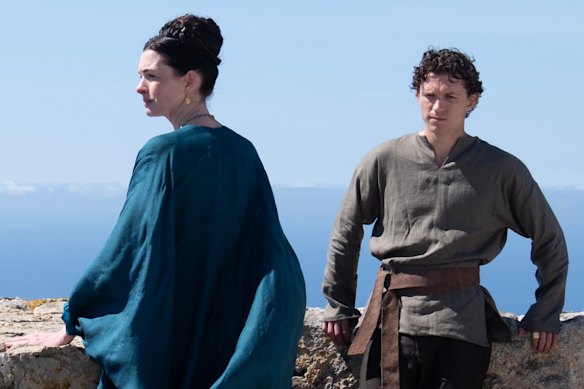
Thirteen films in, it’s Nolan’s turn (“I miss my wife”). With Homer’s ancient epic The Odyssey, he has zeroed in on a text so uniquely well-suited to his own anxieties it’s a wonder it took him this long to get around to it. After all, who is the heroic Odysseus – who spends 20 years away from home, fighting wars and defying gods in a bid to return to his family – if not the original wife guy? And what is The Odyssey if not the urtext for workaholic fathers everywhere, stuck in peak-hour traffic, missing their children’s school recital?
The only question now is whether the man who made superheroes gritty, nuclear physics cool, and Harry Styles an actor (Dunkirk) can also reignite global audiences’ appetite for a very particular genre of cinema. In the mid-20th century, sword-and-sandal epics were Hollywood’s bread and butter before they went the way of the western and the musical. Samson and Delilah, Quo Vadis, The Ten Commandments – from the ’30s through to the ’60s, these historical, often religiously aligned epics delighted audiences and critics alike (to say nothing of the wildly popular Italian “peplum” films, precursor to the “spaghetti western” – a localised knock-off industry that churned out twice as many movies for a fraction of the price).
To watch these old films now is to witness Hollywood at the height of its powers. Ben-Hur (1959) was the most expensive film ever made at the time, utilising more than 300 handmade sets built at the legendary Cinecittà Studios in Rome. The 18-acre (seven-hectare) arena for the famous chariot race was carved into a rock quarry by a thousand craftsmen before being populated by up to 15,000 extras for the 10 weeks it took to film. The following year, Stanley Kubrick’s Spartacus upped the ante with 50,000 extras, including almost 10,000 infantrymen on loan from the Spanish military for its desert battle sequences. Off its $US12 million budget, the film made $US60 million – almost $US700 million in today’s money.
The genre hit its nadir with 1963’s Cleopatra, a lavish four-hour epic directed by Joseph L. Mankiewicz starring Elizabeth Taylor and Richard Burton. Costing three times what Ben-Hur had cost only three years earlier, Cleopatra struggled to make its budget back despite being the highest-grossing film at the American box office that year and receiving nine Oscar nominations. Such astronomical costs, coupled with shifting audience tastes in the nascent 1960s, saw the decline of the golden age of Hollywood’s Greco-Roman fantasia; by the end of that decade, Dennis Hopper would make Easy Rider for less than half a million dollars. The rest is film history.
By the 1980s, Kubrick’s and Mankiewicz’s dogged historical precision had been superseded by all-out fantasy. Sword-and-sandal became sword-and-sorcery. Spartacus became Excalibur. Cleopatra became Conan. In the ’90s, The Last of the Mohicans and Braveheart reminded audiences of the joys of such practically made, historical action epics, but it wasn’t until 2000 that Ridley Scott fully reinvigorated the genre with his barnstorming, best picture-winning Gladiator.
Cribbing the basic premise of Spartacus, with a bit of Ben-Hur chariot action thrown in for good measure, Gladiator felt like a greatest-hits compilation from a bygone era being played to an all-new generation of audience. Its success led to a 21st century mini-renaissance of wildly varying quality. For every half-decent Alexander there was a Scorpion King, an Exodus: Gods and Kings, a Gods of Egypt or a painfully miscalculated remake of Ben-Hur.
It took more than two decades for us to get an official Gladiator sequel, in which the doe-eyed, mini-mulletted internet boyfriend Paul Mescal assumed the mantle of bloodthirsty killing machine (your mileage may have varied). Never forget: there’s a world where Ridley Scott and Russell Crowe didn’t balk at Nick Cave’s proposed Gladiator follow-up, written in the 2000s under the working title “Christ Killer” – and in that world, instead of Gladiator II’s jumbled Force Awakens-style lega-sequel, we got Crowe’s Maximus Decimus Meridius marauding through a purgatorial afterlife, then returning to Earth with a mission to murder Jesus before time-travelling through thousands of years of armed conflict and landing a desk job at the Pentagon.
Two films stand out in the immediate post-Gladiator years: the first is 2004’s Troy, which today plays as The Odyssey’s unwitting prologue. The second is 2006’s 300, helmed by the then up-and-coming Zack Snyder. I can personally confirm that as a teenage boy in the late 2000s, it was more or less impossible to attend a social gathering without another young man kicking you in the chest and declaring, “This is Sparta”.
But 300’s legacy extends well beyond Gerard Butler’s famous catch-cry. It laid the foundations for much of today’s wholly digital cinematography, and honed Snyder’s maximalist, hypermasculine aesthetic only two years after Nolan brought Batman down to earth with his gritty franchise reboot, Batman Begins.
In 2016, when Snyder became caretaker of the caped crusader, he gleefully jettisoned Nolan’s naturalistic house style; Batman v Superman: Dawn of Justice shows the titular characters going toe-to-toe in what can only be described as gladiatorial combat. This too, it seemed, was Sparta.
The founding daddies of DC Comics’ cinematic universe remain stylistically and intellectually yin and yang. Nolan clearly believes that in order for myths to appeal to the masses, the gods in those myths must be relatable; fallible. Meanwhile, the biggest emotional payoff during Synder’s tenure in the DC-verse was the climactic revelation that Superman’s and Batman’s mums have the same name (which I suppose does have a whiff of Greek myth to it). His superheroes are deities in the old Olympian sense: ruthless, six-packed ciphers to be either feared or worshipped but never fully understood.
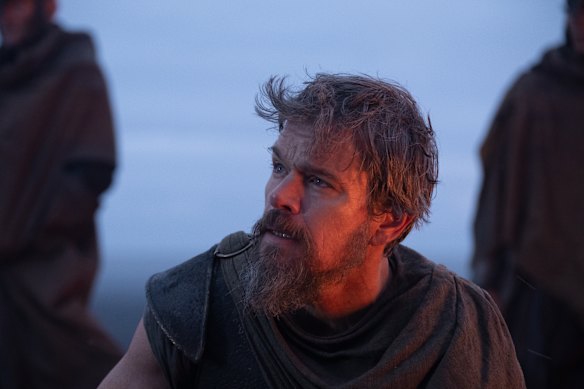
How then will Nolan, a director who prides himself on realism – who made a feature-length repudiation of the very concept of magic with 2006’s The Prestige – tackle an ancient fable brimming with gods, sirens and Cyclopes? On paper, The Odyssey lends itself more to the Snyder school of filmmaking, where the ever-present glow of green screen is a feature, not a bug.
The answer, I believe, lies again with Nolan’s characters. It’s worth noting that the enduring image from Oppenheimer is not the film’s photorealistic atomic explosion, but simply an extreme close-up of Cillian Murphy’s face, tormented by guilt, captured in razor-sharp 65mm.
If The Odyssey proves to be Nolan’s magnum opus, it won’t be because of the period-accurate craftsmanship used to build the Trojan horse, or the thousands of extras on the beaches of Ithaca, or the billion-plus dollars it will probably make at the box office. It will be because he has managed to do again what all enduring myths, and the best movies, do: take something personal and extrapolate it into something universal. A love lost; a childhood missed; a life you could have lived but didn’t. Each a very different kind of kick in the chest.
The Odyssey opens on July 16.
Want more movies? We’ve got you.
Disclaimer : This story is auto aggregated by a computer programme and has not been created or edited by DOWNTHENEWS. Publisher: www.smh.com.au