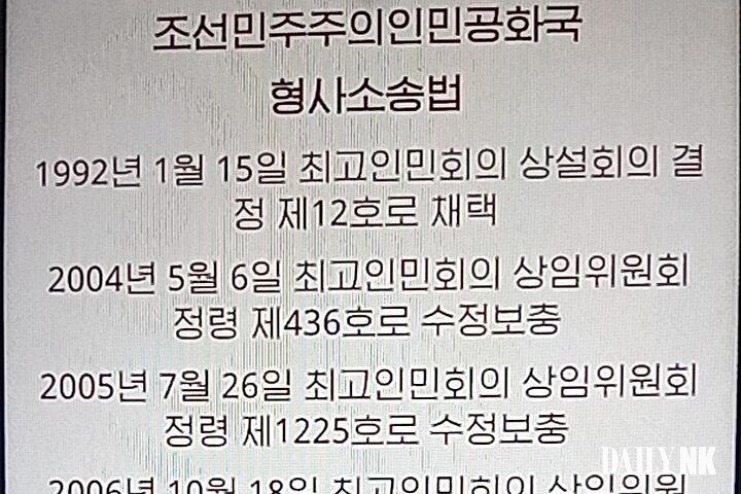
North Korea’s criminal law reform has moved through four revisions since 2021. Each one has added changes that look, on paper, like genuine gains for the rights of suspects and defendants. Pyongyang pushed through more legal and institutional changes in 2026. It renamed its secret police and announced a new police system. Whether any of it translates into real protections for the North Korean people remains an open question.
North Korea revised its criminal procedure law on Jan. 20, 2021. It has updated the law three more times since, on June 30, 2022, May 30, 2023, and Feb. 18, 2025. The most significant changes came in 2022, when authorities strengthened protections for suspects. The 2021 law had allowed suspects to be held for up to two months before an indictment (Article 183). The 2022 revision cut that period to one month (Article 138).
The scope for questioning suspects was tightened too. Under the 2021 law, interrogations could continue without a time limit “when specially necessary” (Article 159). The 2022 revision imposed a hard cutoff of 10 p.m. (Article 148). Prosecutors also lost time to bring charges. The 2021 law had allowed 20 days for cases carrying reform-through-labor sentences or the death penalty. It allowed five days for cases carrying labor-training sentences (Article 258). The 2022 revision cut those windows to five days and three days, respectively (Article 222).
North Korean authorities also moved to strengthen suspects’ right to counsel. The 2021 law required officials to notify a requested defense lawyer of a case within three days (Article 61). The 2022 revision shortened that window to 24 hours (Article 101). The revised law added a new provision too. It let defense lawyers conduct their work independently for the first time (Article 95). It also required investigators, prosecutors, judges and courts to actively guarantee defense lawyers’ activities (Article 110).
That pattern of legislating rights protections carried into the 2025 revision. Authorities added a rule making defense counsel mandatory in certain cases. Those include crimes punishable by life imprisonment with labor or the death penalty, and crimes committed by suspects under 18 (Article 98).
North Korea’s criminal law reform echoes international law
The 2022 revision abolished the preliminary investigation system, a separate pre-trial review process. That process had existed in North Korea for more than 70 years. The 2022 law merged the initial investigation and preliminary investigation into a single procedure. The change was tied to a broader institutional shift. Rodong Sinmun, the official newspaper of the ruling Workers’ Party of Korea, referred to Ri Chang Dae on March 23, 2026, as the “director of the National Intelligence Agency.” Ri is a member of the State Affairs Commission, North Korea’s top governing body. He attended the first session of the 15th Supreme People’s Assembly (SPA), North Korea’s rubber-stamp legislature, that day. Judging by that report, North Korea appears to have renamed its Ministry of State Security to the National Intelligence Agency sometime before the SPA session.
At that same SPA session, North Korean leader Kim Jong Un made an announcement in his policy speech. He said authorities would establish a new police system. Taken together, these changes read as part of a broader effort. Pyongyang appears to be trying to project the image of a “normal state” by abolishing the preliminary investigation system, renaming the Ministry of State Security and creating a police system. The shortened detention and indictment periods align, in form, with the International Covenant on Civil and Political Rights (ICCPR), a United Nations human rights treaty that North Korea has signed. It guarantees the right to trial without undue delay (Article 14.3).
The window for notifying suspects of their assigned defense counsel was cut from three days to 24 hours in the 2022 revision. That change also appears, on its face, to reflect the spirit of the ICCPR, which guarantees defendants adequate time to prepare a defense (Article 14.3). The 2025 revision added a provision on judicial cooperation with foreign countries. It stipulates that cooperation will proceed according to treaties North Korea has signed or joined, and the principle of reciprocity (Article 8). That, too, can be read as a step toward internationalizing North Korea’s criminal justice system.
Whether North Korea follows through remains to be seen
Legal changes on paper and actual improvements in human rights require separate assessments. Judging the latter will require close monitoring of how the law is applied in practice. One risk worth watching involves the preliminary investigation system’s abolition. That system had functioned, however imperfectly, as a check on investigators’ power. It divided investigative authority between two separate roles. Concentrating that authority in a single investigator raises the risk of abuses against suspects’ rights, including coerced confessions.
That risk could grow as North Korea’s new police system elevates the standing of investigators. The early period after the police system’s rollout will be a key window for watching how the loss of institutional checks plays out. The same double-edged reading applies to the new provision allowing defense lawyers to act independently. North Korea’s constitution formally guarantees judicial independence. In practice, though, courts remain under the direction and control of the Workers’ Party of Korea. Given the nature of the North Korean system, defense lawyers cannot be entirely free of that same party control either.
Notably, the 2022 revision also added a clause. It requires that criminal cases be handled “according to the demands of the state” (Article 8). How that requirement interacts with lawyers’ new independence in practice will bear watching. There’s also reason to look closely at the real motivation behind the 2025 revision’s provision on judicial cooperation with foreign countries. It plausibly reflects North Korea’s interest in strengthening cooperation with China and Russia. That cooperation would cover the forced repatriation of North Korean defectors and overseas workers, an issue that has drawn international criticism for years.
The renaming of the Ministry of State Security to the National Intelligence Agency appears likely to work against, not for, the human rights of the North Korean people. The new name suggests a sharper focus on intelligence collection. That raises the risk of deeper encroachment on the privacy of North Korean people. North Korean sources who spoke to Daily NK echoed that concern. They said the new name reminded them of South Korea’s Cold War-era intelligence service, the Agency for National Security Planning, a predecessor of South Korea’s current National Intelligence Service that was notorious for human rights abuses under military rule. They called the association “chilling.” The planned police system likewise appears oriented more toward defending the political system than protecting the rights of the people. Kim Jong Un described its purpose, in his policy speech, as safeguarding the state’s internal security and social stability.
North Korean authorities tend to combine rights-oriented legal changes with tighter social control. That pattern also showed up in the constitutional amendment passed in March 2026. The revised constitution’s preamble declares improving the people’s welfare the highest principle guiding state activity. It adds provisions on affluent and civilized living conditions (Article 22), higher-quality medical services (Article 49) and modern medical facilities (Article 71). At the same time, the revised constitution added a clause on strengthening the fight against “phenomena that run counter to the socialist way of life” (Article 53). That signals a tightening grip on freedom of expression and access to information. It also created a constitutional basis for the Pyongyang Cultural Language Protection Act, a 2023 law that criminalizes the use of South Korean speech patterns and slang (Article 54). North Korea kept its collectivist human rights framework intact too, retaining the constitutional principle that “one is for all, and all are for one” (Article 62).
North Korea has long responded to international criticism of its human rights record. It frames such criticism as an infringement on sovereignty and interference in its internal affairs. In line with that pattern, the 2026 constitutional revision added language to the preamble. That language describes the defense of national interests as an unchanging principle. The addition suggests North Korea’s pushback against international human rights pressure is likely to intensify, framed in the language of sovereignty. That is a troubling sign. If North Korean authorities’ true aim is to genuinely improve the lives of the North Korean people, dialogue and cooperation with the international community offer the only path forward. Only through that path can North Korea gradually move beyond a uniquely North Korean conception of human rights and toward substantive change.
Lee Kyu-chang is director of the Human Rights Research Division at the Korea Institute for National Unification (KINU), a Seoul-based, government-funded think tank. Views expressed in his columns are the author’s own and do not necessarily reflect the views of Daily NK.
Disclaimer : This story is auto aggregated by a computer programme and has not been created or edited by DOWNTHENEWS. Publisher: dailynk.com