
Updated ,first published
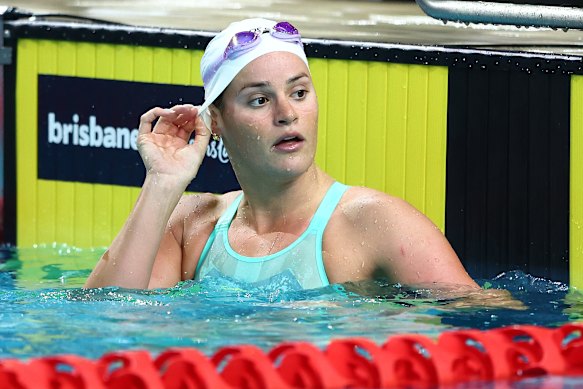
Kaylee McKeown’s shock withdrawal from the Commonwealth Games with glandular fever has opened the door for Dolphins star Mollie O’Callaghan to chase a feat no Australian swimmer has managed before.
Winning one Commonwealth Games gold medal is an outstanding achievement. Winning six is the stuff of Australian legend – but O’Callaghan could conceivably go past that mark in Glasgow now that McKeown is out of the picture.
Susie O’Neill (1998), Ian Thorpe (2002) and Emma McKeon (2022) each won six gold medals in Kuala Lumpur, Manchester and Birmingham respectively, but no swimmer – Australian or otherwise – has won more than half a dozen at a single Commonwealth Games.
Michael Phelps won an astonishing eight gold medals at the 2008 Beijing Olympics, and now the stars may be aligning for O’Callaghan to challenge that mark. Depending on how ambitious she and her coach Dean Boxall want to be with her program, she could realistically contest enough events across the six days of competition, from July 24 to 29, to put herself in contention for six, seven or even more gold medals.
There is another incentive. Australia’s swimmers will receive medal bonuses from billionaire Gina Rinehart worth $20,000 for every individual gold medal they win, giving athletes another reason to maximise their programs in Glasgow.
O’Callaghan will start favourite in her signature events, the 100m and 200m freestyle. She is also a certainty to feature in Australia’s relay teams.
If all goes to plan, O’Callaghan will swim in the women’s 4x100m freestyle, 4x200m freestyle and 4x100m medley relays – events Australia should win.
She is also a leading candidate for both mixed relays — the 4x100m freestyle and 4x100m medley — lifting her potential gold medal tally to seven.
But McKeown’s absence also creates a new opportunity in the backstroke events. McKeown has been undefeated in backstroke events since her glory at the Tokyo Olympics, but O’Callaghan’s ability in those events is often overlooked and definitely underrated.
She finished just 0.06 seconds behind McKeown in the 50m backstroke at last month’s trials, clocking 27.19 — the fastest time this year among swimmers eligible for the Commonwealth Games.
O’Callaghan did not contest the 100m backstroke at trials, but her personal best of 57.88, set in 2024, is comfortably faster than any swimmer from a Commonwealth nation expected to compete in Glasgow. Iona Anderson won the event at trials in 58.60, leaving Australia with the option of entering O’Callaghan.
The 50m backstroke shapes as the more likely addition to O’Callaghan’s program, although scheduling clashes with her freestyle events could force her to back up for two races in the same session. That may prove a step too far.
It comes after Swimming Australia announced on Friday morning that McKeown – one of the greatest backstrokers of all time and a five-time Olympic gold medal winner – had withdrawn from this month’s competition after coming down with glandular fever.
McKeown said the news would be a shock to her Dolphins’ teammates – most of whom would find out about her withdrawal at the same time as the Australian public. She has also withdrawn from the Pan Pacific Championships in California next month, where she would have raced against her arch-rival Regan Smith from the USA in backstroke events.
Mollie O’Callaghan’s potential events at Commonwealth Games
- Women’s 100m freestyle
- Women’s 200m freestyle
- Women’s 50m backstroke
- Women’s 100m backstroke*
- Women’s 4x100m freestyle relay
- Women’s 4x200m freestyle relay
- Women’s 4x100m medley relay
- Mixed 4x100m freestyle relay
- Mixed 4x100m medley relay
*O’Callaghan did not enter this race at trials but could be put forward by Swimming Australia.
“I am gutted to medically withdraw. What I thought a few months ago was the flu has turned out to be my body fighting glandular fever,” McKeown said.
“I was sick going into trials and I just have not got better and I am worried about pushing myself so hard that I end up with chronic fatigue. It was a hard decision to make but it was the right one.”
In a column for The Courier-Mail, McKeown wrote: “The loss of breath and fatigue just after an easy warm-up, not being able to eat, feeling tired all the time, insomnia combined with napping. But the big tell for me was this: sleeping for hours and waking up feeling like I hadn’t slept at all.
“I was swimming times I hadn’t seen since I was 13 and struggling with gym weights I would normally lift with ease.
“Still, I kept pushing through, convincing myself I was just in a hole and that if I worked hard enough, I’d eventually find my way out of it. But deep down, I knew something wasn’t right. My body wasn’t just tired — it felt like it was trying to tell me something, and I had been refusing to listen.”
News, results and expert analysis from the weekend of sport are sent every Monday. Sign up for our Sport newsletter.
 Tom Decent is the chief sports writer for The Sydney Morning Herald.Connect via X or email.
 Billie Eder is a sports reporter at The Sydney Morning Herald.Connect via X or email.
From our partners
Disclaimer : This story is auto aggregated by a computer programme and has not been created or edited by DOWNTHENEWS. Publisher: www.smh.com.au




