The sea keeps its secrets well.
Beneath the ocean’s surface lie some of the planet’s most fragile ecosystems and some of the infrastructure modern life depends on — coral reefs, ship hulls, underwater pipelines, dams, tunnels and bridges.
For decades, inspecting these underwater spaces meant sending divers into difficult and often dangerous conditions.
In rough seas or emergencies, inspections could be delayed for days while teams waited for divers to arrive.
It was this challenge that led two engineers to ask a simple question: if robots can transform warehouses, factories and hospitals, why are people still being sent into some of the most hazardous underwater environments?
That question became EyeROV.
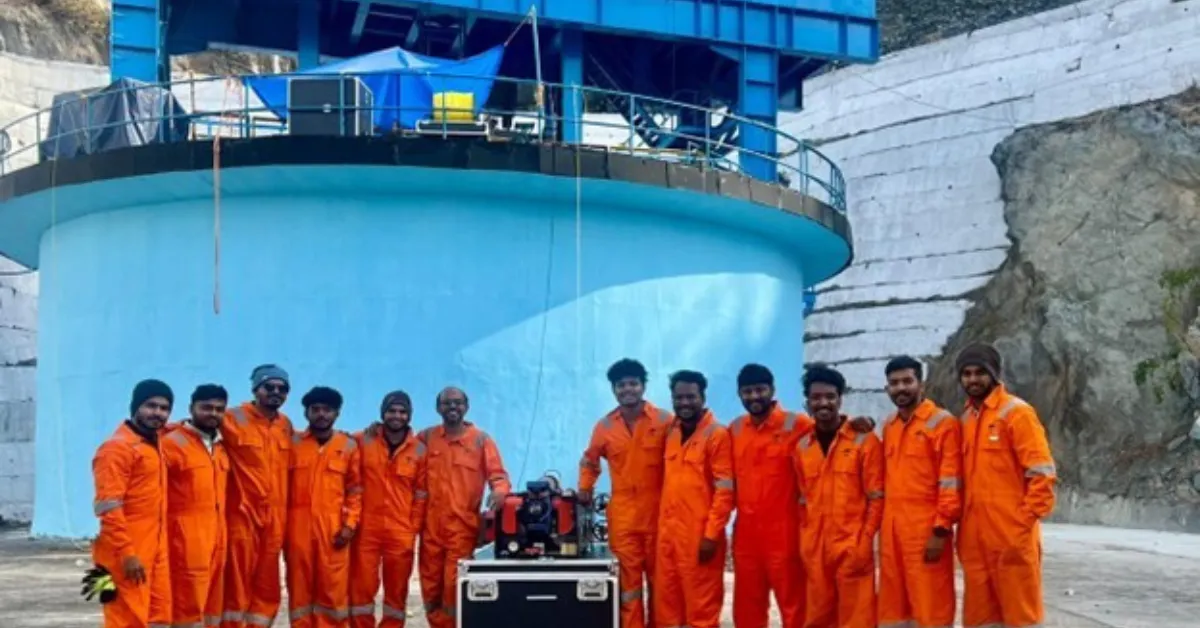
Founded in 2017 by IIT graduates Johns T Mathai and Kannappa Palaniappan, the Kochi-based startup builds indigenous underwater robots powered by artificial intelligence. The systems are designed not only to inspect infrastructure but also to help scientists study marine ecosystems and monitor coral reefs in the Andaman and Lakshadweep islands.
At a time when warming seas, coastal erosion and coral bleaching are reshaping India’s marine ecosystems, the founders believe technology can play an important role in understanding and protecting what lies beneath the water.
A problem waiting to be solved
The founders’ journey to EyeROV began far from the ocean.
Johns and Kannappa were college friends who eventually took different paths. Kannappa went on to study at the Indian Institute of Technology Madras, while Johns pursued his education at the Indian Institute of Technology Delhi.
After completing his master’s degree, Johns joined Samsung Research and Development. But his interest in robotics soon led him to GreyOrange, one of India’s early robotics startups.
Working there showed him that Indian engineers could build globally competitive robotics companies.
Meanwhile, Kannappa found himself facing a very different challenge at sea.
While working as a scientist aboard a vessel, he witnessed the problems that followed a ship collision that required an urgent underwater hull inspection. But there was one issue — no diver was immediately available.
In the middle of the ocean, even a short delay can become a serious operational problem.
When the two friends later reconnected and compared experiences, they realised that underwater inspection still relied heavily on divers.
The gap was obvious.
So they decided to build an alternative.
Building machines for the deep
Today, EyeROV operates from the Maker Village campus in Kochi’s Kerala Technology Innovation Zone and also has an office in New Delhi.
The company has developed a range of marine robotic systems designed for different underwater environments and challenges.
Its compact inspection robot, TUNA, is equipped with HD and 4K cameras and can dive to depths of up to 300 metres.
SAGARA, the company’s larger inspection platform, uses dual 4K cameras with 10x zoom and can move in six directions underwater, allowing it to handle more complex operations.
Sea Serpent, an autonomous surface vehicle, is designed for coastal surveillance and monitoring.
The company has also developed TSROV, a robot capable of travelling through narrow tunnels and pipelines for distances of up to 10 kilometres, making it useful for infrastructure inspections.
Another platform, iBOAT ALPHA, is used for underwater mapping and bathymetric surveys.
Together, these systems offer an Indian-built alternative to imported marine robotics technology.
Making the invisible visible
Underwater inspection is rarely straightforward.
Sediment-heavy rivers, deep reservoirs and damaged tunnels often reduce visibility to almost zero.
This is where EyeROV’s artificial intelligence platform, EVAP, comes in.
Once an underwater robot enters the water, operators guide it remotely using a control station while live video feeds stream back to the surface.
The AI platform then processes this footage to identify defects, generate digital models and create clearer visual reconstructions of underwater structures.
This allows engineers to detect corrosion, cracks, leakages and structural weaknesses without physically entering the water.
For marine researchers, it opens up new possibilities as well.
Scientists studying coral reefs in the Andaman and Lakshadweep islands can collect detailed visual data remotely, reducing the need for repeated dives that may disturb sensitive ecosystems.
Even in low-visibility waters, enhanced imaging helps researchers monitor reef health, biodiversity and habitat conditions more effectively.
Helping protect coral reefs
Coral reefs are among India’s most vulnerable marine ecosystems.
Rising sea temperatures, pollution and physical damage continue to place these habitats under pressure.
Monitoring them, however, is often difficult because many reef systems lie in ecologically sensitive areas where frequent human activity can itself become disruptive.
/filters:format(webp)/english-betterindia/media/media_files/2026/07/10/coral-reef-2-2026-07-10-16-24-58.png)
EyeROV’s underwater robots offer a less invasive way to observe these ecosystems.
The robots capture high-resolution footage and environmental data while minimising direct human interference.
For scientists, this means a better understanding of reef health, bleaching events and biodiversity changes.
The company has already supported marine biodiversity studies in both the Andaman and Lakshadweep archipelagos, contributing to ongoing conservation efforts.
It is an example of how technology developed for industry can also support environmental protection.
Looking ahead
For coastal communities and industries, safer underwater inspections can reduce delays and improve safety.
For scientists, better underexplowater visibility means better data and a clearer understanding of changing marine ecosystems.
For India, it represents the growth of a homegrown marine robotics sector built by Indian engineers.
EyeROV’s work is changing how underwater inspections are carried out — replacing risky human dives in places that may be dangerous, inaccessible or environmentally sensitive.
And in doing so, these robots are helping researchers, engineers and conservationists better understand a world that remains largely hidden beneath the waves.
Disclaimer : This story is auto aggregated by a computer programme and has not been created or edited by DOWNTHENEWS. Publisher: thebetterindia.com