
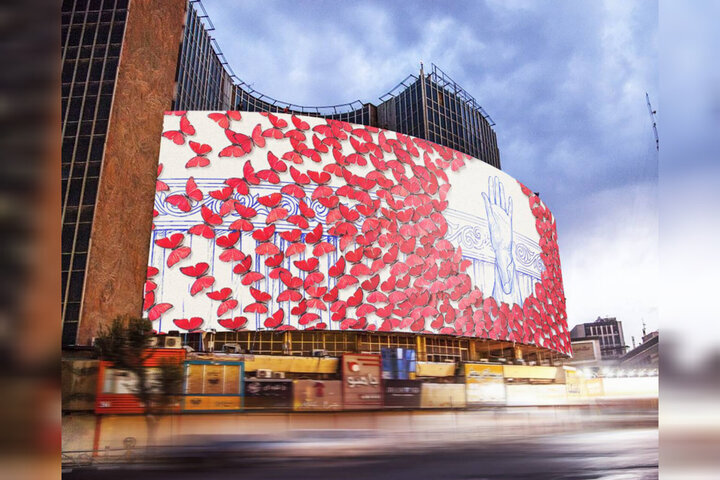
TEHRAN- A new mural was unveiled at Tehran’s Valiasr Square on Friday, marking the final stage of the nation’s farewell to the martyred Leader of the Islamic Revolution, Ayatollah Seyyed Ali Khamenei.
The mural, designed by graphic artist Danial Farrokh—who also crafted the previous installation at the site—depicts the hand of the late Leader in a gesture of farewell. The artwork is adorned with imagery of butterflies, symbolizing the Iranian people, accompanied by the poetic line: “What candle is this, for which all souls are but butterflies?”
The unveiling coincides with the conclusion of the extensive funeral and farewell ceremonies. The processions, which spanned six days and took place across Tehran, Qom, Iraq, and Mashhad, culminated with the official burial of the martyred Leader.
The mural serves as a visual tribute to the profound bond between the Leader and his followers, capturing the atmosphere of mourning and devotion that has characterized the country throughout the mourning period.
This latest installation follows the global acclaim of Farrokh’s previous work, the “Clenched Fists” mural, which was unveiled at the same site back in May.
The piece depicted the Martyred Leader, Ayatollah Seyyed Ali Khamenei, using imagery of clenched fists and a Quranic verse on divine victory to symbolize national resilience and solidarity. This artistic tribute coincided with the historic surge of the JANFADA grassroots campaign; initiated in response to US-Israeli threats, the movement saw over 31 million volunteers—including more than 60 percent women—pledge their devotion to safeguarding the homeland.
Following the coordinated US- Israeli attack on February 28, which targeted key national facilities in Iran, Ayatollah Seyyed Ali Khamenei, the Leader of the Islamic Revolution, was martyred. Ayatollah Mojtaba Khamenei has since been appointed as the new Leader by the Assembly of Experts.
The martyrdom of the Ayatollah Khamenei was not merely the loss of a political figure, but the departure of a spiritual guide whose entire life was dedicated to the pursuit of justice and the liberation of the oppressed. This ultimate sacrifice, born from the depths of a conflict fueled by imperialist ambitions, has left an indelible mark on the collective soul of the Iranian people and the wider Muslim world, transforming a moment of profound grief into a catalyst for renewed resistance and steadfastness.
In the days following his farewell ceremonies, the streets of Iran’s major cities were transformed into rivers of black, as millions of followers gathered to pay their final respects to a leader whose guidance had shaped the country’s political and spiritual trajectory for decades.
The funeral rites were characterized by their unprecedented scale and geographic reach, spanning six days of mourning. The processions began in Tehran and extended to the holy cities of Qom and Mashhad, and even reached Najaf and Karbala cities in Iraq, reflecting the Leader’s influence beyond national borders. These ceremonies served not only as a final farewell but as a massive demonstration of unity and loyalty. The burial, attended by high-ranking officials and vast crowds of ordinary citizens, concluded a period of intense national mourning, transitioning the country from a state of collective sorrow to a renewed commitment to the principles for which the martyred Leader stood.
SAB/
Disclaimer : This story is auto aggregated by a computer programme and has not been created or edited by DOWNTHENEWS. Publisher: tehrantimes.com





