Who would be a defence coach these days?
No one without a high tolerance for pain, especially when it comes to stopping teams such as France. The 32 points France scored against the All Blacks last week was the fewest they have scored all year.
They scored 36 against Ireland, 54 against Wales, 33 against Italy, 40 against Scotland and 48 against England. Les Bleus are averaging 40.5 points a game this year, and it doesn’t seem to matter who they pick in the backline.
Wallabies coach Joe Schmidt is justifiably anxious about the damage that playmakers Romain Ntamack and Matthieu Jalibert could cause in Brisbane on Saturday, but France’s greatest weapon is how they are coached.
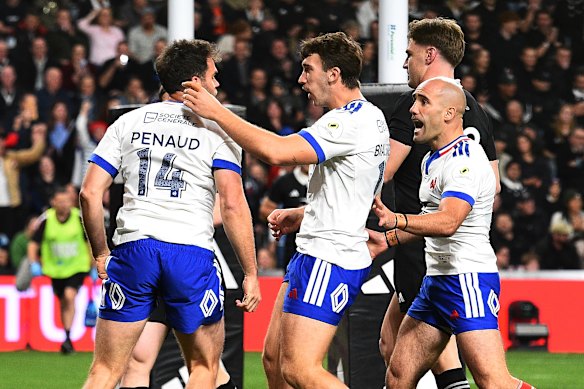
Take a look at the passing sequence that led to winger Theo Attissogbe’s try in the 58th minute against the All Blacks in Christchurch.
After a break down the left edge, it went as follows: halfback to prop, to No.10, to flanker, to another prop, to a second-rower, to centre and then to Attissogbe.
Despite the play involving three tight forwards, the All Blacks did not lay a hand on any of the players in that attacking raid.
Hopefully, the right people at Rugby Australia are taking a close look at that sequence and asking some hard questions about how players in Australia are being coached.
Few, if any, teams in Super Rugby would have scored that try. Why? Because after the initial break, the forwards would have congregated in a pre-planned “pod” and taken contact, effectively wasting a phase.
Eventually, the ball might have been pulled back to the No.10 for a cross-field kick, but by that time it would be a lower-percentage play.
It was also telling how the All Blacks tried to defend that try. They all moved forward, not laterally, because they are so used to opponents taking contact, rather than looking for space.
It meant France No.13 Fabien Brau-Boirie easily beat Ardie Savea on the outside. The All Blacks just weren’t used to the way the French attack.
Importantly, this all comes from France’s coaching and mindset, not an impossible skill set. None of the short passes along the chain from the French players were particularly difficult to execute – they were all well within the capability of Australian players.
But, until the Wallabies and Super Rugby teams break free of their own metaphorical chain of robotic, structure-led coaching, the try that Attissogbe scored will remain out of reach.
That revolution won’t happen this weekend, so how can the Wallabies stop the French in the second Test of the Nations Championship?
With great difficulty, which means they will need to outscore them instead of trying to shut them down.
England took this approach in the final Test of the Six Nations, and almost succeeded. England scored 46 points in Paris and were arguably unlucky to lose.
They did so by effectively throwing caution to the wind in a remarkable game, and it is very hard to see the Wallabies winning unless they at least borrow some of that ambition.
As a result, the losses of Carter Gordon and Ben Donaldson are massive blows. There were some great signs in attack from the Wallabies against Ireland last week, especially in the first half.
Gordon’s running game would have troubled the French. The All Blacks were successful in creating space for No.10 Ruben Love from their first-phase attacks last weekend, but it is a big ask of Declan Meredith to be so assertive on his Test debut on a big stage.
But if the Wallabies want to take a great leap leading up to the Rugby World Cup next year, they have to take a leaf out of France’s book.
Go back to that France passing sequence and instead insert the names of Wallabies forwards: Angus Bell, Fraser McReight, Taniela Tupou and Josh Canham. You can’t tell me those blokes are incapable of using their skills to provide a link between the forwards and backs.
In today’s attack-focused world of Test rugby, fortune favours the brave.
 Paul Cully is a rugby columnist for The Sydney Morning Herald.Connect via X or email.
From our partners
Disclaimer : This story is auto aggregated by a computer programme and has not been created or edited by DOWNTHENEWS. Publisher: www.smh.com.au