
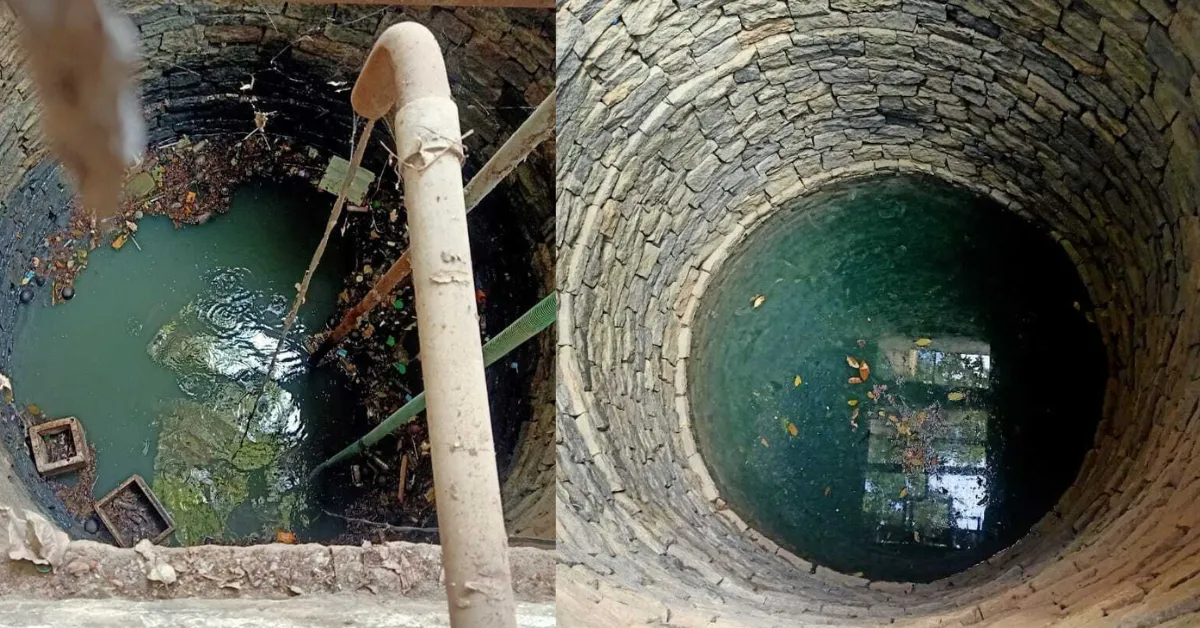
At the edge of a small temple lane in Bengaluru’s Sampangiram Nagar, a circular stone well sits behind a metal grill canopy.
A few years ago, most people walked past it without stopping. Some avoided going near it at all.
Plastic waste floated on the surface. Broken concrete and silt had settled at the bottom. Tree branches hung low over the opening, dropping leaves and debris into the water. The stone walls had cracked in places, with weeds pushing through gaps that had widened over years of neglect.
For many residents, the well had stopped feeling like a water source long ago. It had become a dumping ground.
Today, the same well draws people to it every day.
Residents arrive with steel pots and plastic buckets. Water is pumped into an overhead tank connected to public taps. Families collect water for daily use through the day. Small eateries nearby use it for cleaning. On days when municipal supply is irregular, the well becomes a source they can turn to.
Even in difficult summers, it continued to hold water.
For a city where many families now plan their days around tanker timings, dry borewells, and uncertain water supply, this change matters. A forgotten well becoming useful again may seem like a small neighbourhood story. But in Bengaluru, it points to a much larger possibility: old water systems can still help a growing city face its present water crisis.
The Sampangiram Nagar well is one example of a wider effort across Bengaluru. Residents’ welfare associations, citizen groups, and environmental organisations are restoring traditional wells that had slowly disappeared from public memory as borewells and piped supply systems took over.
When Bengaluru’s water disappeared underground
For decades, Bengaluru’s water story slowly moved underground.
As the city grew, borewells began replacing open wells in homes, schools, apartment complexes, and public spaces. What was once visible to everyone, a well in a courtyard, beside a temple, or inside a neighbourhood, gradually disappeared behind pipes, pumps, and motors.
Deep drilling gave neighbourhoods access to groundwater far below the surface. It felt convenient. Turn on the motor, and water would come up.
But this also changed how people understood water.
With an open well, the water level is visible. After good rain, people can see it rise. During dry months, they can see it fall. The well reminds a neighbourhood that groundwater depends on rain, soil, and recharge.
A borewell does the opposite. It hides the water level deep underground. For years, it may keep pumping without showing how much water is left. The warning comes late, often only when the motor begins pulling up air instead of water.
By then, the crisis has already reached people’s homes.
Open wells work with a shallower layer of groundwater. When rainwater enters the soil and seeps down, it helps refill this layer over time. That is why a functioning open well can show a neighbourhood what is happening beneath its feet.
When such wells are cleaned, repaired, protected from sewage, and connected to rainwater harvesting systems, they can become useful again. They can serve as local water sources during shortages and also help recharge groundwater in the area.
How one forgotten well was brought back to life
The restoration of the Sampangiram Nagar well, completed in 2022, began with a difficult cleanup operation.
The restoration was carried out by SayTrees Environmental Trust, a Bengaluru-based environmental nonprofit founded in 2007 by Kapil Sharma and Lt Cdr Deokant Payasi.
The project was implemented with support from corporate CSR funding and is now maintained through a partnership involving SayTrees, local residents, and civic authorities to ensure the well remains clean and functional.
The public well is seven feet wide and 40 feet deep. By the time restoration teams began work, it had collected years of garbage, civil debris, sludge, and organic waste. The water first had to be flushed out completely using motors before workers could even reach the bottom.
Photographs from the early stages show the extent of neglect. Garbage was packed against the stone walls. Weeds had grown through cracks. Dark, contaminated water stood inside the well, mixed with floating waste.
Cleaning it was slow, physical work.
Workers used manual labour and cranes to remove layers of muck from nearly 40 feet below ground. The extracted silt and debris were piled nearby for days so they could dry. Tractors then carried it away for disposal.
The well structure also needed attention. Its stone walls had to be repaired. The old grill cover had allowed leaves and waste from the tree canopy above to keep falling inside. Restoration teams raised the grill cover and added a sloped canopy to prevent fresh debris from collecting in the water.
The water was then treated using alum, potassium permanganate, and calcium before the well was connected back to community use.
Today, the restored well has a storage capacity of more than 43,000 litres. According to project estimates, more than 1,000 litres are used every day through the public tap connection.
In simple terms, the work followed a model that many neighbourhoods can understand: remove the waste, desilt the well, repair the structure, protect the opening, treat the water, prevent contamination, and connect it safely for local use.
For residents, the difference is daily
For local residents, the change is measured less in numbers and more in daily relief.
“My name is Shrinivas, and I have been living in this area for the past 40 years. I also run a shop here,” says Shrinivas, a resident, in an interview with The Better India. “We do not receive regular corporation water supply, so the community largely depends on local water sources.”
/filters:format(webp)/english-betterindia/media/media_files/2026/07/10/bengaluru-open-well-2-2026-07-10-18-50-00.png)
For him, the well is tied to ordinary routines: running a shop, managing household needs, and getting through days when water supply is uncertain.
“The recent cleaning and restoration of the well has been extremely beneficial for everyone in the neighbourhood. It has improved water availability for residents and local businesses, including hotels and eateries. This initiative has made a meaningful difference to our daily lives, and the entire community has benefited from it.”
Another resident, Vijay Kumar, has watched the well through many phases of the city’s growth.
Living beside the structure, he remembers when the well functioned normally decades ago, before years of neglect slowly consumed it. He also remembers something else: the well never truly failed.
He says the century-old water source continued holding water even during severe drought periods and years of scarcity.
That memory stayed with the community long after the structure itself fell apart. People may have stopped using the well, but the water had remained.
An emotional connection with rainwater
Across Bengaluru, water tankers have become part of everyday life.
In many neighbourhoods, summer now brings a familiar routine: waiting for tanker deliveries, storing water carefully, and worrying about when the next supply will arrive. Apartment complexes often spend lakhs of rupees every month purchasing water transported from peri-urban and rural areas surrounding the city.
This water also comes at a cost to places outside the city. Tankers rely heavily on groundwater extraction from villages around Bengaluru, shifting water stress from urban consumers to rural aquifers. Diesel-powered transport adds another environmental cost.
Restored open wells support the city’s formal water infrastructure by reducing pressure on it.
Several restored wells across Bengaluru are now being used for gardening, construction work, cleaning, and filtered domestic use during shortages. Each functioning well gives a neighbourhood one more local source to depend on, especially during peak summer months.
The shift is practical, but it is also emotional.
“Tanker water creates a consumption mindset,” says a volunteer associated with urban well restoration efforts. “Water arrives like a product. People don’t see where it comes from.”
An open well brings that connection back.
Residents can see the water level. They can notice what happens after rain. They can understand why recharge matters, why waste should stay out of drains, and why paved surfaces change how water enters the ground.
Many restoration projects are now paired with rainwater harvesting systems so that monsoon runoff remains within local ecosystems instead of flowing away into stormwater drains.
A neighbourhood solution for a changing climate
The work around open wells is also becoming part of a larger climate response.
SayTrees has also been expanding water conservation programmes across India through lake restoration and the revival of traditional water systems. So far, the organisation has restored more than 50 lakes and water bodies and revitalised over 30 traditional open wells, collectively creating more than 5 billion litres of water storage capacity.
For Bengaluru, this matters because the city now faces two kinds of water stress at once.
During intense rainfall, several areas flood. During summer, many of the same city’s residents struggle with shortages.
Traditional water systems can help with both. A restored well can hold water, support recharge, reduce surface runoff, and help the surrounding soil retain moisture. It can also preserve older water-management systems that once shaped settlements across southern India.
In neighbourhoods like Sampangiram Nagar, the restored well has brought back a shared public space tied closely to community life and local memory.
For older residents, it is a reminder of a time when water was drawn from places people knew and cared for.
For younger residents growing up amid tanker queues and water-crisis warnings, it shows that solutions may exist closer home than they imagined.
One resident who now visits the public tap daily summed it up simply when asked how much water he collects from the restored well.
“Six buckets,” he said.
Every day.
In Bengaluru, that increasingly means the difference between having water and running out of it.
Disclaimer : This story is auto aggregated by a computer programme and has not been created or edited by DOWNTHENEWS. Publisher: thebetterindia.com






