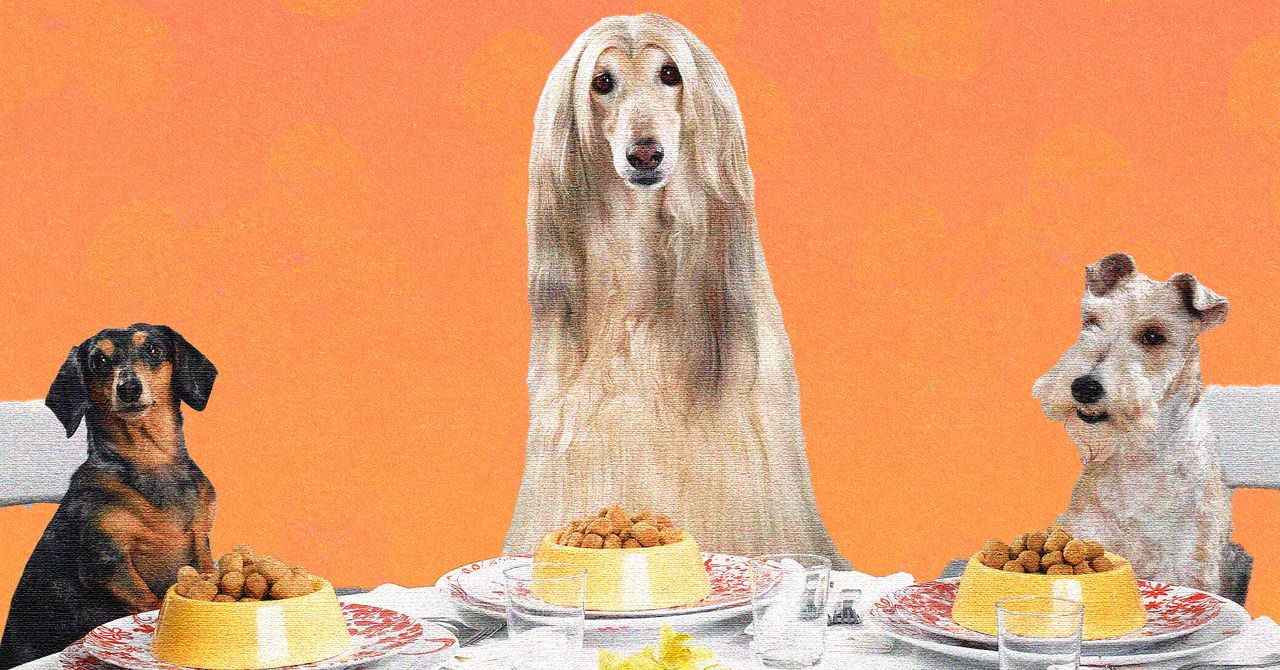
Home-cooked dog food has a more illustrious history than I could have imagined.
In 1966, the ur-food writer M.F.K. Fisher reviewed cookbooks for pets in The New Yorker, and in the late ’90s, Jeffrey Steingarten chronicled the act of cooking chef Daniel Boulud’s “French Country Soup for Dogs and their Owners” for his pooch in Vogue.
French food writer Frédérick E. Grasser-Hermé put out Mon chien fait recettes (My Dog Makes Recipes) in 2001 and threw a launch party where doggie guests were served bone marrow topped with caviar. For her final publication in 2014, Judith Jones—editor of Julia Child, Edna Lewis, and many other gourmand greats—wrote Love Me, Feed Me, an ode to cooking for her Havanese featuring recipes like roast beef shoulder with broccoli rabe and lamb and sweet potato hash. Martha Stewart, in 2022, blogged about what farm-fresh foods her own canines consume. Nara Smith, in 2026, carries on the lineage as an influencer, serving a new rescue pup beef, cabbage, and sardines.
Nowadays, with over 87 million dogs kept as pets in the US, the world of their wellness has gotten even more extreme: There is red-light therapy and longevity pills. But food remains the most fraught matter for many dog owners. According to a pair of American Veterinary Medical Association surveys that spanned more than a decade, there’s been an estimated 3 to 8 percent uptick in those who cook for their canine companions.
I’m now part of that demographic.
When I first got my dog, Benny, in 2019, I worried about what to feed him. I’d given up meat in 2011, but I didn’t think it would be fair to feed vegan kibble to a natural carnivore. I couldn’t see myself sizzling up steaks for him, either. He’s a large, active dog, at 70 pounds; I worried I wouldn’t be able to keep up with properly cooking for him. So I gave him commercial dog food that was recommended by his veterinarian, dressed it up with farm-fresh eggs, steamed vegetables, and sardines. We went on with our lives.
Then, in early 2026, Benny was diagnosed with lymphoma. I started to question myself all over again with the same line of thinking as all those gourmands who’d come before: If food were so important to me and I wouldn’t want to subsist on the same dry food all the time, why did I expect my dog to do so happily and healthfully?
I immediately began to research how to cook nutritionally sound dog food at home that would enable him to retain weight, strength, and vitality during his six-month chemotherapy treatment. But when I did, I felt like I’d fallen into a rabbit hole and couldn’t discern the MAHA from the science.
There were websites that looked like they hadn’t been updated since the ’90s, Facebook and Reddit threads in which people argued over whether or not to peel sweet potatoes, and concerns about carbohydrates that I hadn’t thought about since Atkins went out of style. Hadn’t dogs, the first domesticated animal species, at some point in pretty recent history just eaten whatever the humans around them were eating? And yet, it seemed like if I didn’t have access to pounds of organ meat or keep dried oyster powder in my larder, I shouldn’t even try.
To understand why this dog food world seemed so complex, I talked to Jonathan Stockman, a board-certified veterinary nutritionist and assistant professor at the UC Davis Weill School of Veterinary Medicine. He has noticed that home-cooked food for dogs has been a growing trend for at least 15 years, and he suggests the “melamine crisis” as the origin point.
That crisis occurred in 2007, when a company named Menu Foods that was responsible for making 1,300 recipes for various private-label contracts included wheat gluten that had been poisoned by the inclusion of melamine, a type of plastic. Dogs and cats both began mysteriously dying, and it was traced back to this ingredient found in their meals, initiating a massive wave of recalls—the biggest in pet food history.
Marion Nestle, a prolific author on public health and professor emerita at NYU who has written extensively on consolidation and political influence in the human food system, was inspired by this event to write Pet Food Politics: The Chihuahua in the Coal Mine to chronicle how the recalls occurred and what could be learned from it.
Nestle tells me over email that though pet food recalls still occur regularly, none since Menu Foods’ have been as catastrophic in terms of the number of animals affected. “Most happen because somebody forgot a crucial step or otherwise got sloppy with protocols,” she says. “Dry food is not sterile, and it is a great growth medium for pathogens like Salmonella. If companies do not develop and maintain a ‘culture of safety,’ meaning that everyone involved follows food safety protocols to the spirit as well as letter, accidents happen.”
That major event in the commercial pet food world inspired renewed interest in how to make feeding our animal companions more nutritious and safe, and thus the rise of home-cooked and homemade-style foods, like The Farmer’s Dog, which debuted in the mid-2010s. Its vacuum-sealed meals are made with what the company calls “human-grade” ingredients of meat, vegetables, and perhaps grain, mimicking what you might make at home if you were so inclined.
Influencers Joelle Jay and R.A. Young go by the handle @TheCedLife on Instagram. The duo published a cookbook at the end of 2025 called The Dog’s Table and have a Substack named Precious Kitchen where they go more in-depth on dog nutrition. Their videos show them feeding extravagantly prepared meals like “pawella” and salmon coconut curry to their two small dogs, complete with bespoke mock labels for things like doggie beer and Dave’s Paw Chicken.
“When we started gaining a following we wanted to make sure that we didn’t harm our dogs or, worse, lead others to harm their dogs,” says one half of the couple, Young, over email. “We dug into literature going back over 50 years to understand the optimal nutrient requirements.” He notes that while their elaborate content is made for views, their recipes are designed for day-to-day feeding. “The fancy content is the attention grabber,” says Young. “When it comes to daily food, batch cooking is definitely the way to go. All anyone needs is a freezer and a pot. You can easily make a meal that hits all the major nutrients with seven to eight ingredients all available from the store.”
Stockman, though, doesn’t think homemade food is necessary for every dog nor better than conventional options. He says that while a lot of people have theories about processed pet food containing toxins or other bad ingredients, there’s no evidence to prove that. “This homemade food or homemade-style food is not superior to commercial kibble or canned food,” he says.
For the vast majority of dogs, Stockman says, owners can stick with dry or canned food. If a dog is very picky, isn’t eating enough, or requires more nutrition for medical reasons, then owners can consider home-prepared foods or a home-prepared-style diet.
He recommends the website Balance.it for figuring out the proper ratio of ingredients. It’s what I’ve used to guide my own dog food adventures (along with Martha Stewart’s insight, mirroring how I learned to cook for myself). Stockman also notes that cooking for your dog every day could quickly become cost-prohibitive. I too had the concern that if the narrative about homemade dog food’s virtues becomes too popular, it might make people hesitant to adopt dogs who need homes. Once they add up the costs and consider how much time batch cooking demands, they might think twice about a trip to the pound.
A 2024 study published in the journal Veterinary Sciences showed that dogs with dermatological or gastrointestinal issues have better outcomes while on a homemade diet, and a 2025 study published in Metabolites (funded by The Farmer’s Dog, it should be noted) found that “fresh, human-grade food” also had benefits for metabolism and other health markers. For Benny, I’ve focused on a very high-protein blend, usually chicken-based, with a mix of different vegetables, sardines, and eggs. I’ve even found a home for some would-be compost or food waste, like broccoli and kale stems, in his weekly meals. It’s a learning process to make it as stream-lined as cooking my own oatmeal and omelets, but I’ve gotten into a groove of having to prepare and freeze vegetable blends once per month and meat one to two times per week.
Though I feed myself and my husband tofu and beans as our major protein sources, I’m planning to try some of the French author Grasser-Hermé’s extravagant marrow and caviar ideas to help Benny celebrate when his treatment is over. After a few months of chemo, he has maintained his weight and energy. It’s anecdotal evidence, though, and perhaps I’ve changed his diet as a balm to assuage my own amorphous guilt.
Research does show that people who are very invested in their dogs’ well-being want to make choices for them that mirror ones they’d make for themselves, seeking out labels and ingredients for their pets that reflect their own food values back to them. That explains why so many food writers will cook their dogs extravagant meals and why vegans are the most likely demographic to feed their dogs vegan kibble.
The move toward homemade food seems to be one that has taken shape in the aftermath of the melamine crisis as well as alongside not just the ideologically confused MAHA movement but also the post–Omnivore’s Dilemma awareness of how consolidated the food system is and that ultra-processed foods can influence poor health outcomes.
Nestle would be the authority on that. “From what I can tell, people who want to cook for their pet or buy commercial home-cooked meals cannot imagine feeding their animals commercial dry or canned food, just as they cannot imagine feeding their children any such thing,” she says. “They view all commercial canned and extruded products as overly industrialized, nutritionally poor, and disgusting. The ultra-processed designation just confirms what they already believed.”
The proof of whether changing Benny’s diet was a boon to his health will be, I suppose, in the length of his remission—but plenty of dogs live long, beautiful lives without their owners losing their minds over macros.
Finding the lineage of gourmands and food writers who invested in stunning meals for their furry friends has been more of a pleasure to me than boiling, baking, and grinding eggshells to ensure Benny gets his calcium. They’re also a reminder to me that indeed, humans want to feed their animals the same way they hope to eat: For me, that’s deliciously and well.
Disclaimer : This story is auto aggregated by a computer programme and has not been created or edited by DOWNTHENEWS. Publisher: wired.com