TEHRAN – As the region is engulfed by wars and fast-moving developments that are difficult for observers to keep up with, attention to what is happening in the West Bank has steadily declined. Public interest has waned.
First, it is essential to understand what has unfolded on the ground in the occupied West Bank since October 7, 2023.
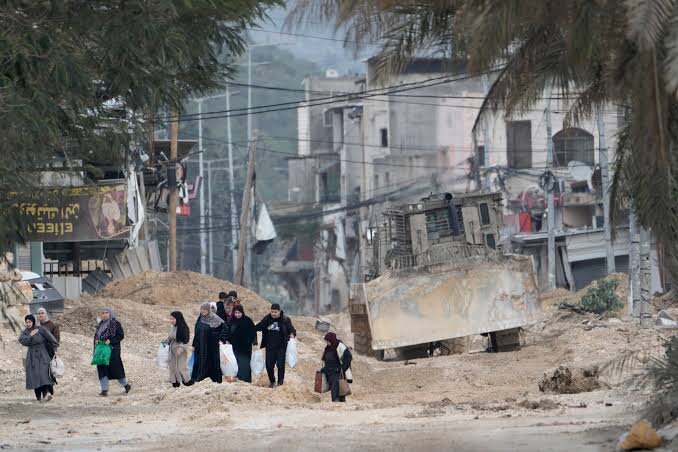
At least 1,200 Palestinians have been killed, 12,600 more have sustained injuries of varying degrees, while Israeli Occupation Forces (IOF) have carried out 24,000 arrests. During the same period, the IOF has destroyed 55 percent of the Jenin refugee camp, displacing more than 25,000 residents, over a quarter of whom have lost their livelihoods.
The IOF has also demolished 40 percent of the buildings in the Nur Shams and Tulkarm refugee camps, forcing more than 40,000 residents to flee their homes, the largest displacement of Palestinians since 1967, according to UN reports.
Amid these displacement campaigns, the crisis at the land crossing (the bridge) between Palestine and Jordan came to the forefront. For Palestinians in the West Bank, the King Hussein Bridge is their only door to the world. But the regime controls it, restricting hours, limiting travelers, and shutting it down at will.
Since October 7, this has left Palestinians stranded, families separated, and patients cut off from medical care. Jordan is on the other side but cannot open it, though critics say it has not tried hard enough. The result is that Palestinians are trapped, with no way out and no control over their own movement.
Yet almost no one discussed the increase in departures from the West Bank, whether to Jordan or beyond, as one of the factors behind the crisis and as a direct consequence of the mounting IOF restrictions imposed on Palestinians and the closure of every avenue for normal life.
On the ground, the occupying regime’s government has, since October 7, built 30 new settlements, set up 165 outposts, approved plans for 61 new settlements, mostly concentrated in Jenin and Hebron, and added 2,721 new settler units to existing settlements.
The objective, as the terrorist Itamar Ben-Gvir put it, is to “bury the Palestinians’ dreams of any form of independence.” At the same time, the Zionist government announced the annexation of crown lands belonging to the Jordanian government and reactivated the Absentee Property Law, through which it seized vast areas of land in Palestine occupied since 1948.
Politically, the Ramallah-based Palestinian Authority, continues to comply with U.S. policies supporting the Zionists, even though the regime’s aggression and settlement expansion have extended beyond Palestine into southern Syria and Lebanon. The military dimension of this expanded occupation has also morphed into an explicit declaration of intent to remain permanently and establish settlement projects, as has occurred in the Yarmouk Basin in southern Syria.
The so-called U.S. “Peace Council” tasked with administering the Gaza Strip, announced that there would be no place for UNRWA in Gaza. This coincided with the Israeli authorities’ decision to prevent UNRWA from providing its services in al-Quds (Jerusalem). Together, these decisions establish a political precedent that will likely be extended to refugee camps throughout the West Bank.
If the project in Gaza relies on attracting foreign investment and commercial interests in the hope of turning the public away from resistance, then the extension of this same project to the West Bank, amid the absence of regional support and the mounting crises facing the Ramallah Authority, can only be seen as another major step toward the displacement of Palestinians.
Some may ask why U.S. policy, working alongside the Zionist regime and the Ramallah Authority, has not adopted plans for the West Bank similar to those being pursued in Gaza. The answer is straightforward: the West Bank lies at the very heart of the Zionist project in Palestine, and the existence of large Palestinian population centers fundamentally challenges that core objective.
Annexing the West Bank while this large Arab population remains would fundamentally alter the structure of the envisioned Jewish state. Consequently, the goal is to remove as many Arabs as possible, whether through forced expulsion or, more commonly, through “soft displacement” by turning the West Bank into a place where Palestinian Arabs can no longer sustain a livable existence.
Beyond this, the West Bank serves as the gateway to the “peace” that colonial interests view as both a political and economic project, enabling the Zionist regime to integrate into its Arab surroundings, particularly the Persian Gulf states, where the colonizers’ greatest economic interests lie. Control over the Persian Gulf and its resources has become even more significant amid the global economic race led by China and the United States.
Hence, efforts are underway toward integrating the region’s economy with its colonial spearhead in Palestine. Politically, through so-called peace agreements/normalization, and economically via the Indian trade corridor project, which begins in the Persian Gulf and reaches the port of Haifa via Jordan.
Strategically, the Zionist regime views the 1948 Palestine’s eastern front as the greatest threat to its existence. This front stretches for 650 kilometers, while the 1948 Palestine’s maximum width (from the river to the sea) is no more than 70 kilometers. In other words, if Palestinian resistance forces cross from the West Bank, they can reach the Mediterranean coast in hours.
This represents the most profound strategic and existential concern for both the colonial and biblical dimensions of the Zionist project. It can only be neutralized through complete control of the West Bank.
Viewed through this lens, the West Bank can be understood as the central arena of confrontation with the colonial project in the region. The drive to seize it is the principal force behind many Zionist policies, beginning with the genocide in Gaza, extending through southern Lebanon and Syria, and culminating in the U.S.-Israeli aggression against Iran.
This is why a substantial share of the region’s political efforts must be directed toward the occupied West Bank, while providing its people with every possible form of support, particularly by strengthening the local economy. Such action must rest on the firm conviction that any so-called peace agreements are nothing more than illusions promoted by colonialism.
Disclaimer : This story is auto aggregated by a computer programme and has not been created or edited by DOWNTHENEWS. Publisher: tehrantimes.com