
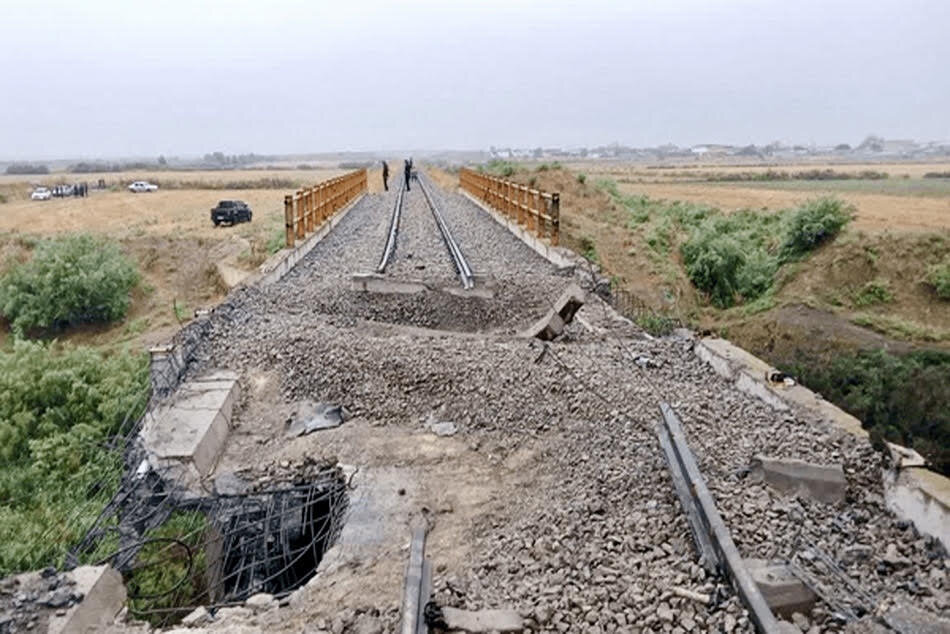
TEHRAN- On the night of July 9, 2026, American cruise missiles struck the Aq-Tekeh Khan railway bridge near Aq-Qala in Iran’s northern Golestan province. The target was not a military base, not an air defense battery, not a missile silo—it was a civilian infrastructure node more than 700 miles from the Strait of Hormuz, the conflict’s primary theater of operations. Seven projectiles hit the bridge, damaging the Gorgan–Incheh Borun railway line. No casualties were reported. Yet the symbolism and strategic implications of this strike demand urgent scrutiny.
This attack marks a dangerous escalation in Washington’s campaign against Iran—a calculated shift from contesting maritime chokepoints to systematically dismantling the overland corridors that sustain the Iranian economy and connect the nation to its Eurasian partners. The United States is no longer fighting a military confrontation; it is waging economic warfare against a civilian population, targeting the very infrastructure that keeps food on tables and medicine in hospitals.
A bridge too far: Strategic logic behind the strike
What makes the Aq-Qala bridge attack so troubling is not simply that it targeted civilian infrastructure—though that alone should alarm the international community. It is the distance from the battlefield and the nature of the target that reveal Washington’s true intentions. Previous U.S. strikes concentrated on military installations along Iran’s southern coast: Bandar Abbas, Sirik, Jask, and Qeshm. The Aq-Qala bridge lies in the northeast, far from any conventional military theater.
So why this bridge? The answer lies in its geographical and economic significance. The Aq Tekeh Khan bridge is part of the China–Kazakhstan–Turkmenistan–Iran rail corridor, a vital overland route connecting Iran to Central Asia, Russia, and ultimately China. During the U.S. naval blockade of Iran’s Gulf ports, this corridor became one of the few remaining arteries through which Iranian trade could flow. Chinese freight traffic along this route tripled, and Russia had been using it for cargo shipments to Iran since late 2025.
By striking this bridge, Washington is sending an unmistakable message: it will not merely contest Iran’s control of the Strait of Hormuz—it will actively dismantle the alternative routes that allow Iran to survive when the strait is closed. This is not a military tactic; it is economic strangulation dressed in military uniform.
The corridor war: America’s real target is Eurasian integration
The attack on Aq-Qala cannot be understood in isolation. It is part of a broader U.S. strategy to undermine Iran’s role in emerging Eurasian transport networks—networks that challenge Washington’s vision of regional order. The bridge sits on a route that feeds into both the North-South Transport Corridor (connecting Iran to Russia and India) and East-West corridors linking China to Europe via Central Asia.
This is precisely why the strike matters beyond Iran’s borders. When the sea lanes closed, Iran’s rail links north and east became the arteries of an alternative logistics architecture—one that connects directly to Chinese and Russian networks that have grown more active as maritime access narrowed. By targeting this bridge, Washington is not just hitting Iran; it is sending a warning to Beijing and Moscow that their efforts to build overland trade routes through Iran will be met with American bombs.
As one analysis put it, the United States is shifting the conflict “from sea lanes to supply chains”. The Aq-Qala strike signals that Washington is no longer only contesting Iran’s control of the strait—it is starting to target the infrastructure that lets Iran function when the strait is contested. This is a fundamental escalation with profound implications for regional stability and international trade.
Civilian infrastructure as a weapon for war
The United States has attempted to justify the Aq-Qala strike by claiming the bridge had military-logistical utility. But this rationale collapses under even cursory scrutiny. The bridge is a civilian structure on a commercial railway line used primarily for moving grain, consumer goods, and raw materials. Its destruction would have no meaningful impact on Iran’s military capabilities in the south. Its only significant effect would be to disrupt the supply of essential goods to the Iranian people.
This pattern is not new. Throughout the conflict, U.S. and Israeli strikes have hit civilian targets across Iran, including the Iranian Space Research Center, weather stations, and broadcasting facilities. Earlier attacks killed 168 children at a girls’ school in Minab. The Aq-Qala bridge joins a growing list of civilian infrastructure targets that Washington has deemed legitimate.
Under international humanitarian law, parties to a conflict must distinguish between military objectives and civilian objects. Attacks that intentionally target civilian infrastructure—or that are disproportionate in their expected civilian harm—may amount to war crimes. When U.S. Defense Secretary Pete Hegseth was asked whether attacks on Iranian civilian infrastructure could constitute war crimes, he dismissed the question as “disingenuous”. That dismissal speaks volumes about Washington’s contempt for international law when it stands in the way of its strategic objectives.
The Iranian government has condemned the strikes as a “flagrant violation” of the UN Charter. Iran’s Foreign Ministry has accused Washington of undermining regional stability and violating ceasefire agreements. These are not mere rhetorical flourishes—they are accurate descriptions of a campaign that systematically targets the civilian fabric of Iranian society.
Human cost: More than bricks and mortar
It is easy to speak of bridges and corridors in abstract terms—to reduce this attack to a chess move in a geopolitical game. But we must never forget what is at stake: the daily lives of millions of ordinary Iranians.
The Aq-Qala bridge sits on a route that has been used to transport essential goods—food, medicine, and raw materials—during the naval blockade. By damaging this bridge, Washington is not striking a military target; it is threatening the food security of a nation. The Iranian provincial authorities confirmed that essential goods distribution had not been interrupted, but the message is clear: next time, it might be.
The timing of the attack—during the funeral of the late Supreme Leader Ayatollah Ali Khamenei, as millions of Iranians gathered in Mashhad—adds a layer of psychological warfare to the physical destruction. The IRGC accused the United States of targeting the bridge to disrupt traffic and exert psychological pressure on millions of Iranians. This is not collateral damage; this is deliberate intimidation.
What kind of nation targets a railway bridge—a structure that carries grain to feed children and medicine to treat the sick—simply to send a political message? What kind of leadership orders strikes on civilian infrastructure hundreds of miles from any battlefield, knowing full well that the only people who will suffer are ordinary families trying to survive?
Conclusion: A dangerous precedent for the world
The attack on the Aq-Qala railway bridge represents a dangerous new phase in the U.S.-Iran conflict—one that threatens to normalize the targeting of civilian infrastructure as a legitimate instrument of state policy. If Washington can strike a railway bridge in northern Iran with impunity, what stops it from targeting bridges, power plants, or hospitals in other nations that defy its will?
The international community must condemn this attack in the strongest possible terms. The United Nations must investigate whether these strikes constitute war crimes under international humanitarian law. And the nations of the world—particularly those that value their own sovereignty and the safety of their own civilians—must recognize that the precedent being set in Iran today will be applied to them tomorrow.
Iran has already demonstrated its resilience. The Aq-Qala bridge was reopened to rail traffic in less than 24 hours. But the fact that Iran can rebuild does not excuse the act of destruction. The question the world must ask—and the question that Washington must answer—is this: When does “military strategy” become economic terrorism against an entire nation?
Disclaimer : This story is auto aggregated by a computer programme and has not been created or edited by DOWNTHENEWS. Publisher: tehrantimes.com





