
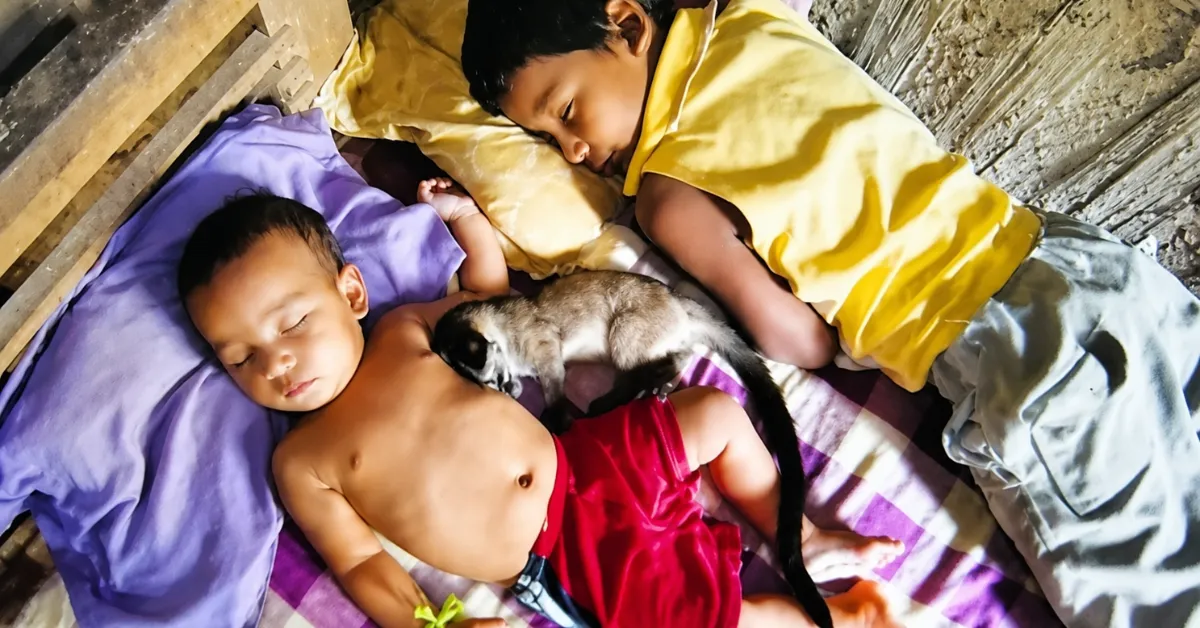
The lesson was called Baby Bhakat. As he flipped through the pages, he came across photographs of a tiny palm civet nestled in a woman’s arms. Another showed a baby lying beside the animal.
It took him a moment to realise that the child in the photograph was him.
For the teenager from Kampur in Assam’s Nagaon district, it was an unexpected reunion with a story he had never really known.
Seventeen years earlier, when Gibon was just six months old, his parents had raised an orphaned Asian palm civet alongside him.
Today, that extraordinary act of compassion has found a place in the NCERT Class 10 English curriculum, introducing students across India to a story that began in a small Assam town.
A cub with nowhere to go
The story dates back to 2009, when a tiny palm civet cub, locally known as Jahamaal, fell from a tree in Tetelisora village in Nagaon district.
Barely two weeks old, the cub had little chance of surviving on its own. Like all Asian palm civets, it depended entirely on its mother. Born with its eyes closed, the species requires weeks of maternal care before it can survive independently.
When villagers found the cub, they called Dharani Saikia, a wildlife enthusiast from Vrindaban Nagar in Kampur, affectionately known as the “Forest Man” for rescuing injured and distressed wild animals.
Along with his elder son, Dharani brought the cub home.
The family soon faced a difficult question: how could they keep such a young animal alive?
After consulting a wildlife rescue centre, they learnt that the cub’s best chance of survival was mother’s milk.
For Anjali Saikia, the decision wasn’t easy. She was already nursing her six-month-old son, Gibon. After some hesitation, she agreed.
The orphaned civet became her third child.
The family named him Bhakat.
Growing up together
Over the next few months, Bhakat wasn’t treated like a rescued wild animal. He became part of the family.
He shared meals of rice, fish and meat with them. At night, he slept on the same bed as the children. As Gibon learnt to crawl, Bhakat explored the house beside him. One was human, the other wild, but the two grew up like siblings.
Feeding a baby palm civet, one of our common fruit eating small mammals rescued by the team of @action4ifaw and @wti_org_india with Assam FD. @deespeak@asomputra@karthikavk#assam#AssamFloods#RESCUE#rehabilitationpic.twitter.com/ONCGWj19Ky
— Vivek Menon (@vivek4wild) July 14, 2019
Their unusual bond caught the attention of conservation photographer Rommel Shunmugan, who travelled to Kampur after hearing about the rescue.
He spent 10 days documenting the family’s life with Bhakat before returning to Delhi.
Over time, the family lost touch with him and assumed the photographs had become part of an old assignment.
Life moved on. Bhakat became a cherished memory.
And very recently, Gibon returned home after completing his Class 10 board examinations at Jawahar Navodaya Vidyalaya in Dhing with an unexpected discovery.
Inside his NCERT English textbook was the story of Bhakat.
From a village home to classrooms across India
The chapter, titled Baby Bhakat, was introduced in the NCERT Class 10 English syllabus for the 2024–25 academic year and has been retained for 2025–26.
It recounts how an Assamese family cared for an orphaned palm civet and features photographs of Dharani, Anjali, baby Gibon and Bhakat.
For Gibon, the discovery was deeply personal.
He had no memory of those early months and didn’t even realise he was the baby in the photographs until his parents told him.
For the people of Kampur too, the inclusion has become a matter of pride. They say a story that had almost faded with time has finally found the audience it deserved.
Changing how we see civets
Asian palm civets have long carried an unfair reputation.
Across India, they are known by names shaped by myths and misconceptions. In Delhi, they are called Kabar Bijju or “gravedigger”. In Kolkata,Bhaam or “baby stealer”. In Maharashtra, Kandechor, meaning “onion thief”.
Wildlife experts, however, describe a very different animal.
Asian palm civets are shy, nocturnal and largely solitary mammals found across tropical Asia.
They feed on fruits, insects and small animals, playing an important role in dispersing seeds and helping control rodent populations. But habitat loss, urban expansion, conflict with humans and poaching for musk used in perfumes continue to threaten their survival.
/filters:format(webp)/english-betterindia/media/media_files/2026/07/14/civet-2-2026-07-14-14-47-54.png)
As forests shrink, civets increasingly wander into towns and cities, where they are often mistaken for pests instead of wild animals displaced from their natural homes.
Bhakat’s story offers another way of seeing them—not as intruders, but as vulnerable creatures trying to survive.
A story that travelled far
Baby Bhakat leaves behind more than the memory of a civet cub raised alongside a human child.
It preserves a remarkable moment when an ordinary family in a small Assam town chose compassion over indifference.
From a coconut tree in Tetelisora to a conservation photographer’s lens, and eventually to the pages of an NCERT textbook read by millions of students, Bhakat’s journey has come full circle.
And in classrooms across the country, a simple story is quietly reminding the next generation that conservation often begins with one small act of kindness.
Sources:
‘Nagaon family’s civet cub tale makes it to CBSE class 10 textbook’: by Correspondent Assam Tribune, Published on 14 June 2026
Disclaimer : This story is auto aggregated by a computer programme and has not been created or edited by DOWNTHENEWS. Publisher: thebetterindia.com









