TEHRAN — As the United States continues to violate the newly signed memorandum of understanding (MoU) with Tehran, Iranian lawmakers have fiercely called for the immediate termination of the interim agreement, demanding a revolutionary shift in the country’s defense doctrine.
The MoU, electronically signed on June 17 by Iranian President Masoud Pezeshkian and his American counterpart, Donald Trump, explicitly called for a permanent end to hostilities on all fronts and committed both sides to final peace negotiations within 60 days. However, in a flagrant breach of the deal, US forces have carried out bombing attacks in southern Iran over the past several days. The aggression came shortly after Trump declared that the June agreement was “over.”
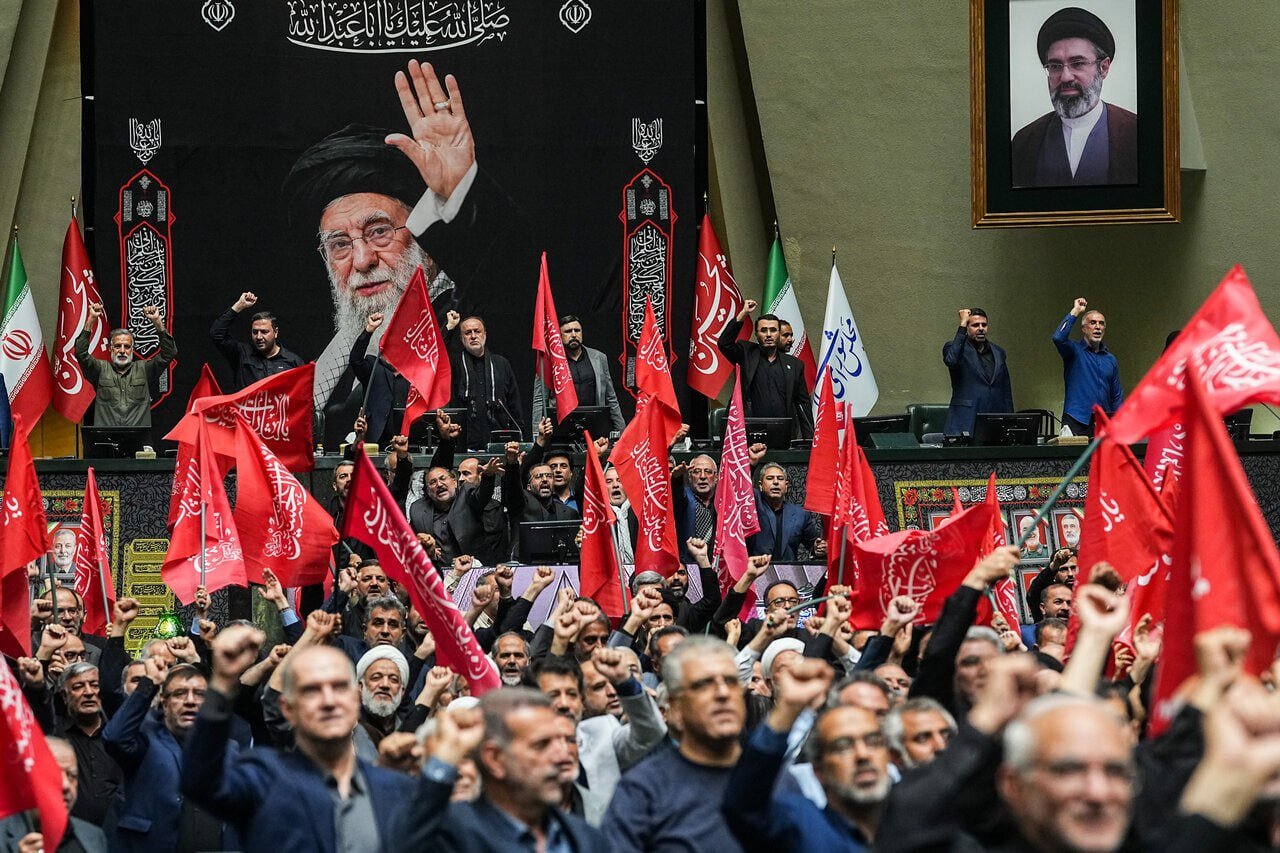
In a powerful joint statement issued on Tuesday, 180 members of the Iranian Parliament (Majlis) condemned the bad faith of the American administration and urged the heads of the three branches of government to adopt an uncompromising stance.
“Now that the foolish US president has declared this memorandum of understanding over, the nation urgently expects the heads of the three branches of government to adopt firm and revolutionary positions on this matter,” the statement read. “This experience has once again proven the words of our Imam (martyred Leader, Ayatollah Seyyed Ali Khamenei): that Iran’s issues with the United States cannot be resolved through negotiations.”
The lawmakers urged the Presiding Board of Parliament to urgently establish a special commission to review the negotiations and the MoU in accordance with the Constitution and Parliament’s rules of procedure. This commission would facilitate specialized parliamentary oversight to ensure strict adherence to the late Leader’s strategic guidelines.
Redefining Iran’s defense doctrine
A central pillar of the joint statement was a demand to prioritize legislative measures aimed at strengthening Iran’s deterrence capabilities, specifically targeting the security and management of the strategic Strait of Hormuz.
The lawmakers stated: “Alongside the critical responsibilities of the Armed Forces and the Supreme National Security Council, Parliament considers it its duty to introduce the necessary legal measures for decisive deterrence. These should range from upgrading and fundamentally transforming the country’s defense doctrine to passing legislation governing the Strait of Hormuz. We therefore expect the esteemed Presiding Board of Parliament to give this critical issue the highest priority and place it at the top of the legislative agenda.”
Expressing absolute support for the Armed Forces, particularly the Islamic Revolution Guards Corps (IRGC), the lawmakers pledged full parliamentary backing to ensure that the military receives all necessary resources to safeguard Iran’s sovereign waters.
Vengeance for martyred Leader
The parliamentary statement also reaffirmed the nation’s sacred duty to avenge the martyrdom of Ayatollah Khamenei, who was assassinated on February 28 during the opening day of the joint US-Israeli aggression against Tehran.
“The martyrdom of the Leader of the Ummah has made vengeance for his blood and retribution against the perpetrators, masterminds, and those who ordered this grave crime inevitable and impossible to forgo,” the lawmakers declared.
The initial US-Israeli war on Iran, which lasted 39 days, resulted in thousands of Iranian casualties but ultimately ended in strategic failure for the aggressors. Faced with devastating retaliatory strikes by Iran’s armed forces against Israeli targets and US bases in the Persian Gulf region, Donald Trump was forced to capitulate and agree to a ceasefire on April 8.
While international observers and Western media widely characterized the US-Israeli offensive as a severe strategic miscalculation that left Iran in a stronger regional position, recent American airstrikes indicate that Washington has failed to learn from its past mistakes.
The latest escalation centers heavily on control of the Strait of Hormuz. While Tehran had previously maintained that commercial vessels could safely transit the strategic waterway under Iranian coordination, Donald Trump has sought to illegally dominate the strait. On Monday, Trump bizarrely claimed that the US would take over the passage and impose a 20% toll on all cargo shipped through it.
Commenting on the bizarre declaration, Rob Geist Pinfold, a lecturer in international security at King’s College London, told Al Jazeera that the US threat to impose tolls “is really indicative of how the US went into this conflict without any coherent or clear strategy.”
“It’s a really strange dynamic,” Pinfold noted, highlighting that Washington continues to grossly underestimate Iran’s capacity to set the regional agenda. “As a result, we see the US floundering and coming up with some of these, frankly, strange and illogical declarations from President Trump.”
In swift retaliation for the renewed US airstrikes on civilian infrastructure in southern and southwestern Iran, the IRGC Aerospace Force executed highly coordinated missile and drone strikes against US military assets in the region.
According to an official IRGC statement, the retaliatory operation successfully targeted the headquarters of the US Fifth Fleet in Bahrain, setting its critical fuel storage facilities ablaze. In addition to setting these facilities on fire, the precision strikes completely destroyed a Patriot radar system, the Fifth Fleet’s air-control radar, and a C-RAM early warning radar system.
The illusion of Western treaties
The latest collapse of the June 17 MoU serves as a definitive historical lesson for the Islamic Republic and the wider region. Once again, the actions of the United States have demonstrated that Western signatures are entirely worthless and that treaties with Washington are merely stalling tactics designed to mask continued imperial aggression.
By targeting Iranian civilian infrastructure and reneging on a signed peace agreement within weeks, the Trump administration has shattered any remaining illusions regarding diplomatic engagement with aggressive powers.
As the 180 lawmakers asserted, Iran’s security, its de facto control over the Strait of Hormuz, and the legacy of its martyred Leader, Ayatollah Khamenei, cannot be guaranteed at a negotiating table. True security is born from the fire of self-reliance and overwhelming military deterrence.
The devastatingly precise retaliatory strikes by the IRGC against the US Fifth Fleet in Bahrain send an unmistakable message to Washington: the era of American unilateralism in the Persian Gulf is over. If the United States refuses to respect diplomatic agreements, it will be forced to respect Iran’s iron on the battlefield.
Disclaimer : This story is auto aggregated by a computer programme and has not been created or edited by DOWNTHENEWS. Publisher: tehrantimes.com