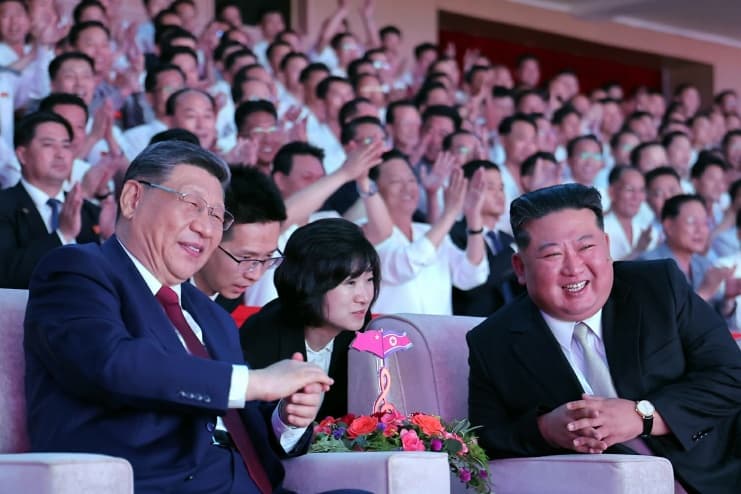
North Korea has issued a new China directive to cabinet officials, ordering them to separate economic gains from ideological control even as Pyongyang seeks warmer ties with Beijing in 2026.
A source in North Korea’s Kangwon province told Daily NK on Tuesday that the ruling Workers’ Party of Korea’s central leadership urgently sent the directive to the cabinet in late June. Party leaders want to prevent an erosion of ideological discipline, the source said. At the same time, they want to seize on the ostensibly warmer China-North Korea relationship following Chinese President Xi Jinping’s visit to Pyongyang and maximize economic gains.
The directive appears to reflect a calculated strategy. North Korea wants to publicly showcase closeness with China. Behind the scenes, though, it continues a delicate balancing act between the United States and Russia. Its central message calls for a strict separation of political and security matters from economic ones. Officials should welcome Chinese capital with flexibility, the directive states, but must tightly control ideological infiltration such as the spread of Chinese culture.
According to the source, officials in the foreign economic sector received an unusually pragmatic instruction. They were told to “conduct business flexibly” so that Chinese investors feel comfortable opening their wallets.
The directive also told officials to offer China conveniences in trade procedures and customs clearance. The goal is to shore up foreign currency reserves in the second half of 2026. Officials were urged to avoid political friction and skillfully extract economic gains only.
China directive draws line between money and culture
The directive calls for flexibility on the economic front. But it takes the opposite approach on political and internal security matters, demanding a strict, two-track posture. The directive reportedly states, “Make money, extend credit, but do not let ideology mix in.”
Rumors spread among the North Korean people after Xi’s visit. Some claimed that watching unauthorized Chinese films or dramas would no longer draw punishment now that the Chinese president had visited. In response, the directive orders officials to work with security agencies to crack down on those spreading such rumors. It also calls for tougher enforcement against unauthorized recordings. No ideological deviation will be tolerated, the directive states.
The source said the party’s dual-track approach toward China reflects an intent to exploit Beijing’s own strategic calculus. China has moved to narrow the distance with North Korea in recent months, the source said. Beijing appears eager to avoid losing influence on the Korean Peninsula. That concern has grown as North Korea deepens its military and political ties with Russia.
The goal, the source explained, is to extract maximum economic benefit from China’s own sensitivities about its relationship with Washington. At the same time, North Korea wants to seal off its people from Chinese-style reform and opening. It also wants to block capitalist culture that could undermine the regime’s internal cohesion, much like sealing a border shut.
Foreign affairs and foreign economic officials at the Wonsan City People’s Committee grew fearful after the directive came down. The committee is a local administrative body that oversees civil affairs in the east coast city of Wonsan. Officials worried that a single misstep in conversations with Chinese nationals could draw accusations of absorbing Chinese cultural influence. At the same time, they are scrambling to find ways to get Chinese nationals to open their wallets and help meet the year’s targets.
Even senior officials in the local foreign affairs department grumbled about the order. Superiors are demanding they “clearly separate political and security matters from economic affairs, like cutting tofu with a knife,” one official said. Bringing in Chinese money while blocking Chinese cultural influence is far harder in practice than it sounds, the official added.
Reporting from inside North Korea
Daily NK operates networks of sources inside North Korea who document events in real-time and transmit information through secure channels. Unlike reporting based on state media, satellite imagery, or defector accounts from years past, our journalism comes directly from people currently living under the regime. We verify reports through multiple independent sources and cross-reference details before publication.
Our sources remain anonymous because contact with foreign media is treated as a capital offense in North Korea — discovery means imprisonment or execution. This network-based approach allows Daily NK to report on developments other outlets cannot access: market trends, policy implementation, public sentiment, and daily realities that never appear in official narratives.
Maintaining these secure communication channels and protecting source identities requires specialized protocols and constant vigilance. Daily NK serves as a bridge between North Koreans and the outside world, documenting what’s happening inside one of the world’s most closed societies.
Disclaimer : This story is auto aggregated by a computer programme and has not been created or edited by DOWNTHENEWS. Publisher: dailynk.com