
Life
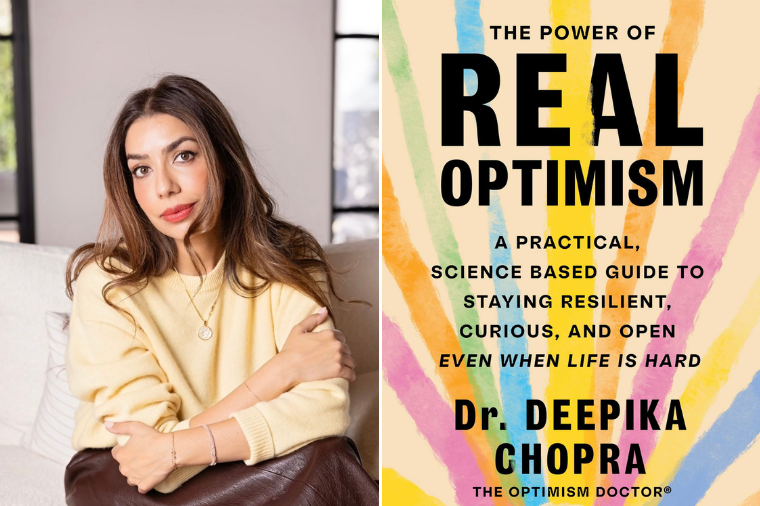
Dr. Deepika Chopra is not your average therapist. Scroll through her Instagram, and you’ll find all the trappings of a seemingly charmed life: sun-drenched days in Los Angeles, dinners with friends including Mindy Kaling, holidays abroad, and snapshots with her husband and three children. On the surface, it would be safe to assume that she lives a silver-lining type of life, one where the sun always shines, and optimism comes naturally to her. Yet beneath the glossy surface lies a far more interesting truth. The woman known worldwide as “The Optimism Doctor” was not born an optimist. She learned how to become one.
“I am not someone who has ever considered myself a natural optimist,” Chopra insists over Zoom late one evening. “I was raised by a family and parents that really exemplify that [optimism]… but personally I would say, in my own microcosm of family, I’m probably one of the more pessimistic people.” It’s surprising, then, that Chopra would choose to build her career on the study of hope. However, over years of research and practice, Chopra found herself increasingly drawn to one question: “Why do some people emerge from hardship with hope intact, while others become paralyzed by it?” The answer, she discovered, had little to do with nature and everything to do with nurture. For many, optimism conjures images of relentless positivity (“good vibes only,” please) or an unwavering belief that everything will work out, peppered with motivational sayings such as “this too shall pass.” But Chopra sees it differently. Rather than ignoring hardship, which she categorizes as a tenet of toxic positivity, she argues that real optimism requires us to acknowledge it fully. As she puts it, “to be optimistic is really the expectation that the future still holds possibility while at the very same time remaining deeply engaged with reality.”

In fact, according to Chopra, there is a glaring misconception about what optimism really is. Instead of always looking at the glass half-full, she posits that it’s about accepting the present to allow oneself to move forward with the future, as she explains, “It’s not believing that life will be easy; it’s more so believing that even when life is difficult, our actions still matter, and we still have agency.” It’s a philosophy that she’s had to put to the test personally when, at the same time, she was writing the proposal for her recently released book The Power of Real Optimism, her two-year-old son Dio was diagnosed with an extremely rare illness—one that would see him spend the next year in and out of hospitals with surgeries and treatments. “Writing a book on optimism felt like a cruel irony,” reminisces Chopra, whose book is centered on the belief that optimism is not a personality trait; it is a skill. One that can be learned, practiced, and strengthened. “I remember almost laughing about it, to be honest. I called my editor and was like, ‘I don’t think I can write this book anymore.’ There’s no way I can write this book. I don’t feel even a shred or a seed of optimism,” she adds. “I wasn’t doing anything that resembled someone who was an optimist. I wasn’t sleeping, I wasn’t eating; I was ruminating over and over on why this was happening to us. I was full of rage.”
It wasn’t until one evening, while she was watching the movie A Family Affair on Netflix, that she heard one of the characters say, “The end is none of your business,” that she arrived at a turning point. “I had a shift from that rumination of being in threat mode in my brain. I was able to shift to agency, and like, what is my very next step? What’s my next move? What can I do?” Turning to her teachings, Chopra decided to focus on what she could control, and by doing so, she could re-teach herself to be optimistic. “Optimism is a muscle,” she explains. “You need to keep training it.” And so, she went back to what she knew best: creating joy lists, saying her affirmations, and trying to shift her focus from hopelessness to possibilities. “We need to actually arm ourselves with the correct tools that are sort of in sync with how the brain actually works to be able to help us carry it in a way that’s different from how we’ve been carrying it before.”
Chopra’s message feels particularly relevant at a time when uncertainty has become a near-constant backdrop to modern life. Whether it’s regional conflict, economic instability, or a triggering news cycle, many find themselves caught between the need to stay informed and the risk of becoming overwhelmed. But, as Chopra reiterates, the solution comes not from denial or blind positivity. “I think the days of being able to just say everything will be okay, everything happens for a reason, are really some of the most unhelpful things we can do.” Instead, it’s important to maintain agency in the face of uncertainty, and in that, learning our own strengths: “I know that; I really know it, in my core now. I can do hard things.”
– For more on luxury lifestyle, news, fashion and beauty, follow Emirates Woman on Facebook and Instagram
Images: Supplied
Disclaimer : This story is auto aggregated by a computer programme and has not been created or edited by DOWNTHENEWS. Publisher: emirateswoman.com






