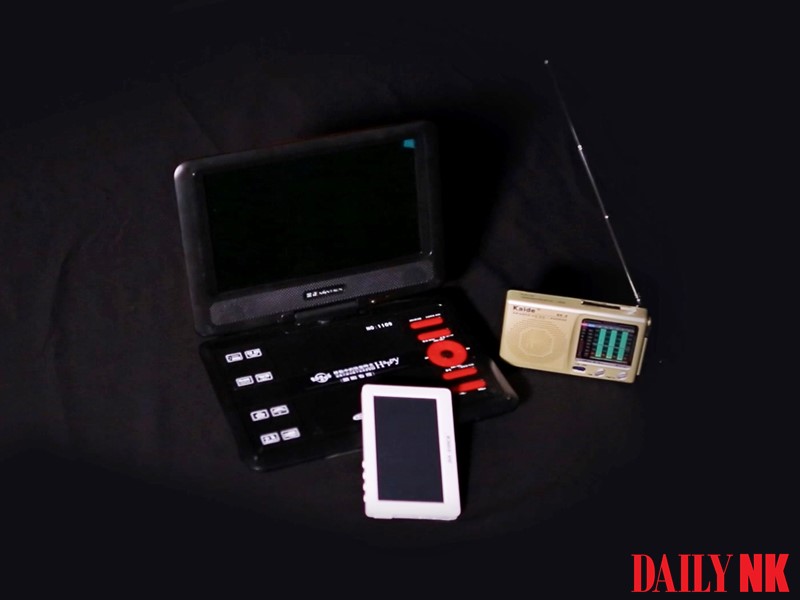
Young North Koreans from wealthy families are deliberately buying old, worn-out video players instead of newer models. They can easily afford better devices. Instead, they are betting that crackdown squads will never suspect a well-off household of using such outdated gear, a source in North Hamgyong province told Daily NK recently.
North Korean authorities have stepped up crackdowns on what the state calls “impure recorded materials,” a term covering South Korean films, dramas and other banned foreign media. In response, young people in Hoeryong, a city in North Hamgyong province, have increasingly turned to old notetels, portable multimedia players once widely used across North Korea. People use them to watch video content from SD cards or USB drives. The devices help young people slip past inspectors.
“As the crackdown on watching impure recorded materials intensifies, the methods for avoiding it are also growing more sophisticated,” the source said. In Hoeryong, young people have recently been searching out old notetels in growing numbers, simply to get around inspections.
The source explained how the system works. Young people from financially comfortable homes carry MP7 and MP8 media players in public, brand names for multi-function devices used across North Korea. They use them openly to watch state-approved films or study materials. At home, the same young people turn to separately hidden, older notetels. They load these with SD cards or USB drives to watch banned South Korean movies, dramas and entertainment programs.
Young people keep their public device separate from their private one. This way, they stay prepared for a crackdown at any time.
Some young people could use Chinese mobile phones to watch outside content instead. But the source said this carries greater risk for most North Koreans. Members of North Korea’s ethnic Chinese community, known as hwagyo, face fewer restrictions on owning such phones. For everyone else, simply possessing one can lead to serious consequences if discovered.
“If we put a memory card in our own phone to watch a South Korean drama, it can leave traces,” the source said. “That can get us caught in a crackdown. People could watch it on a Chinese phone instead, but just having one is risky. That’s why young people divide the roles between an MP7 or MP8 and a notetel.”
Old devices offer better cover for young people
According to the source, young people are not buying notetels that match their family’s financial standing. Instead, they deliberately seek out old, worn devices. These draw less suspicion from inspection squads.
“Members of the crackdown squads are thinking, ‘Surely a family that well-off would not use something so old,’” the source said. “Young people are using that assumption against them.”
Notetels were once popular across North Korea. They were relatively inexpensive and used less power than other devices, making them a common choice for watching video content. Demand had gradually declined as MP7s, MP8s and other multi-function devices spread. But the source said demand has recently risen again. Prices are now climbing due to a short supply.
In Hoeryong, notetels currently trade for 500 to 600 Chinese yuan, or about $74 to $89. The price depends on the device’s condition. Older or lower-performing models sell for even less, the source said.
Young people prioritize how inconspicuous a notetel looks. The more worn-out a device appears on the outside, the better its odds of avoiding detection. Buyers look for devices that still function properly for watching video but appear as old as possible.
“They use a functioning MP7 or MP8 in public to watch officially approved content,” the source said. “At home, they use a hidden, old notetel to watch banned South Korean films and dramas. Even as the crackdown intensifies, young people are not giving up on watching this content. They are instead working out, in more careful detail, how not to get caught.”
Reporting from inside North Korea
Daily NK operates networks of sources inside North Korea who document events in real-time and transmit information through secure channels. Unlike reporting based on state media, satellite imagery, or defector accounts from years past, our journalism comes directly from people currently living under the regime. We verify reports through multiple independent sources and cross-reference details before publication.
Our sources remain anonymous because contact with foreign media is treated as a capital offense in North Korea — discovery means imprisonment or execution. This network-based approach allows Daily NK to report on developments other outlets cannot access: market trends, policy implementation, public sentiment, and daily realities that never appear in official narratives.
Maintaining these secure communication channels and protecting source identities requires specialized protocols and constant vigilance. Daily NK serves as a bridge between North Koreans and the outside world, documenting what’s happening inside one of the world’s most closed societies.
Disclaimer : This story is auto aggregated by a computer programme and has not been created or edited by DOWNTHENEWS. Publisher: dailynk.com