
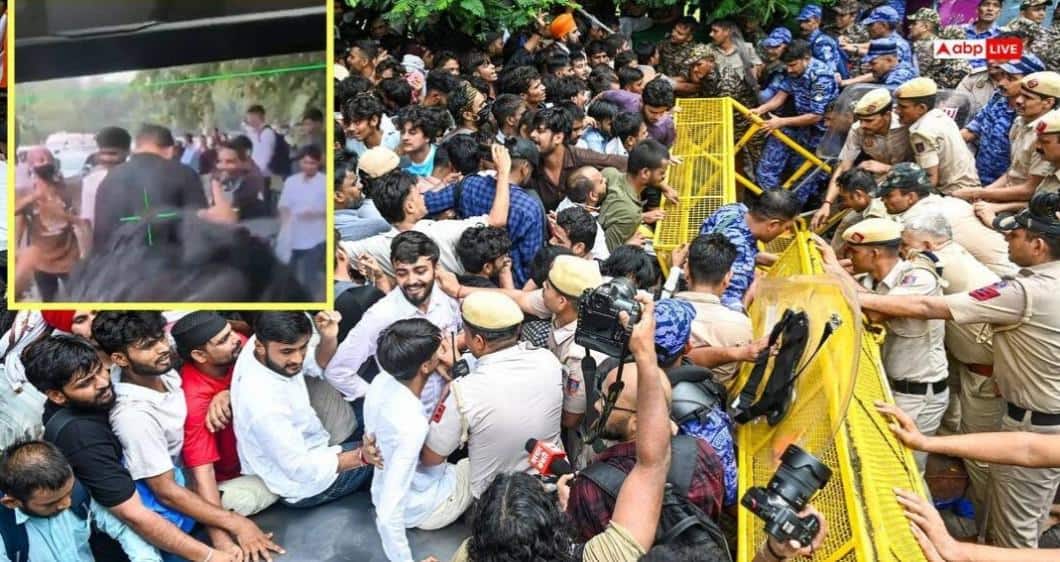
The emergence of the Cockroach Janta Party (CJP) and the thousands of young people who gathered under its banner have prompted a broader debate that extends beyond examination paper leaks, unemployment or a march towards Parliament. The more significant question is whether India’s political class is losing its ability to communicate with Generation Z.
The issue is not confined to the ruling party. It affects the Opposition, national parties and regional parties alike. While political organisations consistently seek the support of young voters, they often appear unwilling to understand how this generation thinks or what it expects from politics.
A Generation That Feels Ignored
Political parties routinely tell young Indians before every election that “the future of the country is in your hands.” However once elections conclude, many young citizens feel excluded from the political conversation.
The CJP did not emerge from a traditional political organisation but from satire. What began as an online joke asking what would happen if all the “cockroaches” united gradually evolved into a shared identity, then into a community and eventually into a street movement.
Following the Parliament march, the CJP announced that while its protests would continue, it would not immediately organise another march because it did not want more young people to be injured. BJP president J.P. Nadda subsequently met the group’s representatives, while Prime Minister Narendra Modi called for a “foolproof” public examination system.
While these developments indicate that a conversation has begun, they also raise an important question: why did thousands of young people have to take to the streets before that conversation started?
The Representation Gap
The disconnect becomes more apparent when India’s demographic profile is compared with its political leadership.
India is estimated to have 377 million Gen Z citizens. Although different studies define the generation differently, it broadly includes those born between the late 1990s and early 2010s. In 2026, most belong to the teenage and young adult population, with the midpoint of the age group around 21 or 22 years.
By contrast, the average age of a Lok Sabha MP is 56, while the average age in the Rajya Sabha is approximately 61. Only 11 per cent of Lok Sabha MPs are aged 40 or below, while more than half are over 55.
This represents not merely a difference in age but a gap of more than three decades in lived experience between young citizens and India’s highest representative institutions.
However, age itself is not the central issue. Sonam Wangchuk, who is nearly 60 yet continues to attract significant support among young Indians, suggesting that the real challenge is whether senior political leaders are genuinely curious about understanding younger generations or simply interested in instructing them.
Youth Wings Without Youth Voices
The editorial observes that almost every political party maintains youth wings, student organisations, digital teams and social media operations. Yet these structures often function as mechanisms for distributing messages rather than incorporating young voices into decision-making.
Decisions are frequently made at senior levels before being passed down for younger workers to amplify through social media campaigns and hashtags.
Gen Z increasingly questions why it should merely promote political messaging instead of having its own concerns reflected in party decisions.
Social Media Is Not The Same As Conversation
Political parties have adapted to digital platforms but, according to the editorial, often continue to use them as one-way communication channels.
Technology has enabled political leaders to distribute messages to millions of people almost instantly, but this has not necessarily translated into meaningful engagement.
A leader may have millions of followers while maintaining very little genuine interaction because follower counts measure reach rather than relationships.
Understanding How Gen Z Consumes News
The Gen Z allegedly possesses only a short attention span.
But a Google-Kantar study involving more than 4,000 young Indians, found that 91 per cent discover news through social media while 88 per cent consume news through video platforms. For 65 per cent, news appears while they are already scrolling through other content.
The same study found that 84 per cent had used generative AI to understand, explore or verify news. It also reported that 49 per cent remained cautious about unverified sources, while 43 per cent checked information before sharing it.
ALSO READ:
According to the editorial, these findings do not suggest that Gen Z is immune to misinformation. Instead, they indicate that dismissing the generation as politically unserious overlooks how differently it processes information.
Rather than watching lengthy speeches, many young people consume multiple short clips, compare statements, examine public comments and seek evidence before accepting political claims.
‘Receipts’, Not Rhetoric
Gen Z increasingly expects politicians to provide what internet culture calls “receipts”—evidence supporting their claims.
Whether politicians announce investigations, promises or policy decisions, young voters increasingly expect data, timelines and measurable progress instead of broad assurances.
Why Political Messaging Feels ‘Cringe’
Political leaders have increasingly appeared on podcasts, created social media reels, collaborated with influencers and adopted internet trends.
However, Gen Z differs from merely imitating its language.
Using internet slang while avoiding substantive questions, it argues, often appears “cringe”, a term used to describe behaviour that feels forced, unnatural or performative.
Similarly, political spokespersons who repeatedly deliver identical scripted responses are compared with “NPCs”—non-player characters in video games that repeat the same dialogue regardless of the player’s actions.
Young Indians are not demanding that politicians begin saying “bro” or “LOL”; they want leaders who listen without equating disagreement with disloyalty.
Politics Without Permanent Loyalty
The editorial suggests that Gen Z approaches political loyalty differently from previous generations.
Political parties often seek long-term allegiance from supporters. Young voters, however, increasingly approach politics with the same flexibility they apply to digital platforms and consumer brands.
Support for one issue does not necessarily translate into support across every issue or every election.
This is “subscription politics”, where continued support depends upon continued performance.
Poor performance results not necessarily in support for rival parties but in disengagement altogether.
In that context, dissatisfaction with the government should not automatically be interpreted as endorsement of the Opposition.
The editorial notes that CJP founder Abhijeet Dipke stated that the organisation would neither seek nor accept active support from any political party because young people had lost faith in the existing political establishment.
More Than An Internet Movement
According to the editorial, the CJP demonstrated that young Indians were never disconnected from politics. Instead, many lacked spaces where politics could be discussed in language they understood, at a pace they preferred and with opportunities for participation.
Satire, memes and humour created that entry point before serious political concerns entered the discussion.
The editorial argues that while every demand or strategy of the CJP should not automatically be accepted without scrutiny, dismissing the movement as merely an internet joke would be equally misguided.
The Challenge Before Indian Politics
Political parties need not imitate Gen Z but instead create meaningful opportunities for young people to participate in setting political agendas.
This would require more than symbolic youth councils, carefully curated digital interactions or applause following announcements. Instead, it calls for genuine participation, uncomfortable questions and measurable progress reports.
Leaders should avoid dismissing younger citizens by telling them they are “too young” to understand politics.
According to a 2026 Deloitte India survey, 54 per cent of Gen Z respondents had delayed major life decisions because of financial pressures. Careers, home ownership, marriage, education and entrepreneurship, it argues, are increasingly being postponed.
This reflects not youthful impatience but “delayed adulthood”.
India’s Gen Z has not abandoned democracy. Rather, it has “muted” many political parties.
“CJP is one of those notifications,” the editorial states, before posing a final question to both the government and the Opposition: whether they will simply produce more political content or fundamentally update the way they engage with India’s youngest generation.
Speaking Gen Z’s language is no longer sufficient. Political leaders must also be willing to hear what Gen Z is saying—otherwise, the generation’s response may simply be, “Okay, Boomer.”
ALSO READ:
Before You Go
Political War: Rahul Gandhi Demands Accountability From PM Modi Over Student Protest Row
Disclaimer : This story is auto aggregated by a computer programme and has not been created or edited by DOWNTHENEWS. Publisher: abplive.com





