Other Models We Tested
Photograph: Martin Cizmar
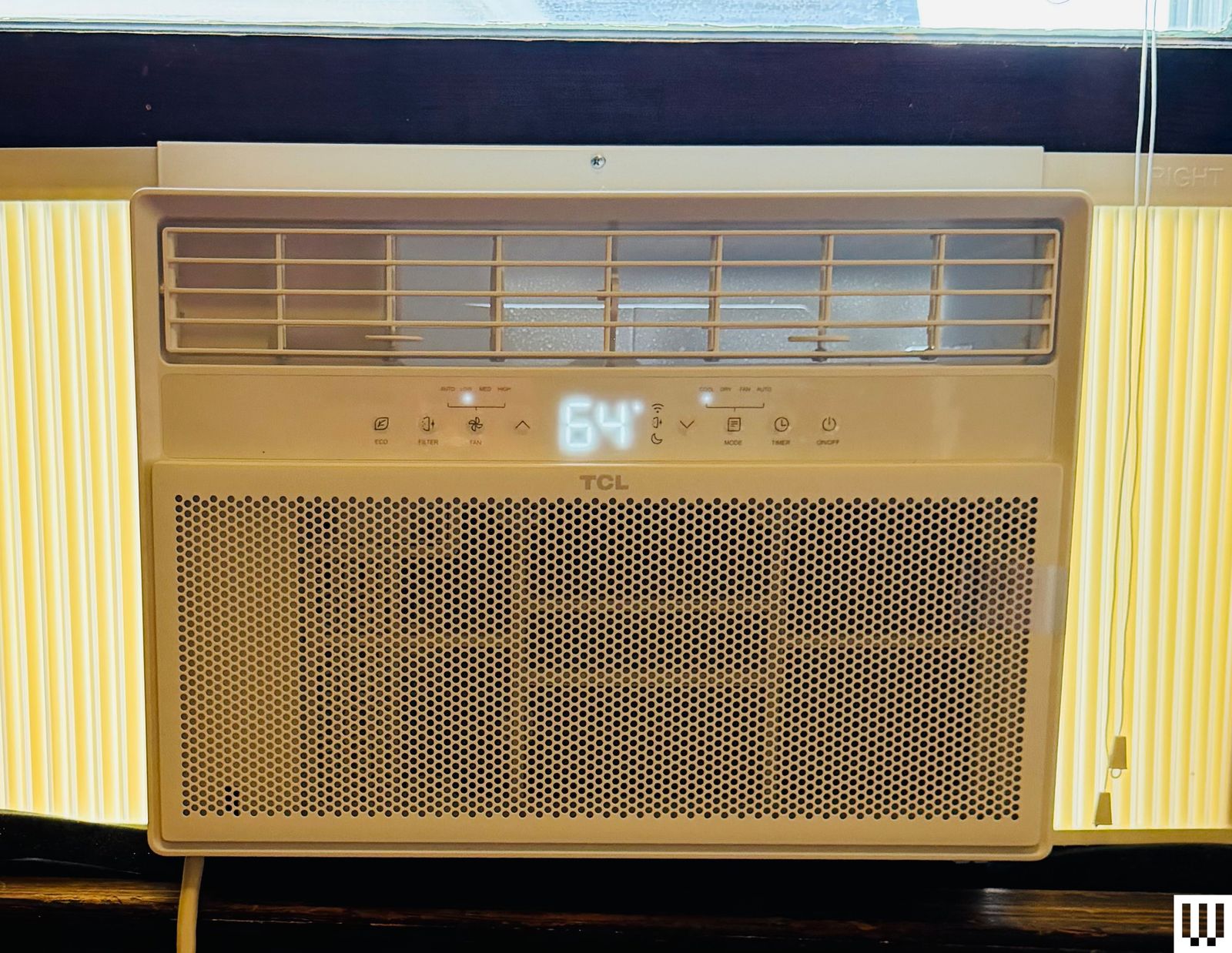
TCL Q-Series Air Conditioner (10,000 BTU) for $369: Chinese electronics company TCL has been making air conditioners for only five years, but it is tackling the category the way it did for TVs—that is, by quickly conquering turf with excellent value. I tested the 10,000-BTU version of the Q Series window AC in an 120-square-foot upstairs bedroom that gets very little flow from my home’s central AC. It took three hours to drop the temperature by 10 degrees from a sweltering 78, but as it operated at a fairly quiet 60 decibels, I didn’t mind it. Installation was a breeze thanks to the included frame. The TCL has Matter connectivity, but I was not able to get it to connect to my Apple Home app, apparently a common issue. There is a remote that has all the controls from the unit itself. The thermostat is accurate within one degree, and the unit reliably turns itself on and off to keep the room temperature on its mark. The CEER rating ranks an impressive 15.0, equaling WIRED’s top-pick Midea, and the TCL costs $100 less at the same power output. But while quiet compared well with many other models, this TCL is still louder than the Midea and doesn’t offer the U-shaped device’s superior insulation. Easy install may be a selling point over the U-Shaped model. —Martin Cizmar
Dreo Portable Air Conditioner 740S (10,000 BTU) for $700: Look, I’m loving the new generation of portable air conditioners but not because they’re portable. Fact is, wheels aside, they’re pretty big and heavy, and the thick hoses make them bulky in a room. But they’re easy to install without lifting into a window frame, a real boon for solo residents. And because the only thing that needs mounting in a window is a bracket for the hoses, these ACs can be used on pretty much any window shape—a boon especially for those in older buildings. The Dreo has all these virtues, plus a respectable 12 CEER rating, courtesy of dual hoses and a smart inverter. (In general, avoid portable units without dual hoses, as this can cause a depressurization effect that lowers efficiency.) I’ve been using this portable in the difficult-to-access window in my 150-square-foot office, and its effects are basically instant. The evaporative cooling tech also means I don’t have to drain water. But our top-pick Zafro offers a lower price, and a slightly better CEER efficiency rating at a similar operating noise level of around 60 to 65 decibels on high fan speeds. Still, this is an excellent portable AC unit. If you see a deal, snap it up.
GE AWAS05BBA Window Air Conditioner Unit (5,000 BTU) for $231: This 5,000 BTU unit is less powerful than our favorite budget window air conditioner pick from GE. There’s no app and no remote, and airflow options are limited: You can’t direct air up and down, only left and right. But it’s the cheapest model we recommend, relatively easy to install, and much quieter than you’d expect for the price. It’ll cool a small 150-square-foot space quickly and mostly frictionlessly. But we haven’t tested it as long as for our top budget pick.
LG Window Air Conditioner Unit (12,000 BTU) for $379: The LG 12,000 BTU Smart Window Air Conditioner offers efficient large-room cooling at a surprisingly low price. It weighs 90 pounds and requires professional installation with a bracket. Its 60-decibel operation places it squarely in the middle of the pack on noise. This said, WIRED reviewer Lisa Wood Shapiro found it blends into a room well with its white-on-white design, and that the filter replacement indicator light is useful. The app was laggy and difficult to use during Wood Shapiro’s testing, but there is a remote.
Friedrich Kuhl Air Conditioner for $1,228: This unit from Friedrich is among the most expensive we’ve tested, and one of the heaviest—in part because of a metal chassis designed to provide easy maintenance access and deter first-floor break-ins. This model allows adding a custom Friedrich FreshAire MERV 13 filter to clean the air as it cools. The screen is easy to read, and the device comes with a remote. An app lets you schedule the unit’s use over the course of the week, but note that connection with the smart app was a little janky, and it paired only with 2.4 GHz signals.
EcoFlow Wave 2 for $1,299 (but usually on sale for much less): Wood Shapiro tested the newest model, but previous models of the EcoFlow are often available at steep discounts. After happily testing the EcoFlow Wave 1 for more than a year in his wife’s office, WIRED senior editor Julian Chokkattu far preferred the EcoFlow Wave 2 (8/10, WIRED Recommends) because it’s both lighter and more cost-friendly, with a higher 5,100 BTU rating (up from 4,000). A heating mode rated at 6,100 BTU means you can keep using it in the winter to warm up. The company says it’s best for rooms up to 107 square feet. You do need to place it near a window to have one of the included ducts connected to the vent to take hot exhaust from the back of the unit out of the room. What makes this unit versatile is its alternate power sources. You can use a standard AC outlet, but you can also buy an add-on battery to keep it working when you don’t have access to electricity, or hook it up to solar panels.
Zero Breeze Mark II for $999: With its 2,300 BTU, the Zero Breeze (7/10, WIRED Review) won’t have the same cooling power as the EcoFlow Wave, but it’s much lighter at 17 pounds. This bundle includes a battery that makes the whole thing weigh about 30 pounds, but you’ll get four hours of use without needing to be near a wall outlet. Like the EcoFlow, you get a few vent pipes to direct exhaust away and direct cool air to a specific area, but unlike the EcoFlow, you can’t charge the battery and use the AC at the same time.
Zero Breeze Mark III for $1,399: As WIRED reviewer Chris Null notes, the Mark III (7/10, WIRED Review) is both larger than the Mark II and quite a bit heavier, now at 22 pounds. Add on the 1,022-Wh battery pack and you’ll pack on another 14 pounds, though that frees you from having to be near a power outlet. New for the Mark III is the fact that batteries can now be stacked and charged in sequence, each daisy-chained to the next (though at $600+ per battery, this can get pricey fast). Each Mark III battery also has extra outputs that can be used for other devices—one USB-C port, one USB-A port, and a 12-volt DC socket. However, the Mark II battery had all of the above plus a second USB-A port. No word on why this was removed. However, the new version is a bigger, punchier unit by most standards and a worthwhile buy for outdoors enthusiasts
Power up with unlimited access to WIRED. Get best-in-class reporting that’s too important to ignore. Includes unlimited digital access and exclusive subscriber-only content. Subscribe today.
Disclaimer : This story is auto aggregated by a computer programme and has not been created or edited by DOWNTHENEWS. Publisher: wired.com