TEHRAN- High-ranking officials of Iran and Iraq signed four cooperation agreements and memoranda of understanding between the two countries in order to elevate the level of relations.
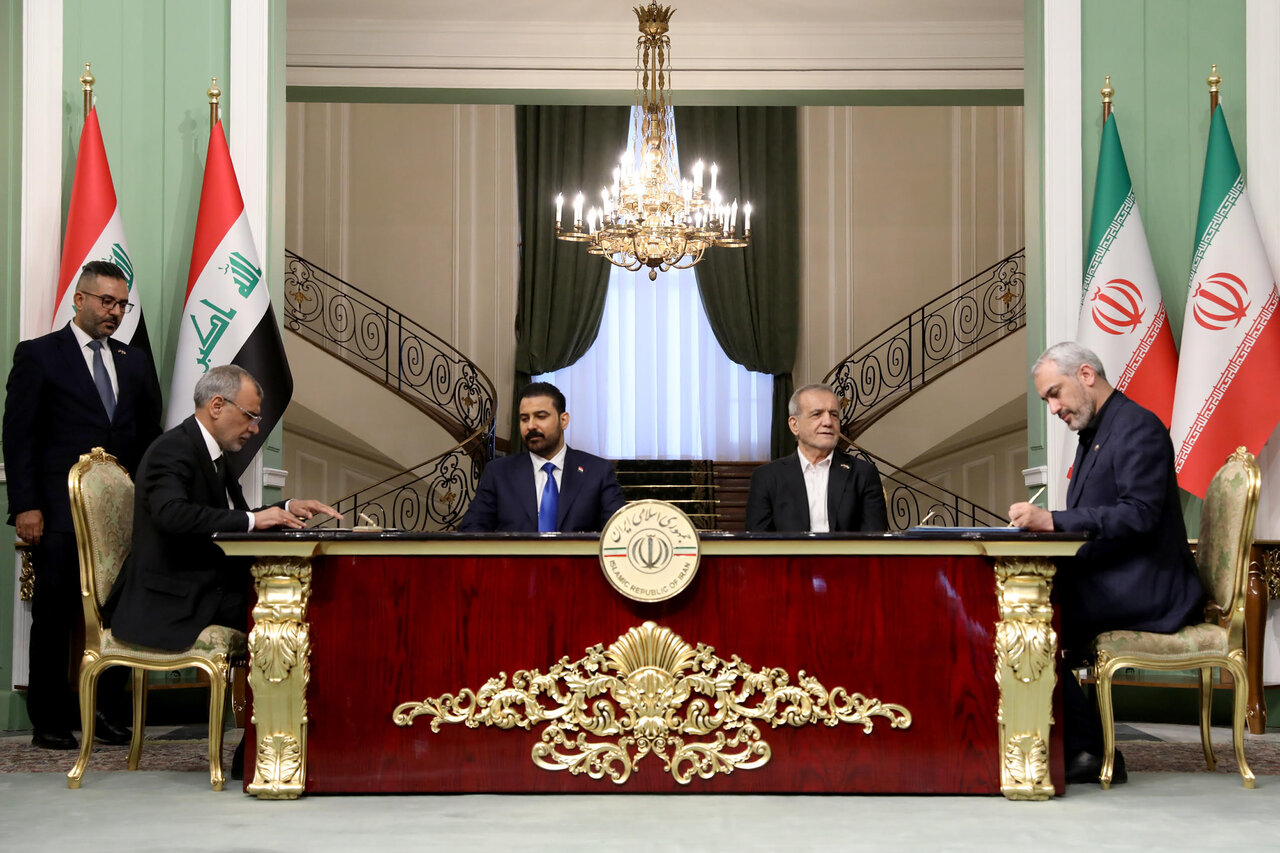
During the official visit of Ali Falih al-Zaidi, the Prime Minister of Iraq, and the high-ranking delegation to Tehran, high-ranking officials, in the presence of the heads of the two countries, signed four cooperation agreements and memoranda of understanding between the two countries.
The agreement on road transport of goods, the memorandum of understanding for the construction of the Khosravi – Khanaqin – Baghdad railway, the memorandum of understanding on sister-city relations between Tehran and Baghdad, and the memorandum of understanding on public administration, education, and human resources were the four cooperation documents signed among the high-ranking officials of the country and in the presence of the President of Iran and the Prime Minister of Iraq.
Ali Falih al-Zaydi, the Prime Minister of Iraq, at the head of a high-level delegation, arrived in Tehran on Thursday, July 23. According to a report by IRNA on Thursday, al-Zaydi arrived in Tehran on an official visit at the invitation of Masoud Pezeshkian, the President of Iran.
Upon his arrival in Tehran, he was welcomed at the airport by Seyyed Ali Madanizadeh, the Minister of Economy and head of the Iran-Iraq Joint Economic Committee.
The Prime Minister of Iraq had previously stated regarding the trip to Tehran that he would discuss common issues and ways to strengthen bilateral cooperation in meetings with high-ranking Iranian officials.
According to the Iraqi News Agency (INA), al-Zaydi wrote on his page on the X platform: ‘Today I am going to Tehran on an official visit and will meet with high-ranking officials of the Islamic Republic of Iran to discuss important bilateral issues, joint cooperation, consult on regional issues, and strive to strengthen regional security and stability.’
He said: ‘Iraq and Iran have historical, civilizational ties, shared borders, and common interests, and these commonalities mean that the relations between the two countries are based on cooperation, dialogue, and mutual respect, and serve to strengthen the growth and prosperity of both countries and support regional and global security and stability.’
Iraqi Ambassador to Iran Yasser Abdulzahra Al-Hajjaj has reaffirmed Baghdad’s commitment to strengthening ties with Tehran, describing the relationship between the two neighboring countries as one rooted in centuries of shared history, civilization and cultural affinity, while emphasizing that Iraq’s foreign policy is based on balanced regional engagement, dialogue and mutual respect.
In an article published by the Iraqi News Agency (INA) ahead of Iraqi Prime Minister Ali Al-Zaidi’s planned visit to Tehran, Al-Hajjaj said it was a privilege to represent Iraq in a country with which it shares deep historical, geographical, cultural and religious bonds.
“As I begin my mission as Ambassador of the Republic of Iraq to the Islamic Republic of Iran, I am honored to represent my country in a nation whose relationship with Iraq is founded on history and geography, as well as profound human, cultural and religious ties,” he wrote.
The ambassador said Iraq views its regional neighborhood as a strategic depth and an essential partner in building a more prosperous future, arguing that regional stability can only be achieved through cooperation, dialogue and confidence-building among neighboring states.
“Experience has shown that lasting regional stability can only be realized through cooperation, dialogue and mutual trust, while sustainable economic development remains the strongest foundation for long-term peace and security,” he said.
Al-Hajjaj noted that Iraq-Iran relations have expanded considerably in recent years across political, economic, cultural and social fields, driven by strong people-to-people ties and a shared historical legacy.
He said bilateral relations now possess significant potential to enter a more advanced phase centered on expanding economic partnerships, encouraging investment, increasing trade, and enhancing cooperation in transportation, connectivity and energy projects in ways that serve the mutual interests of both countries.
The Iraqi diplomat stressed that Baghdad remains committed to pursuing a balanced foreign policy grounded in national interests, openness toward all countries and the avoidance of regional polarization.
According to Al-Hajjaj, Iraq believes dialogue remains the most effective means of resolving disputes, while regional cooperation provides the strongest guarantee for lasting peace and stability.
He added that Iraq possesses considerable soft power derived from its ancient civilization, historical ties and extensive cultural, religious and social connections with neighboring countries, positioning Baghdad to play a constructive role in promoting regional understanding and stability.
The ambassador described relations with Iran as one of Iraq’s foremost foreign policy priorities because of their political, economic and social importance.
Al-Hajjaj also highlighted the significance of Iraqi Prime Minister Ali Al-Zaidi’s forthcoming visit to Tehran, saying the trip reflects Baghdad’s determination to deepen bilateral relations, broaden strategic partnerships and strengthen coordination on issues of shared concern.
“The visit also reaffirms Iraq’s continued commitment to dialogue, constructive engagement and confidence-building as the guiding principles of its regional diplomacy,” he wrote.
The ambassador said Iraq has strengthened its regional and international standing in recent years by consolidating state institutions, maintaining a balanced foreign policy and leveraging regional and international partnerships to promote development and stability, making the country a credible regional actor capable of building bridges among different parties.
He emphasized that Iraq-Iran relations extend well beyond official diplomatic engagement and are sustained by enduring bonds between the peoples of the two countries.
According to Al-Hajjaj, those ties have been reflected in numerous humanitarian and cultural occasions, including the broad participation of Iraqis in funeral ceremonies held in Iraq for the late Iranian leader Ayatollah Seyyed Ali Khamenei, which ‘demonstrated respect, appreciation and the depth of popular connections between the two nations.’
The ambassador also cited the annual Arbaeen pilgrimage as one of the clearest manifestations of Iraq-Iran relations, saying the event embodies the values of fraternity, solidarity, mutual assistance and shared civilizational heritage.
“The future of Iraq-Iran relations should be built upon maximizing our shared strengths, expanding economic and cultural cooperation, and deepening political dialogue in a manner that serves the interests of both peoples while contributing to regional peace and stability,” Al-Hajjaj concluded.
“Good neighborliness is not merely a principle of foreign policy; it is a strategic choice for building a more stable and prosperous future for the entire region.”
MA
Disclaimer : This story is auto aggregated by a computer programme and has not been created or edited by DOWNTHENEWS. Publisher: tehrantimes.com