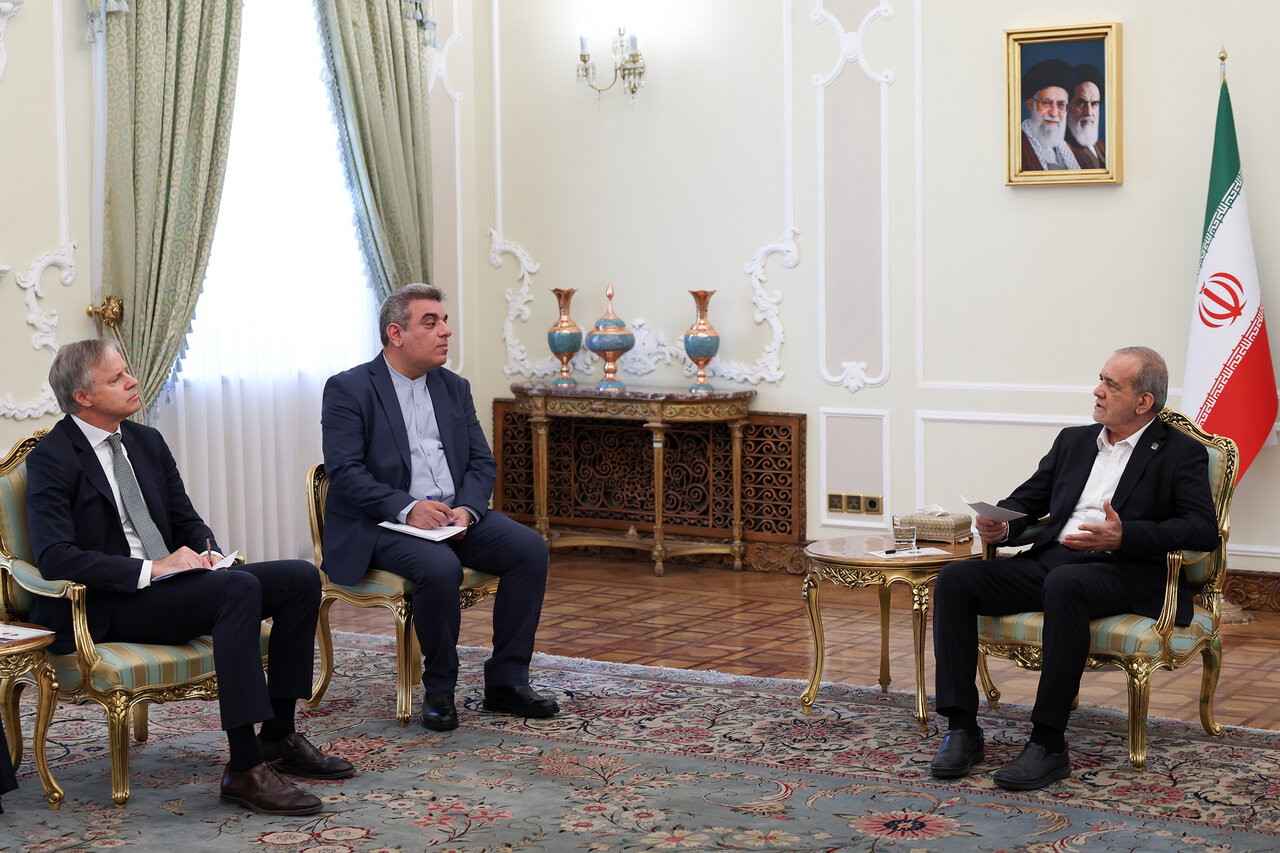
TEHRAN – Iranian President Masoud Pezeshkian has called for rebuilding relations with Germany, expanding cooperation with Ireland and deepening strategic ties with Sri Lanka, as he received the credentials of the three countries’ newly appointed ambassadors in Tehran in a series of separate meetings on Wednesday.
The meetings underscored Tehran’s broader diplomatic strategy of strengthening bilateral partnerships while reaffirming its commitment to dialogue, mutual respect and constructive international engagement.
Receiving Germany’s new ambassador, Axel Dittmann, President Pezeshkian acknowledged the more than century-long history of diplomatic and economic relations between Tehran and Berlin but said bilateral ties had deteriorated significantly in recent years.
He stressed that restoring relations would require a fundamental shift in Germany’s approach and sustained efforts to rebuild mutual trust.
Pezeshkian cited several measures that have strained bilateral relations, including the closure of the Islamic Center of Hamburg, restrictions imposed on Iranian consular services and sanctions targeting Iranian banks.
He also criticized Berlin’s position regarding recent military attacks against Iran, describing them as violations of international law and humanitarian principles. The president questioned ‘the international community’s silence’ over attacks on civilian infrastructure, including schools and medical facilities, arguing that technological progress should serve humanity rather than become an instrument of political pressure.
Despite the differences, Pezeshkian reaffirmed Iran’s commitment to diplomacy and constructive dialogue, saying Tehran remains prepared to resolve disputes through political and legal channels.
For his part, Ambassador Dittmann described the longstanding relationship between Germany and Iran as historically significant and pledged to promote honest and responsible dialogue between the two countries. He said his mission would focus on confidence-building measures and practical solutions aimed at gradually improving bilateral relations.
In a separate meeting, President Pezeshkian received Ireland’s new ambassador, Aidan Cronin, highlighting ‘common positions’ between Tehran and Dublin on major international issues as a solid foundation for expanding bilateral cooperation.
He said shared opposition to occupation and double standards in international affairs provides an opportunity to deepen political engagement within a framework of mutual respect and shared interests.
Addressing regional developments, Pezeshkian criticized US and Israeli actions against Iran, describing attacks on civilian infrastructure as clear violations of international law and humanitarian norms.
He also accused some governments of applying double standards on human rights by remaining silent over the humanitarian crisis in Gaza while failing to condemn attacks on civilian targets in Iran.
The Iranian president reiterated Tehran’s interest in expanding constructive engagement with the European Union and suggested Ireland could play a constructive role in facilitating dialogue and reducing misunderstandings between Iran and Europe.
Ambassador Cronin emphasized the positive history of relations between the two countries and said there was considerable potential for expanding cooperation.
He reaffirmed Ireland’s opposition to military attacks against Iran, describing them as inconsistent with international law, and said civilian casualties, particularly the tragedy at Minab School, had deeply affected both the Irish public and government.
The ambassador also reaffirmed Dublin’s commitment to international humanitarian law and its continued opposition to violence against Palestinians.
Meeting Sri Lanka’s new ambassador, Fazeeha Azmi, President Pezeshkian emphasized the longstanding friendship between Tehran and Colombo and expressed Iran’s readiness to broaden cooperation across a wide range of sectors.
He identified trade, investment, energy, agriculture, technology and economic cooperation as priority areas, while calling for the activation of the two countries’ Joint Economic Commission to develop a practical roadmap for future collaboration and ensure implementation of existing agreements.
Pezeshkian also thanked the Sri Lankan government for its humanitarian assistance in facilitating the repatriation of the remains of Iranian martyrs following ‘the illegal US attack on an Iranian naval vessel,’ calling the gesture a reflection of the close friendship between the two nations.
Ambassador Azmi conveyed greetings from Sri Lanka’s leadership and noted that the two countries will mark the 66th anniversary of diplomatic relations in 2027.
She also expressed appreciation for Iran’s longstanding support for Sri Lanka in international organizations, particularly regarding issues related to national sovereignty, and reaffirmed Colombo’s commitment to further expanding bilateral cooperation and coordination on the international stage.
Disclaimer : This story is auto aggregated by a computer programme and has not been created or edited by DOWNTHENEWS. Publisher: tehrantimes.com