
Kangaroo Island off the coast of South Australia has no feral foxes, rabbits, deer, pigs or goats. Now the dream of eradicating cats from Australia’s third-biggest island is a step closer to reality.
The Albanese government is adding $2.7 million to the effort, the final piece of funding to complete an ambitious multiyear feral cat control project led by the Kangaroo Island Landscape Board.
The funding injection combines with $370,000 in new philanthropic donations via the Invasive Species Council, and $800,000 from the South Australian government announced in March.
Invasive Species Council chief executive Jack Gough said “the finish line is in sight” for one of Australia’s most important island conservation programs to date.
“This is a nationally significant investment in what will become the largest feral cat eradication ever undertaken on an inhabited island anywhere in the world,” Gough said. “Backing this eradication program is backing the survival of species found nowhere else on earth.”
Since 2020, the landscape board, an arm of the South Australian government, has killed 1900 feral cats by trapping and hunting using a large network of AI-connected cameras. An estimated 150 remain on the Dudley Peninsula, separated from the rest of the island by an electric fence.
Last year, a dwindling budget forced the landscape board to focus on maintaining gains rather than making progress. The new funding will pay for a fresh push to eliminate feral cats on the peninsula by 2030.
Federal Environment Minister Murray Watt said feral cats had already contributed to the extinction of more than 20 mammal species. Kangaroo Island was home to more than 30 threatened species.
“The KI community has achieved great results in recent years in reducing feral cat numbers, but we’re conscious that, without further effort, numbers could rebound,” Watt said.
Monitoring activity suggests the landscape board is on track to reduce the remaining feral cat population by more than 95 per cent this winter, before moving into mop-up operations and then 24 months of monitoring to prove the absence of cats. There are no more easy wins and the final 150 cats will be the hardest and most expensive to remove.
The ultimate goal of the landscape board is to eradicate feral cats from the entire island, while the local government has a policy to phase out ownership of pet cats.
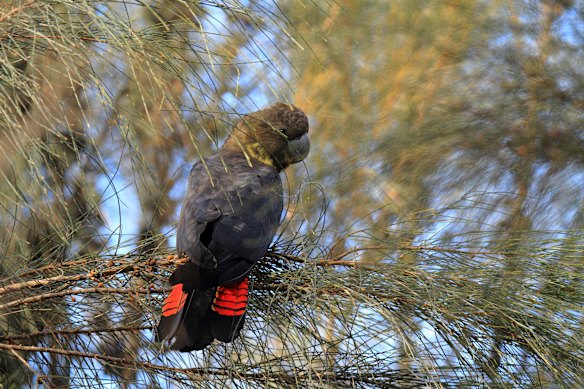
As the apex predator on the island, feral cats devastate native wildlife including Kangaroo Island dunnarts, southern brown bandicoots, Kangaroo Island echidnas, little penguins, hooded plovers and western whipbirds. The cats drain farmers’ resources – money and time – as they spread diseases to sheep, such as toxoplasmosis.
Kangaroo Island Mayor Michael Pengilly, a sheep farmer, said the community solidly backed feral cat eradication and the results so far were encouraging.
Pengilly acknowledged that council’s “last cat policy” to end cat ownership on the island by allowing people to retain their existing pets, but not replace them was “by its nature, more problematic”. It would require state legislation to take effect, he added.
“We’re not going in to get rid of Granny’s cat, we know people like their cats, and the end of family cats particularly in towns is a long way off,” Pengilly said. “It’s something that has to be on the radar in the long term to make the place cat free.”
Kangaroo Island is Australia’s next biggest after Tasmania and the Northern Territory’s Melville Island. It has never had feral rabbits or foxes, and it was declared free of feral goats and deer several years ago, and pigs in June this year.
The project has relied on community support because most of the Dudley Peninsula is on private land. Jayne Bates, a sheep farmer and former mayor, believed the feral cat eradication had 100 per cent support, and people were warming to the idea of a pet cat ban.
“We’ve been hoping for three decades to get rid of these cats because of the environmental impact and the financial impact on farmers, and finally, we’re within sight – we can almost feel it,” Bates said.
Invasive Species Council policy director Dr Carol Booth said removing feral cats, foxes and rodents from islands was urgent because of the looming threat of H5N1 bird flu.
“We can’t stop H5N1 reaching Australia’s wildlife, but we can give threatened species a much better chance of surviving by removing invasive predators and restoring healthier ecosystems,” Booth said.
Feral animal and weed control on islands has an outsize benefit for conservation because islands have a high concentration of unique biodiversity. In less than 0.5 per cent of Australia’s landmass, islands contain more than 11.5 per cent of species listed as nationally threatened under federal environmental laws. Globally, most species extinctions have occurred on islands.
More than 240 introduced vertebrate populations have been eradicated on more than 170 Australian islands, according to the now-closed Threatened Species Recovery Hub.
The threat of bird flu has prompted the government to increase efforts, with new programs under way to eradicate rodents on Adele, Beacon and Gun Islands in Western Australia, cats on Lungtalanana (Clarke) and Three Hummock Islands in Tasmania, goats and cats on French Island in Victoria, and black rats on Warul Kawa (Deliverance Island) in the Torres Strait.
The Invasive Species Council is pushing for a national islands eradication fund with $200 million from the federal government over 10 years, plus matching funds from state and territory governments and philanthropists.
Get to the heart of what’s happening with climate change and the environment. Sign up for our fortnightly Environment newsletter.
 Caitlin Fitzsimmons is the environment and climate reporter for The Sydney Morning Herald. She was previously the social affairs reporter and the Money editor.Connect via email.
From our partners
Disclaimer : This story is auto aggregated by a computer programme and has not been created or edited by DOWNTHENEWS. Publisher: www.smh.com.au