Cameron Woodhead and Tony Way
THEATRE
Uncle Vanya ★★★★
Melbourne Theatre Company, Arts Centre Melbourne, until August 22
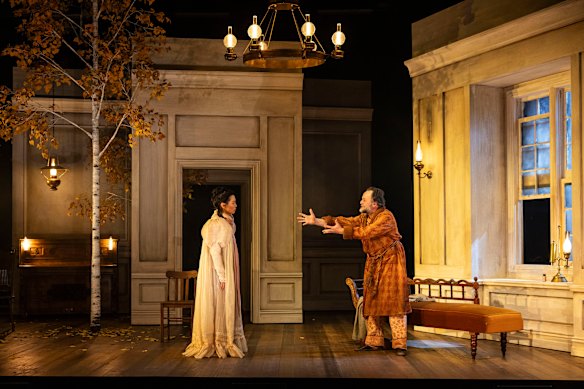
It’s a rare and charming thing to see Uncle Vanya done in period dress, as it is in Anne-Louise Sarks’ latest production for the MTC, on a splendid set that evokes a crumbling provincial estate in the last decade of the 19th century.
Contemporary Chekhovian performance tends to modernise, reframe, relocate. It’s as if we wanted to fire a bullet at the past – an exercise in futility, as Vanya himself discovers twice. Time doesn’t work that way.
Playwright Joanna Murray-Smith believes (rightly) that such modernising is unnecessary in a good Chekhov production. Her Vanya adaptation gives a light textual massage for clarity, to draw out the comedy and update the vernacular.
As you’d expect from Murray-Smith, the sardonic one-liners are mercilessly sharp, and characters slip in words like “f—wit” and “bonking”, while being aware enough to admit that, well, “No one says ‘bonking’ any more.”
Beyond that and the sound design – the Violent Femmes’ Add It Up doesn’t feel appropriate to the general vibe – it’s a faithful, lightly periodised production and an excellent intro to Chekhovian tragicomedy.
Singling out actors for praise in Chekhov may be inevitable but always feels like a betrayal. Star turns can damage the delicate ensemble performance required to portray human contingency and incompleteness, and on that level this production sometimes feels more like a collection of exquisitely rendered individual performances – the human equivalent of the autumn leaves falling in its opening scene – than a true ensemble piece.
There’s still much to admire. Sarks emphasises humiliation as key to whatever self-awareness the characters might avoid or achieve, and the romantic excruciations (everyone is famously in love with the wrong person) are beautifully done.
Philippa Northeast invests the role of Sonya with girlish comedy, throwing herself at Astrov (Fayssal Bazzi) with the full cringe of unrequited infatuation, while the charismatic doctor and environmentalist – whose dashing good looks and vaulting idealism coexist with burnout and radical disillusionment and emotional disconnection – seduces the beautiful young Yelena (Catherine Văn-Davies) with a palpable edge of self-loathing.
Daniel Henshall’s Vanya is a veritable humiliation magnet. It’s a notably unsympathetic portrayal. A beta male to the core, this Vanya is an intensely pathetic figure who projects his own inadequacies onto his brother-in-law, the Professor (played in a nimble, lightly drawn lampoon of intellectual pomposity by Shaun Micallef) even as he makes embarrassing moves on the Professor’s young wife and pours blatant misogyny over everyone, including his would-be suffragist mother (Carolyn Bock).
Vanya might feel like a minor character in his own life, but it’s Chekhov’s actual minor characters who cope best with humiliation. The longsuffering Waffles (Don Bridges) is warmly and affectionately conveyed, as is the stolidity of the pipe-smoking Nanny (Evelyn Krape).
They’re both gloriously unselfconscious – one antidote to humiliation – and such brief moments of freedom are among the production’s most elevating, including a poignant scene where Sonya and Yelena are together, chatting and drinking and playing together like sisters, away from all the fuss the men are causing.
On opening night, some performances didn’t seem entirely bedded down. Henshall appeared to go dry at one point – a metatheatrical humiliation that seemed apposite, in context – but it might be the consistency of dramatic tempo that’s the biggest niggle.
How we experience time, and how we handle futility and ennui, are among Chekhov’s main themes, and the one time I saw the Russians perform Vanya – by the Maly Drama Theatre of St Petersburg in 2007 – they brazenly manipulated the elastic temporal quality of theatre. (That production went for over three hours, dared the audience to be bored, and unfolded as inescapably as if it were being performed inside a black hole.)
It would be churlish – maybe even Vanya-like – to complain that the audience wasn’t bored enough, though, and if it doesn’t quite deliver the epiphany into the human condition you get from the highest level of Chekhovian performance, this production’s desire to entertain is a no less crucial element of the drama.
After all, Chekhov’s characters are always performing to allay such tedium, or at least give it form. And that aspect of being human is as timeless as it gets.
Reviewed by Cameron Woodhead
MUSIC
From Winter’s Stillness ★★★★
Australian Chamber Orchestra, Hamer Hall, until July 27
What do you get when you cross the Australian Chamber Orchestra with a jazz trumpeter and a Norwegian trio of female voices specialising in medieval, Nordic folk and contemporary music?
Well, certainly an edgy musical hybrid pushing the boundaries of “classical” programming, delighting intrepid listeners and probably perplexing others. The perplexity was heightened because printed programs only became available at interval, leaving most of the audience adrift in the unusual musical terrain of the first half.
Trumpeter Arve Henriksen’s The Plume of Ash and Acceptance set a reflective mood, contrasted by the indefatigable minimalism of Terry Riley’s Half Wolf Dances Mad in the Moonlight.
Estonian composer Tõnu Kõrvits’ Bells, written for Henriksen and Trio Mediæval (singers Anna Maria Friman, Ditte Marie Bræin and Jorunn Lovise Husan), exerted a mesmeric quality that sat well alongside Academy Award-winning Icelandic composer Hildur Guðnadóttir’s Time and Water (especially written for this tour).
This Little Child, a sad traditional Norwegian song preceded Icelandic band Sigur Ros’ Fljótavik, an ideal vehicle for Hendriksen, whose unique, mellow tone unfurled over the music’s ground bass.
In the second half, movements of Soviet composer Alfred Schnittke’s Concerto Grosso No.1 were interleaved with jazz-infused musings on Nordic chant and folk material.
Schnittke’s iconoclasm is mercifully leavened with a generous sense of humour. Soloists Richard Tognetti and Satu Vänskä met the outrageous technical demands with aplomb, aided by customarily fine support from the rest of the ACO.
Using a cyclorama against which performers were either silhouetted or spotlit, head of lighting Joe Cox created a welcoming, unifying mood across this diverse program.
Trio Mediæval’s limpid vocal quality was a delight throughout and together with flashes of brilliance from Henriksen, this eclectic experience was bound to get listeners talking – presumably as the ACO intended.
Reviewed by Tony Way
Find out the next TV, streaming series and movies to add to your must-sees. Get The Watchlist delivered every Thursday.
From our partners
Disclaimer : This story is auto aggregated by a computer programme and has not been created or edited by DOWNTHENEWS. Publisher: www.smh.com.au