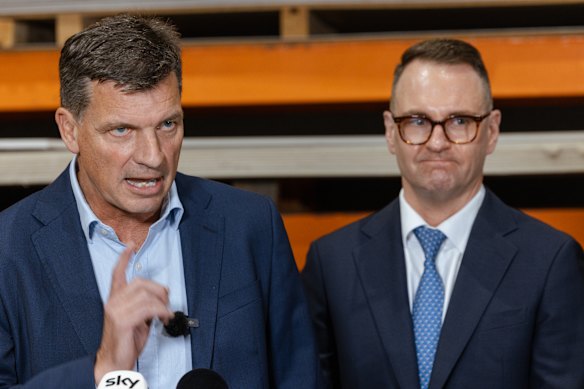

The Liberal Party has been submerged in another bout of confusion about how to deal One Nation, after Opposition Leader Angus Taylor dismissed a frontbencher’s suggestion the parties could join forces after the election to form a governing majority.
The question of how to fend off One Nation has caused ructions in the party for months. Backbench senator Alex Antic quit group chats with colleagues last week in a “dummy spit” after this masthead reported their concerns he would seek to create an alliance with One Nation in South Australia.
The issue was given life again on Monday morning when senator Andrew Bragg said the party must acknowledge that if neither One Nation nor the Coalition held a majority of seats after the next election, but could combine to form government, then “of course we would be pragmatic”.
Explaining his comments to this masthead, the Coalition housing spokesman said: “The number one priority is to best the communist Labor government.”
He went on to say: “We’ve got to be honest. If there’s an opportunity to form a government to beat the communists, then we’ll do it. That shouldn’t be controversial.”
Bragg’s statement reflected the possibility of the Liberals, Nationals and One Nation forming an agreement if the right-wing parties end up with more seats than Labor after the 2028 election. Current polling suggests it is unlikely that Labor will lose its majority.
However, what might have appeared to be a relatively benign prediction sparked controversy because Taylor and his team have been keen to diminish the idea the Coalition and One Nation could cooperate.
As Labor escalates its arguments that a vote for the Coalition is effectively a vote for Pauline Hanson, Taylor responded to Bragg by quash any speculation: “There will be no coalition with One Nation.”
The opposition leader went on to tell reporters: “Our coalition is with the National Party. What is very clear is we’re not going to form a coalition with One Nation, and I know Andrew knows that.”
Taylor’s top ally, frontbencher James Paterson, said he would be “surprised if Andrew Bragg is advocating for a coalition with One Nation”.
“That’s not my understanding of his views. I think he made the sensible point that we’ll work out our preferences in the normal time and the normal way closer to the election,” Paterson said on ABC Radio National.
Bragg, who has adopted a straight-talking approach and often veers from agreed talking points, is a leading moderate who supported the Voice to parliament and has been critical of One Nation. Yet his views on the realpolitik of potentially combining the Coalition’s numbers with One Nation’s have put him in alignment with Antic, who is on the right fringe of the party.
Antic’s colleagues told this masthead he had performed a “dummy spit” after exiting chat groups with his conservative colleagues last week following this masthead’s reporting of rumoured plans of a Liberal-One Nation alliance in his home state of South Australia.
In a podcast appearance released over the weekend, Antic said the reporting was overblown.
However, he told 2 Worlds Collide host Sam Bamford that Liberal Party founder Robert Menzies won seven elections after bringing a network of anti-Labor groups together.
“He got them all to take a bit of a haircut on their expectations and he formed the Liberal Party,” Antic said.
While he raised Menzies’ actions in a conversation on how to deal with One Nation, he also said that he did not know if this was necessarily the best course of action today.
“I just don’t think that it is helpful to be fighting with One Nation,” Antic said.
Emeritus Professor Judith Brett, arguably the pre-eminent historian on the Liberal Party, said Antic’s citation of Menzies’ formation of the Liberal Party to fit the current moment displayed “a complete historical misunderstanding of what it was that Menzies did”.
Brett, who wrote the critically acclaimed book Robert Menzies’ Forgotten People, said Menzies created a nationally unified outfit out of more than a dozen state-based outfits which in some cases had different names but shared policy positions and worked together at elections.
“Now, we’re talking about a party with a long and proud history of government joining with a party which had no experience, it’s one organisation, and has no well-developed policies.”
Cut through the noise of federal politics with news, views and expert analysis. Subscribers can sign up to our weekly Inside Politics newsletter.
 Paul Sakkal is Chief Political Correspondent. He previously covered Victorian politics and won a Walkley award and the 2025 Press Gallery Journalist of the Year. Contact him securely on Signal @paulsakkal.14.Connect via X or email.
From our partners
Disclaimer : This story is auto aggregated by a computer programme and has not been created or edited by DOWNTHENEWS. Publisher: www.smh.com.au