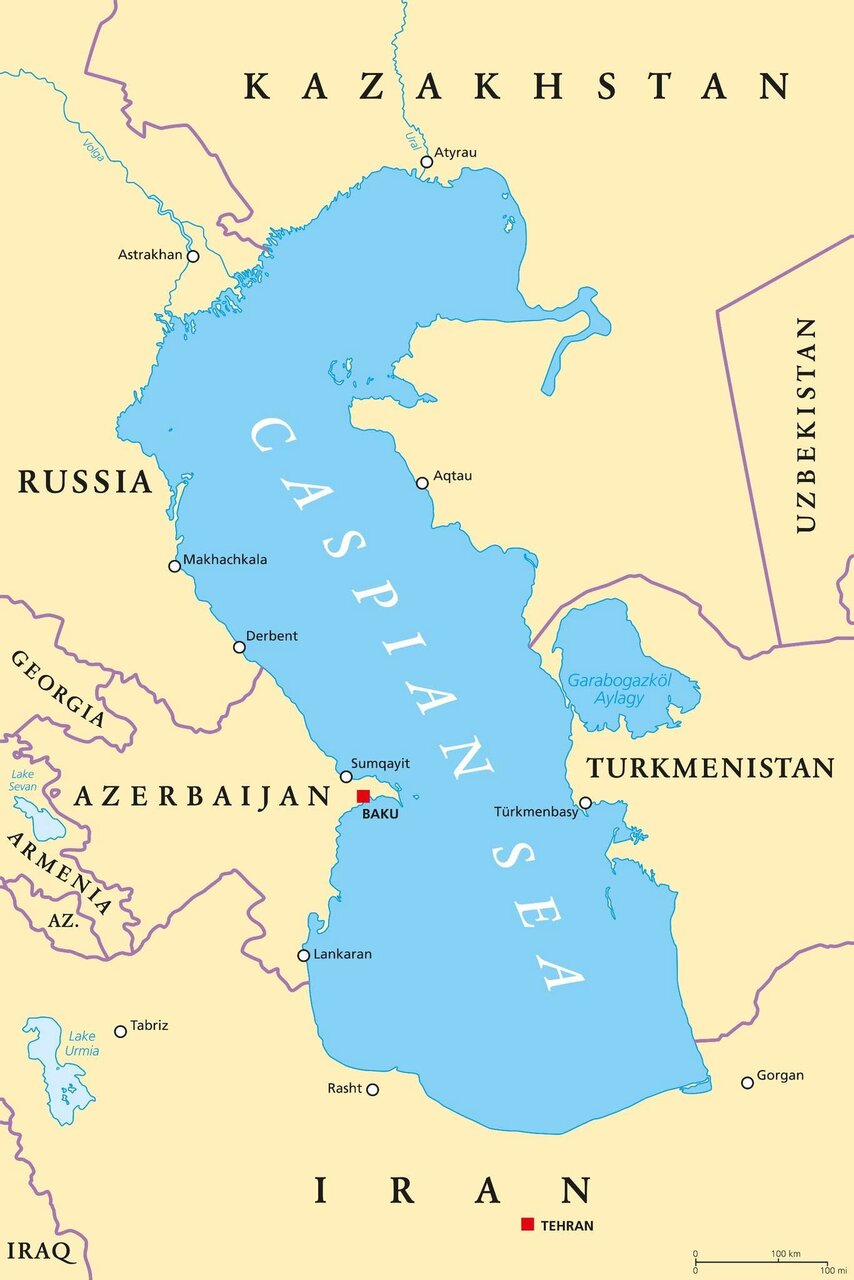
An unexpected headline appeared across the media: Ukraine attacked an Iranian vessel in the Caspian Sea. Beyond the military dimensions of the incident, however, a more consequential question emerged: What is Ukraine doing in the Caspian Sea? Is this merely the decision of a country at war seeking to expand the geographical scope of its military operations, or should it be understood within the framework of a new set of geopolitical equations that are gradually taking shape? Can contemporary developments still be explained through the analytical frameworks of the past, or are we witnessing the emergence of a new security geography in Eurasia?
To answer these questions, perhaps we must take a step back. When the NATO Summit was held in Ankara, few could have imagined that a series of seemingly unrelated developments would gradually become pieces of a much larger puzzle. In the aftermath of the summit—which placed Russia alongside Iran in its final communiqué—a chain of events unfolded, with President Zelenskyy’s recent message on X as its most explicit manifestation.
Following the summit, Iran landed two civilian aircraft in Sana’a and Al Hudaydah. The crisis in Saudi-Yemeni relations, which had shown signs of de-escalation, once again erupted, culminating in the closure of the Bab al-Mandab Strait. Yet, Bab al-Mandab imposed far greater pressure on Europe’s economy than on that of the United States, given Europe’s substantial dependence on the Bab al-Mandab–Suez corridor for trade and supply chains. Only days later, the United Kingdom, Italy, and Bulgaria announced their readiness to host American combat aircraft in the event of military action against Iran.
A few days later, amid the military confrontation between the United States and Iran in the Persian Gulf, American military commanders appeared to be caught off guard. The precision and effectiveness of Iran’s missile strikes had seemingly increased dramatically. Western media outlets and political figures pointed to Russian intelligence and satellite assistance to Iran, while the President of the United States made an implicit reference to the issue in a post on Truth Social. It was against this backdrop that, when Ansar Allah targeted Saudi Arabia’s oil infrastructure—the ownership of a significant portion of which is held by Western companies—the image of Ukrainian strikes on Russian oil facilities inevitably came to mind for many analysts. Can these developments truly be understood in isolation from one another? Were the events unfolding in the Persian Gulf merely reflections of Middle Eastern dynamics, while those in Ukraine pertained solely to European security? Or do they constitute the shared language of an emerging deterrence equation—one that transcends geographical boundaries and is gradually intertwining the crises of the Middle East and Eurasia?
Meanwhile, some observers have interpreted Ukraine’s attack on Kazakhstan’s oil export terminal in Novorossiysk as evidence of Kyiv’s strategic autonomy and even a divergence of interests between Ukraine and Europe. At first glance, such an argument appears reasonable: How can Europe support a country that attacks a route supplying part of Europe’s own energy needs? Yet this apparent contradiction exists only if contemporary developments are viewed exclusively through a geoeconomic lens. The reality is that post-war Europe has repeatedly demonstrated its willingness to absorb short-term economic costs in order to preserve and redefine its geopolitical position in Eurasia. Did Europe not willingly bear considerable economic burdens when imposing sanctions on Russia?
Consequently, the central question is no longer whether Kazakh oil reaches Europe, but rather through which route it reaches Europe. Within this framework, the attack on Novorossiysk may also carry an important geopolitical message: Central Asia must gradually begin to envision alternative energy corridors—from the Caspian Sea to Azerbaijan and onward to the Mediterranean. What appears, at first glance, to run counter to Europe’s immediate economic interests may, in fact, represent part of Europe’s willingness to incur short-term costs in pursuit of a more favorable long-term geopolitical order.
Perhaps the most important message conveyed by the attack on an Iranian vessel in the Caspian Sea lies not in the extent of the damage inflicted, but in the geography chosen for its execution.
Until only a few years ago, the Caspian Sea was a body of water whose security was defined primarily within the framework of agreements among its five littoral states. Today, however, extra-regional actors appear to be redrawing the security map of Eurasia. The fact that Ukraine can conduct an operation in the Caspian Sea and withdraw from it is more than a limited military action; it carries a profound geopolitical message: the Caspian Sea is gradually becoming part of the emerging security geography of Europe and NATO.
If Russia’s strategic reach extends to Bab al-Mandab through Iran, NATO’s strategic reach has now extended to the Caspian Sea through Ukraine.
Perhaps another name for this transformation is the Eurasianization of Europe’s security outlook on Iran. Within this framework, Iran is no longer merely a nuclear dossier or a Middle Eastern actor from Europe’s perspective. Rather, it has become part of a broader geopolitical chain stretching from the Caspian Sea to Bab al-Mandab and from the Caucasus to the Mediterranean. What is unfolding today between Iran and Europe is not simply the intensification of political or nuclear disagreements; it reflects the emergence of a new phase in the geopolitical competition between the Heartland and the Rimland across Eurasia. The war in Ukraine, developments in Bab al-Mandab, competition over transregional corridors, growing Iran-Russia cooperation, and Europe’s increasing sensitivity to issues of energy security and maritime trade all suggest that Iran is no longer viewed merely as a Middle Eastern actor, but as an increasingly consequential player in Eurasia’s geopolitical landscape. In other words, if Europe’s foreign ministries once stood at the forefront of policymaking on Iran, today its security, military, and geostrategic institutions have become equally influential in shaping that policy.
Finally, the most important question facing the states of the South Caucasus today is not which economic corridor promises greater returns. Rather, it is whether Azerbaijan and Armenia fully appreciate the geopolitical consequences of the choices they are making. The South Caucasus is no longer merely a crossroads of competing regional interests; it is gradually becoming one of the new fault lines of great power competition across Eurasia. Just as the Persian Gulf states, willingly or unwillingly, became one of the world’s principal theaters of geopolitical rivalry over recent decades, the South Caucasus may likewise be approaching a similar historical moment.
The greatest strategic mistake regional actors can make is to interpret contemporary developments solely through the prism of short-term economic interests. Today, states are not merely choosing routes for pipelines and transit corridors—they are choosing the security geography of their future. The fundamental question is therefore no longer which transit route promises greater economic benefit, but rather what place the South Caucasus seeks to occupy within Eurasia’s emerging order: a bridge for regional cooperation or the frontline of geopolitical competition among major powers? If Europe once viewed Iran through the prism of the Middle East, post-war Europe increasingly appears to define Iran within the broader geopolitical framework of Eurasia.
(Masoud Amiri is an expert on Caucasus and Eurasian affairs. The opinions expressed in this article are those of the author and do not necessarily reflect the official stance of the Tehran Times.)
Disclaimer : This story is auto aggregated by a computer programme and has not been created or edited by DOWNTHENEWS. Publisher: tehrantimes.com