

Too strange to enter the British pop canon in their time, a new generation has discovered the singular sound of the Durutti Column.
When the Durutti Column’s enigmatic, 72-year-old guitarist Vini Reilly sits down in front of his computer’s camera, his shock of white hair is neatly trimmed and he’s swimming in a grey plaid shirt. Once named “the best guitarist in the world” by the Red Hot Chili Peppers’ guitarist John Frusciante, his long nails are sculpted for plucking in his singular, emotional delicacy.
In a gentle voice quivering with age he expresses wonder at the albatross hatching grounds of my birth country (New Zealand), before self-deprecatingly retreating. “Sorry. I’ve got an old bloke’s thing of a wandering brain. I do have a brain,” says Reilly, who is readying to release Renascent, his 21st studio album as the Durutti Column and first in 16 years.
Wanderings aside, he wants to make one thing clear about our interview: “I’ll say from the start there are no no-go areas. No secrets. No polishing over things. Just the facts… A while ago I became delusional, and then hallucinatory, so I will not say anything unless I’m sure I’m saying it. Carry on, sir.”
Formed from members of Manchester’s post-punk scene in 1978 by Factory Records co-founders Tony Wilson and Alan Erasmus, the Durutti Column became a vehicle for Reilly when the band broke up on the eve of recording its debut album. He played guitar on Morrissey’s debut album,Viva Hate, but unlike the label’s flagship acts – Joy Division, New Order, Happy Mondays – Reilly’s gauzy, intricate guitar instrumentals, often improvised live, were too strange to enter the British pop canon upon their release.
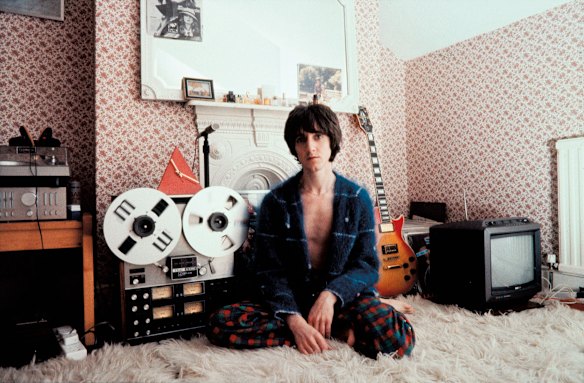
But years later, his inimitable sound – one that allows profound, ethereal lightness and dubby melancholia to exist within the same palette – has garnered admiration from pop musicians from Harry Styles to Frank Ocean, who sampled 1980’s Sketch for Summer on Pink + White in 2016, and Blood Orange’s Dev Hynes, who last year sampled 1998’s Sing to Me on The Field.
Reilly laughs when I describe recently hearing his music on a wine bar’s auto-generated “chill out” playlist. The audience matters more to Reilly than how his work reaches them.
“You could have a fantastic exhibition of the Dutch masters, a curated, brilliant thing in a gallery. But those paintings all cease to be art when the gallery closes. It’s only expressing anything while some person is looking at that painting, looking into it,” says Reilly. “The audience is making whatever I’m doing music, not me.”
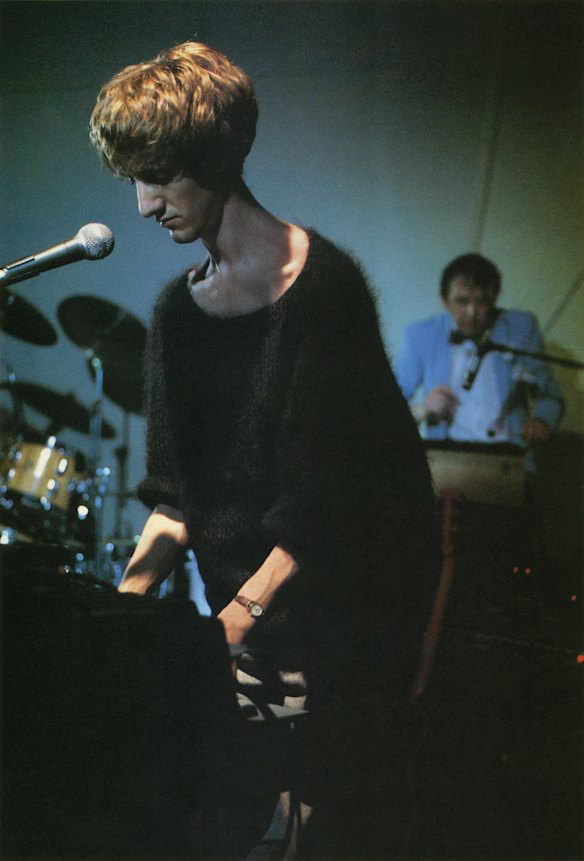
Reilly was prolific until his 16-year album gap began in 2010. Following a series of ischaemic strokes he lost mobility, memory and the ability to play his guitar. Post-stroke delirium saw him hospitalised.
“When I wasn’t making sense, my memory had huge gaps. It’s like you don’t know who you are. You don’t know what’s happening precisely because it’s this brain that’s not working. Your own imagination fills in those gaps… I thought I’d been in the military, which is hilarious,” says Reilly. “The frustration is impossible to bear, and you explode.”
‘The audience is making whatever I’m doing music, not me.’
Determined to relearn his beloved instrument – and his hybrid technique blending flamenco, classical and rock – Reilly returned to the nightly practice routine of his youth. “At first, it’s even harder than before. Then there’s a click and the independent movement and control of my fingers, the sense of touch which had gone, that came back little by little.”
Slowly, the tunes came back, too. In 2017, the band’s current producer/multi-instrumentalist Keir Stewart began recording in Reilly’s kitchen on a field recorder, then socially distanced from a van in the street during pandemic lockdowns. The collaborative new album also includes the band’s longtime, 86-year-old drummer Bruce Mitchell, who has been with Reilly since the Durutti Column’s second album, and Reilly’s neighbour Caoilfhionn Rose who sings on two tracks.
Renascent is a typically exquisite recording from a complicated, contradictory composer. In its press materials, Reilly says empathy is the album’s guiding emotion. He describes being so small as a grammar school student that he couldn’t fit the long trousers worn by the larger boys, who he’d watch fight from afar.

“Some of those hard cases were only able to hit each other in the face because they just hadn’t got that empathy. I found that absolutely impossible,” says Reilly, who grew up on Manchester council housing estates. I ask him for a present-day example.
“If you look at the extremists of the world who have no empathy and no way of gaining any, they are just horrendous. There’s no answer to them. The only answer to them will be the same answer we had to use with Hitler and just get them gone,” he says.
“And also, the only cure for things like paedophilia is to kill them… If you kill that paedophile, you’ve saved how many ordinary kids from being turned into paedophiles? It’s the only answer.”
Delivered with his delicate lisp, the brutal limit to Reilly’s empathy arrives shockingly. It’s hard not to view this conversational whiplash through the lens of his health struggles, but he has asked to be taken at his word.
Famously, the band’s first LP, The Return of the Durutti Column, came packaged in a sleeve covered in sandpaper by the out-of-work members of Joy Division. Much like the man on the screen before me, it was a package of abrasion and profound beauty.
He explores forgiveness in the haunting, desperate refrain of the band’s new single Liars, an infrequent example of Reilly’s spoken singing: “I’m sorry. I love you. I’m sorry. I’m sorry. I love you.”
“Dichotomy is part of the human condition,” he says of Liars. I ask if there’s anything in his own life to which the refrain might apply.
“My own family are just amazing. I love them. I love all of them. But it was very difficult to connect with me, even before the stroke and the illness and everything else, because the world they inhabit is not anything like the one I inhabit,” he says.
Reilly has survived bouts of clinical depression since 1972. I ask if he has developed any coping mechanisms over the years, and he drifts back to the schoolyard. “I remember being a school boy. Someone’s got you pinned down and banging you about. You can’t ever allow yourself to think: I give up. You can’t say it, you never say it, until eventually they stop.”
Renascent by the Durutti Column is out now.
Want more music stories and reviews?
Disclaimer : This story is auto aggregated by a computer programme and has not been created or edited by DOWNTHENEWS. Publisher: www.smh.com.au






