Malaysia will end its nine-year absence from the Formula 1 calendar by making a long-awaited return in 2026, replacing Bahrain due to the ongoing Middle Eastern conflict.
This news was announced last Sunday and Sepang will host its first race since 2017 on 2-4 October, though under the ‘Bahrain Grand Prix in Malaysia’ tag.
Despite the unusual circumstances – and event name – it is still a grand prix at the highly popular Sepang circuit, which has produced several memorable moments over the years.
So, here is a look back at five highlights from Kuala Lumpur’s time in F1 between 1999 and 2017.
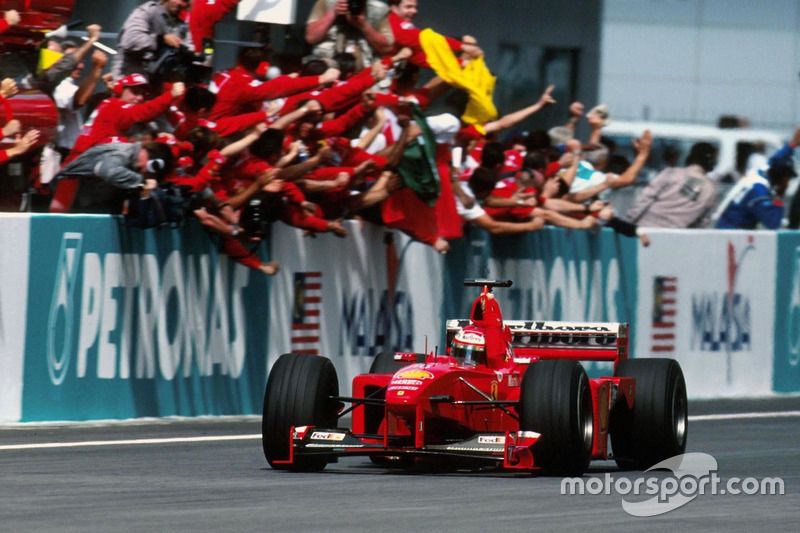
1999 Malaysian Grand Prix: Ferrari 1-2 controversially reinstated
Eddie Irvine, Ferrari F399 takes the win
Photo by: Sutton Images
Malaysia made its F1 debut in 1999 as the penultimate round that season, which entailed a close fight between McLaren and Ferrari for the constructors’ championship, plus Mika Hakkinen and Eddie Irvine for the drivers’ title.
This obviously dominated discussions heading into the race weekend, but so did the return of Michael Schumacher who had just recovered from a broken leg he sustained at Silverstone just three months’ prior.
Although it takes most athletes a long time to return to their best after a lengthy injury, Schumacher isn’t ‘most athletes’ and the then double world champion made the perfect return by storming to pole in a Ferrari 1-2, with McLaren 3-4 led by David Coulthard.
While Schumacher may not have wanted Irvine to be the man to end Ferrari’s title drought – its last drivers’ crown coming via Jody Scheckter in 1979 – he certainly put his pride aside in Sepang as he let the Northern Irishman by on lap four to subsequently hold up Coulthard and Hakkinen.
Schumacher acting as a ‘number two’ – ironic! – certainly worked as it enabled a relatively routine victory for Irvine, who turned his two-point deficit to Hakkinen into a four-point lead as the McLaren driver took third behind a Scuderia 1-2.
But then the post-race drama unfolded. Straight away, both Ferrari cars were disqualified due to its F399’s bargeboards allegedly being 1mm too wide and with it, Hakkinen and McLaren became champions by default.
Ferrari protested the decision though, and six days later its 1-2 was reinstated, as the FIA’s International Court of Appeal found that race officials didn’t have accurate enough equipment and that the car parts were in fact legal.
“A bad day for the sport,” is how McLaren boss Ron Dennis summed it up, but he still had reason to smile at the Suzuka finale as a Hakkinen victory gave the Finn his maiden title. Ferrari, however, still managed to end its 16-year constructors’ championship drought by finishing second and third.
2003 Malaysian Grand Prix: Raikkonen takes his first win
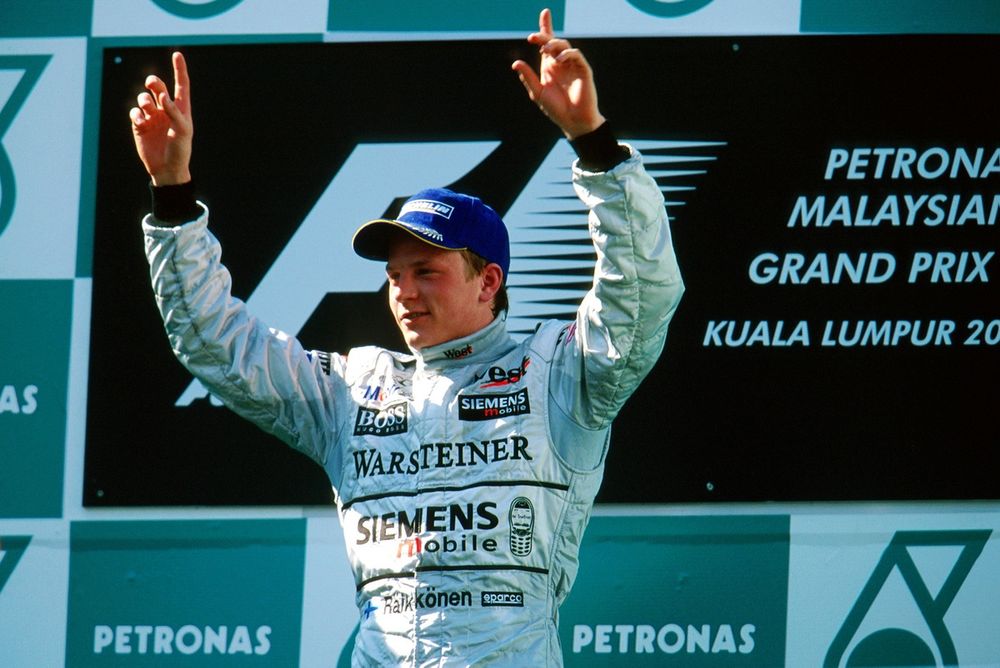
Kimi Raikkonen, McLaren
Photo by: Sutton Images via Getty Images
F1 2026 will likely see teenage sensation (Andrea) Kimi Antonelli claim his maiden world title, but 2003 was the year the original ‘Kimi’ burst onto the scene. Kimi Raikkonen that is, having taken his first grand prix victory at round two in Sepang that campaign.
Raikkonen, then in his second season at McLaren, didn’t enjoy the best qualifying as a slide at the hairpin left him seventh on the grid but good fortune soon arrived. That’s because the Finn had climbed up to fourth on lap one thanks to contact between Renault’s Jarno Trulli and Ferrari’s Schumacher, before taking third from his former Sauber team-mate Nick Heidfeld at Turn 1 on the second tour.
Third soon became second when team-mate Coulthard endured an electrical problem on lap three, leaving just Fernando Alonso up ahead – the Spaniard having just become F1’s youngest pole sitter as part of Renault’s first front row lockout since France 1983.
But this is where strategy came into play, because the McLaren started with a higher fuel load than Renault. So while Alonso pitted on lap 14, Raikkonen stayed out for five extra tours and this is where the race was won, as a much lighter load for that brief stint allowed the Finn to post much quicker lap times.
So when he finally pitted, he came out ahead of Alonso and subsequently dominated his way to victory by 40 seconds over second-placed Rubens Barrichello, who’d also jumped ahead of the Renault via the pits.
2009 Malaysian Grand Prix: Half points awarded

Jenson Button, Brawn GP BGP001 Mercedes sits on the grid after the race was stopped
Photo by: Andrew Ferraro / Motorsport Images
One thing to bear in mind for the Malaysian Grand Prix is its weather, which is often unpredictable and 2009 is the greatest example of that. Qualifying was dry and so was the race start, but teams were aware that rain was looming and it made the matter of gaining track position during the early stint vital.
That year’s world champion Jenson Button ultimately prevailed, having reclaimed the lead after a poor lap one where he dropped to fourth, just as Ferrari became the first team to make that slicks-to-wet gamble via Raikkonen.
But on this occasion it backfired, because with no signs of standing water, his Bridgestone tyres quickly faded away. That didn’t stop other teams from soon following suit though as lap 19 saw more drivers dive in for wets, yet the intermediates were best suited at this crossover stage.
Those who nailed the strategy were rewarded and the intermediate runners of Button, Heidfeld and Timo Glock led the way on lap 31, when rain finally reached the whole track. Come this point though, there was no stopping it and conditions became torrential with thunderstorms present.
So the Sepang race continued until the 33rd lap, at which point it was deemed too dangerous to race resulting in half points being awarded for the first time since Australia 1991. There would then be another 12 years – Belgium 2021 – until F1 faced a similar scenario.
2013 Malaysian Grand Prix: “Multi 21”

Mark Webber, Sebastian Vettel, Red Bull Racing
Photo by: Sutton Images
Back in the day, Red Bull was not as much of a ‘one-driver team’ as it is today, because Mark Webber was capable of bringing the fight to Sebastian Vettel on occasion. At times, there’d even be friction between the pair from 2009 to 2013 – with Malaysia in that final year being a prime example.
So much so, it caused the now infamous “Multi 21”.
It started with Vettel being on pole, but Webber had made a terrific start from fifth and led a Red Bull 1-2 by lap 15 thanks to nailing the timing to switch onto slick tyres. Obviously the soon-to-be four-time world champion had missed out, but the Austrian outfit still instructed its cars to hold position.
“Sebastian, multi-map 2-1, multi-map 2-1, and look after your tyres please,” was race engineer Guillaume Rocquelin’s message to Vettel on lap 25.
But 18 tours later, with 13 still to play, the German defied the order by attacking Webber with an unsuccessful lunge down the inside of Turn 1. “This is silly, Seb,” was Christian Horner’s reaction, but Vettel kept going with repeated attempts.
“Yeah, that’s good teamwork,” said Webber, before being informed, “OK Mark, he was told – he was told”!
Vettel eventually got the move done and took victory by four seconds with McLaren’s Lewis Hamilton completing the podium. Webber, still visibly frustrated, took his anger to the cooldown room by saying, “Multi-21 Seb, yeah, Multi-21” while shrugging his shoulders.
“In the end Seb made his own decision today and will have protection as usual and that’s the way it goes,” Webber added in the podium interviews, with Vettel later apologising.
2016 Malaysian Grand Prix: Hamilton’s title chances blow up

Max Verstappen, Red Bull, Daniel Ricciardo, Red Bull, Nico Rosberg, Mercedes
Photo by: Pirelli
Malaysia was the turning point in the bitter title fight between Hamilton and Nico Rosberg during the 2016 campaign. The Briton arrived with an eight-point deficit, was set to turn that into a five-point advantage and end Rosberg’s run of three, straight wins, only to leave South East Asia 23 points behind with only five grands prix remaining.
The Briton had done everything right, starting with qualifying as he took pole in a Mercedes 1-2 by four tenths before enjoying a clean getaway while chaos descended behind. That ‘chaos’ concerned Rosberg, who spun to the back after being tagged by Vettel’s lunging Ferrari on the inside of Turn 1.
So, while his title rival was forced into a recovery drive, reigning champion Hamilton controlled the way out front and it seemed to be one of those days where nobody could stop him. Except, for his power unit, which dramatically failed with only 15 laps remaining causing his Mercedes to grind to a halt.
“Something, or someone, doesn’t want me to win this year,” was the reaction from a very dejected Hamilton, who’d endured several reliability woes that year. What made matters worse is that it handed a podium spot to Rosberg behind a Red Bull 1-2, the German having also overcome a contentious 10s penalty for contact with Raikkonen at Turn 2.
It nevertheless gave the title prerogative to the #6 Silver Arrows. A win at the following race in Japan, before four consecutive runner-up finishes to Hamilton gave Rosberg his maiden crown…and then retirement.
We want your opinion!
What would you like to see on Motorsport.com?
– The Motorsport.com Team
Disclaimer : This story is auto aggregated by a computer programme and has not been created or edited by DOWNTHENEWS. Publisher: motorsport.com