
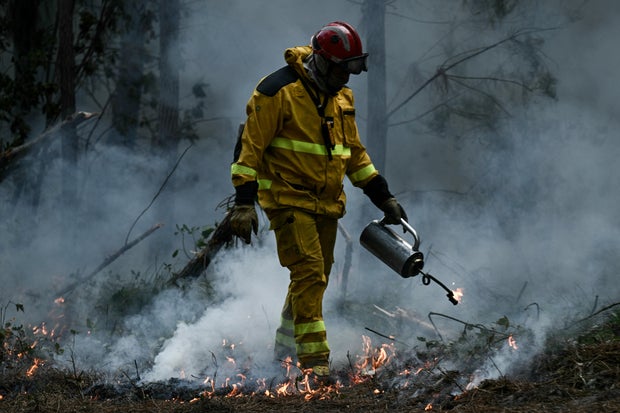
Ege-Cap Ferret, France — French authorities gave the go-ahead Thursday for 84,000 evacuees forced out by a monster wildfire to go back to their homes in southwest France, the strongest sign yet that firefighters are turning a corner in their battle against the flames that have burned an area four times the size of Paris.
The authorized returns announced Thursday covered nine localities that had been evacuated. In all, more than 220,000 people were forced to flee their homes since last week.
Higher humidity, cooler temperatures and some drizzle raised hopes that Thursday could be a decisive step on the way to vanquishing the fire.
The regional prefecture said returning evacuees must keep their phones on for evacuation alerts and should be packed and ready in case they need to leave again.
Nearly two-thirds of the 224,000 people initially ordered to evacuate have now been allowed to go home. Some 60,000 people who had been evacuated from three suburbs of the city of Bordeaux, to the east, were given the go-ahead to return on Tuesday.
Authorities also said a highway that has been closed since the weekend would reopen Thursday afternoon, clearing a major artery for road traffic with Spain and vacationers as France enters its peak August holiday period.
But CBS News correspondent Ramy Inocencio says nearly 80,000 people remain displaced from their homes across all of southern France, and the fire is not out.
Among those forced to flee in recent days were George and Amal Clooney, who said they had fled their home in the southwest of France.
Volunteers join the wildfire battle
Local officials reported a “rather calm” night, with the fire not growing beyond the roughly 162 square miles already affected. Fire crews remained at “total mobilization,” with 2,200 firefighters and over 20 aircraft.
But the scale of the disaster has demanded even more help on the ground, and CBS News’ Ramy Inocencio spent time Wednesday with residents who have stepped up to try and tackle every little fire, leaving firefighters to battle the biggest blazes.
Nils Seval is a surf instructor, but this week he’s been spraying down flareups that emerge from blazes still smoldering underground even in areas where big flames have been extinguished.
“The ground is smoking, because fires go everywhere,” he told CBS News. “Underground, sometimes like one meter [three feet] underground.”
Yves Herman/REUTERS 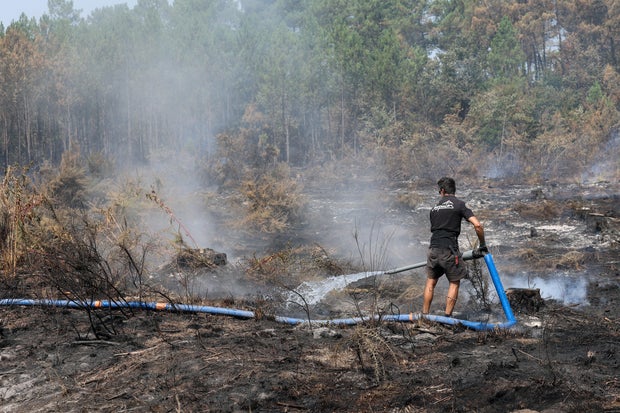
Seval and his fellow volunteers have been at it since last week, and they haven’t given up yet.
He said it was simply too much for the fire crews to tackle on their own, and he admits it has taken a toll, leaving him and other volunteers exhausted.
“We take some short pause, like three hours, four hours,” he said, “but it’s okay. It’s for all the village, all the community.”
Weather conditions offer hope for relief
The hope on Thursday was that more help was coming, from nature itself.
Sophie Brocas, the prefect for the Gironde region, expressed some optimism that lower temperatures could help.
“If that’s confirmed, we could foresee a return to a more normal life for residents, but also for businesses that need to work,” she told reporters late Wednesday.
Humidity reached 80% overnight but was expected to drop by midday, authorities said. Some rainfall was expected along the coast that “could reach the fire zone,” Gironde officials said in a morning note.
Temperatures that peaked around 104 Fahrenheit a day earlier were set to drop Thursday, topping around 80 degrees along the coast. An “orange” heat wave alert — the second-highest level after “red” — was lifted shortly before dawn.
Wildfires across Europe
The fires in France’s tourism-heavy Bordeaux region, home to famed vineyards and stunning forests, are among the blazes that have swept across pockets of Europe in recent weeks, including Spain, Greece and even the U.K.
On Thursday, firefighters were tackling multiple forest fires in four of Turkey’s western provinces, the state-run Anadolu news agency reported.
Blazes in touristic Mugla and Antalya and elsewhere raged overnight as hot weather and strong winds gripped the region. Residents were evacuated as teams with firefighting planes and helicopters battled the fires.
A day earlier, authorities in neighboring Greece said three firefighters died on the island of Crete as the country’s wildfire emergency stretched from the Atlantic coast to the eastern Mediterranean.
At the peak of the evacuations, a third of a million people were driven from homes and vacation sites in France and Spain.
Fire crews were battling a blaze on heathland in England’s southern Suffolk County on Thursday — one of many U.K. regions currently parched by drought.
CBS News’ partner network BBC News said authorities had declared a major incident “due to the size and complexity” of the wildfire, with an area along Suffolk’s coast equal to about 14 soccer fields ablaze, forcing residents to evacuate from about 200 mobile homes.
Joe Giddens/PA Images/Getty 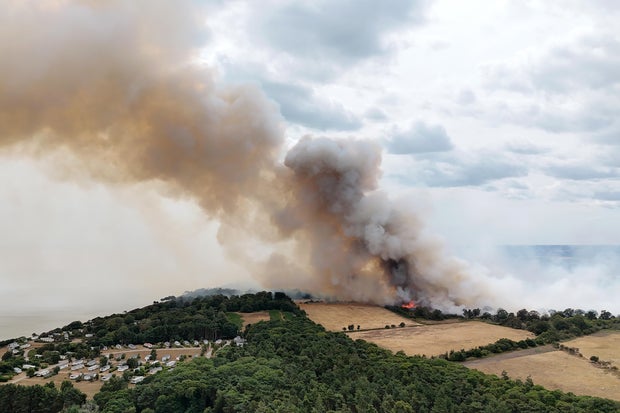
There were no reports of structural damage or injuries, and the BBC cited the local fire service as saying there was no current risk to nuclear power station about four miles from the flames.
Britain’s Environment Agency said on Wednesday that about half of England was experiencing a drought, as the country entered its fourth heat wave of the year. Parts of central, eastern, and southern England are facing drought conditions, which came on quickly due to a combination of very low rainfall and high temperatures.
“Rivers are running low, farmers are having to harvest crops early, wildfire risk is increasing, and millions of people are living under restrictions on water use,” the agency said in a statement.
This is England’s second drought in a row and the third in the past five years as Britain’s climate changes, the agency said.
Disclaimer : This story is auto aggregated by a computer programme and has not been created or edited by DOWNTHENEWS. Publisher: cbsnews.com






